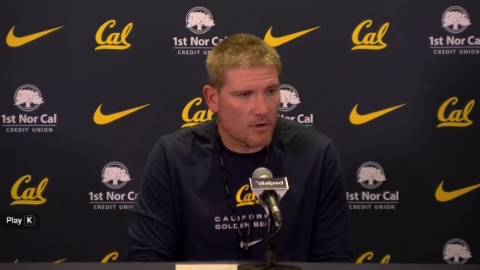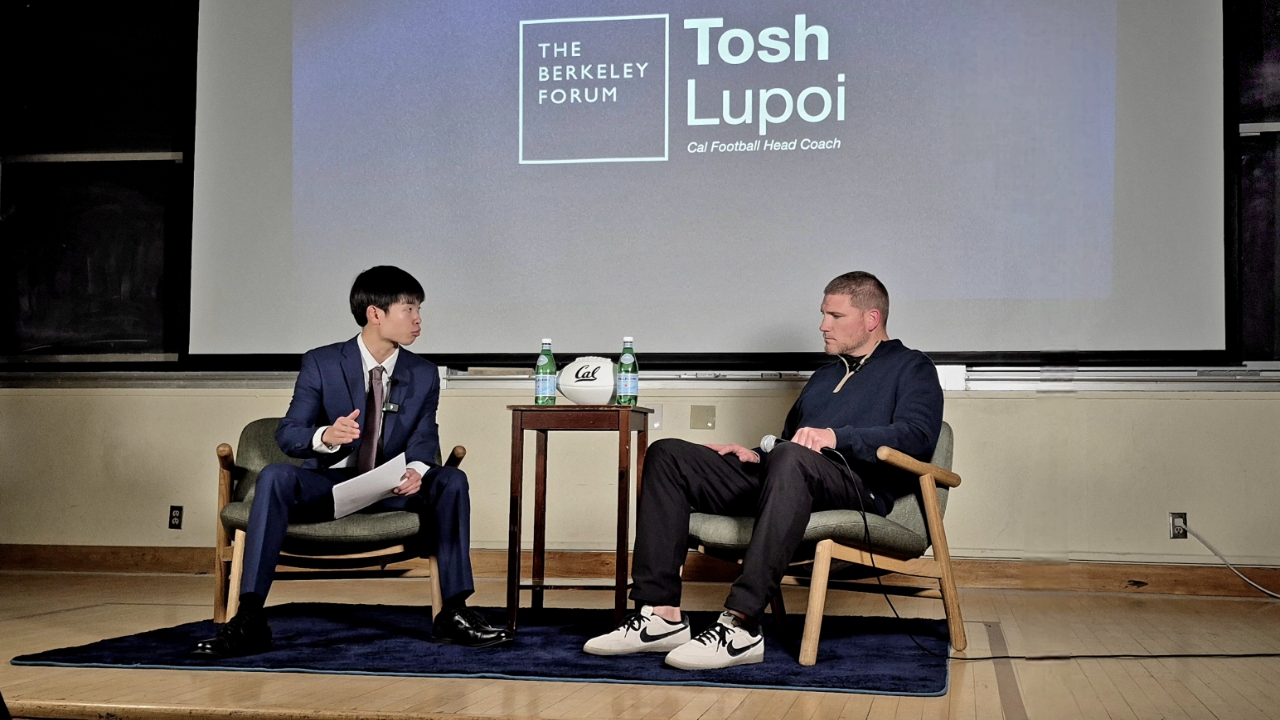
Tuesday night on campus, The Berkeley Forum, a student-run organization at UC Berkeley that hosts public conversations with leaders across business, sports, and politics hosted Cal head coach Tosh Lupoi for a Q&A with host Benjamin Wong.
The emcee asked a series of questions designed to help Cal fans get to know what makes the new head coach tick, beginning with how his work ethic became established.
“I think a lot of it, my grandfather was a immigrant and came over, lived the American dream and kind of worked from the ground up and a big part of my entire family foundation views early views and approach in life and everything I do. So from a very early age, I was afforded the opportunity to get up really early and travel within the Oakland area on a consistent basis, and he opened a produce market (Lupoi’s Market) on Ygancio Valley Road (in Walnut Creek).
“At that time, I claimed that I was working. I certainly wasn't. I was playing around in the conveyor belt and jumping around on pallets. But my whole family, my older brother, older sister, my parents, spent every day working at the at the produce market, and that was one of the earliest memories of my life, just being a part of that process. It’s a place that was open 365 days a year, Christmas morning and 6 am every morning. So that was something, just viewing him on a daily basis, of his approach, getting up really early, going to Oakland marina, getting fresh produce, fresh crab, and then bringing back and kind of seeing that whole operation so that that certainly played a huge role in my early principles and values and foundation of how I approach every day.”
The head coach was asked how his upbringing and the work ethic he developed carried over to football for him.
“There was something about applying all those principles to a really challenging sport and I think just the camaraderie, the bonding involved, and being a part of a culture and being a part of something where all different walks of life, socioeconomic backgrounds, racial backgrounds, all the differences coming together for a universal goal,” Lupoi said. “And some of those principles and values instilled in me at an early age, seeing that throughout football and being drawn to it.
“I started playing football really early as an eight year old in Pop Warner...going throughout the Pop Warner experience to De La Salle High School, being a part of something really unique, where we never lost a game in high school. And coming to Cal and we lost plenty of games the first year. Then with the new staff and being a part of a full-fledged culture change was a really cool, unique experience. And being a part of a team that had been through a lot of adversity and then being a part of something really special and building that. And then we're getting to the point where we're winning 10 games a season and the expectation of winning the conference championship and being a part of some top five teams during that throughout that process was something really special. And then carrying that on to the to the NFL, and then coming back to college football. And now, what we're trying to do every single day (at Cal).”
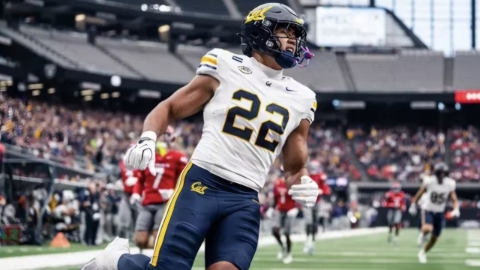
It’s clear from the level of engagement generated as well as the testimonials that have come from former teammates and players he’s coach at Cal, from Marshawn Lynch, to Desean Jackson to Aaron Rodgers to Cameron Jordan that Lupoi has had a major impact on some of the all-time Cal greats - some of whom will end up in the NFL Hall of Fame and it’s a testament to his work ethic and relationship building skills.
“I think just being a man of action,” Lupoi noted as one of the reasons he’s had the impact he’s had. “So the same values that that we’re hitting with our guys every day right now.
“Words are great things you write up on the wall, tee-shirts. They're great motivational tools. The challenge is in being a man or woman of action. And I think as far as with respect to my peers and feedback is that loyalty to the game and that that loyalty to having that mindset of how to work in your competition, your teammates, and being a part of a healthy, and at times, a healthy confrontational environment is okay. You know, being able to call out a teammate as long as you're the one that's leading and meeting the expectations.
“A lot of those guys that you mentioned just now have been back here and some of them on multiple occasions. There's some legends in this room, Tom Sverchek right here that I played with, former teammate. Doug Brien back there. There's some some guys that I have great respect for but you know, a lot of these individuals have had some of these similar experiences here and they come back for a reason, because they care about this place just like I do, you know. But I think setting the tone by action is most important. So for example, you just live today. The goal is to attack today. How we win today. And again, those are words. But I was in here myself early and set the tone, working out, committing to a diet. We start our workouts at 7 am so that means the expectation the guys are getting here much earlier, firing away their muscles, setting their mind to go attack that we're out on the field together.
“Some programs kind of hand off this time but our strength and conditioning department -our entire staff - is out in the field every single day with our fellows together, going through that fire and building that culture together. And then we obviously had a class today, so our staff was out on campus today doing class checks. And I think it's, it means a lot to the fellows when they the head coach, the entire staff, we’re all in this game together.”
The Bears head man didn’t always want to be a coach. He wanted to be a player for as long as he could. But circumstances dictated that he chart a new path and once he made the decision to change directions, he was all in, just like he was as a player, with a relentless work ethic.
“I think you hear a lot from from coaches where they knew they wanted to be a coach when they were 10 or 11 years old. That was their pathway. That was absolutely not my my intention,” Lupoi said. “I wanted to play and I loved the game. Loved playing the game and had an amazing experience here and when I had some adversity, it's an easy way to say why I didn't make it in the NFL - I broke my foot on three different occasions. But the fact is, I wasn't talented enough to continue that career, so when that NFL dream was officially cut, I was offered the opportunity literally that day by coach Tedford.
“So still, even in my mindset was, well, I'll finish off get my master's degree at Cal, and that's going to afford some opportunities and so I came back to be a graduate assistant. And then it probably took all 36 hours where I was like, ‘This is what I want to do for the rest of my life’ and just getting in a room and being able to coach and learn on the run. But at that time, there was truly only one graduate assistant on both sides of the ball and it's nothing like it is today, where there's two graduate assistants per position that feels like an analyst and the giant volume of individuals that are part of the staff.
“So every duty was put on your shoulders and you were everybody's graduate assistant. And sometimes that extended well beyond football. That involved dry cleaning, pickups, daycare, dog care, house care for Coach Tedford, which that have to be a behind the scenes talk as far as how that went, a couple of other things that go into your menu. And, well, this is what coaching is.
The Bears’ new head coach has always had a comfort level with student athletes, much of it born of the diverse experiences he was constantly exposed to throughout his childhood years, developing a comfort level moving seemlessly between all manner of diverse backgrounds.
“My mother's from Oakland, born in Hayward, moved all around the East Bay,” Lupoi said. “And one of the amazing attributes of the bay, especially east bay, it's just being extremely comfortable in any environment. When I was afforded the opportunity to be a part of certain different environments, my mother worked at Brendan Theater in Pittsburg, spending a lot of summers there and Walnut Creek, Concord, everywhere. So just being comfortable in a lot of environments helps. Ultimately, (I’ve) never really understood where some coaches might have the philosophy of, ‘I'm going to be a great coach or be a great recruiter,’ - one or the other but my attempt is to be great at both. So because of the public perception or the excitement, for whatever reason that goes into recruiting, it kind of devalues or undervalues what you do as a coach.
“You'll find, whether you're talking wealth management, like with Deloitte, JP, Morgan, Chase, Wells, Fargo, Bank of America, for the strongest organizations in the world, there's going to be a commonality of the best organizations prioritizing talent acquisition. So finding great people is rule number one. It's not different in our profession, either. So from a staff standpoint, from a player standpoint, identifying, evaluating and bringing in really good employees, recruiting talent acquisition, we bring in great players.
“From there, how we guide them, how we develop and implement a culture and attack every day, that's where we can develop something really special. I think early on, I saw the value of that. As a player, my teammates, there were some great players that made us play better, and we defended passes really well when Nnamdi (Asomugha) was lined up at corner, and then when we threw the ball down field to Desean Jackson and Keenan Allen, it works way better than you just throw it to Christian Prelle, right? So could there be the opportunity to do both? Recruit at a really high level, coach at a really at high level
“My coaching started to work really well. Coaching Cameron, Jordan Tyson didn't work as well. You know, sometimes as hard as guys that were had limited attributes in athleticism. So that's gold, and that continued on, and that's why the National Football League really different, great players get drafted really high, free agents don't get drafted or drafted low like a Tosh Lupoi or Tom Sverchek, right? So that doesn't seem to be really rocket science to me. For others, I guess it is. But when you get afforded the opportunity of growth and go to different places like a five-year experience next to Nick Saban, statistically, the best to ever do it and him reaffirming the absolute number one importance of recruiting.
“Week number one, coaching with Urban Meyer, the only other living human being that's won two national championships at two different places. Rule number one, talent acquisition. So that keeps getting reaffirmed, and then just talking to all my colleagues or individuals that have been in different professions, you keep hearing that, sharing that. So I think we're on something at this point.”
Lupoi has something unique to sell at Cal, having grown up a fan of the Bears, getting a BA and Masters degree at Cal then coaching there, not to mention the power of the degree and what doors it can open for student athletes after their playing careers are over.
“I think what’s really important is what you're selling,” Lupoi said. “I love to correlate it to maybe finances or something else in football. But what product are you selling? Making sure that it's aligned with your messaging and now that we're here, that's very natural being a former Cal Bear to play here, did his undergraduate, undergraduate here, master's program here, that's going to come very natural, right? So, being in a place where you're representing the number one public institution in the world, being a place also that just has a strong NFL tradition, and now that we've complimented with hiring an NFL defensive coordinator and an NFL offensive coordinator, multiple coaches on our staff from the NFL, parlaying that with the development of their futures, both on and off the field, and then tying that in with how we use that education.
“I think that this place has the strongest potential as anyone in the entire country, if we can continue to grow from a support standpoint, right? It's great to have a number one education in the name attached to that, but how are you utilizing it? If we can grow dramatically in that when it comes to tying in our strongest alumni base that wants to be involved, we have the seventh highest living alumnus in the entire country. So if we can make them aware and how they can help and be involved and grow from a corporate sponsor standpoint, that's what we're trying to do really hard right now. And tap into some things where programs like Indiana, for example, where two and a half years ago, if you asked who has a better football program, Cal or Indiana? I think a lot of people might have said Cal. But they developed a great culture. Have tremendous respect for the head coach and his values and where they've grown.
“And then also from a marketing standpoint, from an NIL standpoint, of people getting involved and excited, that's what can take our program to the next level. Knowing that, I think, just from awareness standpoint, too, is the the individuals that have been involved, rightfully so. When you look at the way college football has been shaped here, especially just in the last six years, five years, four years, the impact of of the portal and the NIL, of understanding how we can navigate much better from a retention standpoint. So priority number one, the talent acquisition, of how NIL can be involved, but then understanding the retention. And that's where I come from, a place that's that's established an extremely strong culture that I take a lot of pride in at the University of Oregon for the last four years with Coach Lanning. And the facts are that we we never lost a single starter in four years to the to the portal, not one.
“So when you're involved with a lot of different creative ways of how to retain the players, that becomes a lot more exciting for folks to get involved with, and more. So see, it is not just a donation, but an investment. They're truly investing and changing everyone's lives. We can have the players be a part of something that they believe in, a head coach, a culture, a staff, and we're retaining our mentors within that program that's going to highly increase the individuals to be retained as well. And then you have some creativity involved, where we can keep these players here, and everybody gets really excited about these are individuals that are coming in this program and also finishing.”