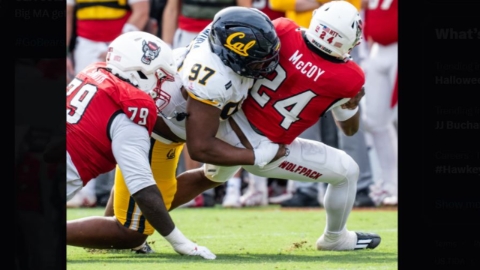
You can hear the audio podcast on Soundcloud, Spotify, Apple Podcasts or on most podcast streaming services or view the podcast video above.
``````````````````````````````````````````````````````````````````````````````````````````````````````````````````
One of the hardest things about football isn't playing. It's preparing to play when you don't know if you're actually going to get the chance.
You practice all week. Watch film. Study the game plan. Lift. Recover. Go to meetings. Get yourself physically and mentally ready.
And then Saturday comes.
Maybe you get 20 carries. Maybe you get two. Maybe you don't get any. That's a tough place to live as a competitive running back. Especially when you know you can play.
That's why I wanted to have Cal running back Ashten Emory back on Ultimate Insider.
We talked before the season, when he was still battling to establish himself in the Bears' backfield.
Now we're five games in, and things have changed. Adam Mohammed has been injured. Ashten's role has expanded. And against UNLV, he got 12 carries and scored the touchdown that put Cal ahead in the fourth quarter.
But here's what I loved about our conversation.
Ashten didn't talk about suddenly becoming ready. He talked about already being ready.
Next Man Up Isn't a Slogan
Every football team talks about the next-man-up mentality. It sounds great. Until you're the next man. Because being ready isn't something you decide to do when the starter gets hurt. By then, it's too late. The preparation has already happened. Or it hasn't.
When I asked Ashten how difficult it was to step into a larger role, he didn't hesitate.
He said it wasn't particularly hard because he'd been preparing for that moment all along. He knew the standard. He practiced to the standard.
Now he was simply being asked to perform to it.
That's what professionals do.
Opportunity doesn't create readiness. It reveals preparation. And that's true whether you're a running back waiting for more carries, a quarterback waiting for his first start, or somebody at work hoping to get the next big opportunity.
You don't get ready when they call your number. You get ready so that when they call your number, you can go.
The Little Things Are the Big Things
Cal's offense has struggled through the first five games. There's no sense pretending otherwise. We talked about it.
I asked Ashten what was happening that fans might not recognize from watching the games.
His answer? Little details. Scramble-drill responsibilities. Catching the football with two hands. Looking it all the way in. Securing the ball. Getting the right assignment. Eliminating pre-snap penalties. None of those things sound especially exciting. But together, they determine whether an offense stays on schedule or spends the afternoon fighting itself.
A missed block here. A penalty there. A dropped pass. A wrong read.
Suddenly you're behind the chains. Now the defense knows what's coming. And everything gets harder.
Ashten said the coaching staff has been emphasizing those details constantly.
If somebody jumps early in practice, somebody else takes the rep and the player who made the mistake runs. Not because running to the goalpost magically makes you a better player. Because there has to be a standard.
And the standard has to mean something.
How you do small things is how you do all things.
That's one of my favorite sayings. And it's especially true in football.
A Locker Room That Can Handle the Truth
One of the most interesting parts of our conversation came when I asked Ashten about the atmosphere inside the Cal locker room. The Bears are 2-3. Not where anybody wanted to be.
When teams start losing, there are a couple of directions things can go.
Players can start pointing fingers. Protecting their egos.
Blaming somebody else. Or they can start telling each other the truth.
Ashten says Cal is doing the latter.
Players coach players.
If somebody misses an assignment, a teammate can say something.
And the response isn't, "Who are you to tell me what to do?" It's, "You're right. I've got to fix that."
That's a big deal. Because accountability without trust often feels like an attack. But accountability inside a connected team feels like support. You're not calling somebody out to embarrass him. You're calling him up to the standard you've all agreed to meet. That's what a real brotherhood looks like. And it's what we mean when we talk about the Power of Unit.
The Kid Who Wasn't a Starter
Then I asked Ashten something I've wanted to understand since our first conversation.
Where does his attitude come from? Because this kid has a great one. He's enthusiastic. He's grateful. He doesn't seem interested in spending much time feeling sorry for himself. And he doesn't need everything to be going perfectly to enjoy playing football.
His answer took us back to when he was a kid.
He wasn't always a starter. Even in youth football, he had to work for opportunities. Nothing was guaranteed. That experience gave him a chip on his shoulder. But it also gave him perspective.
Now he's playing Division I football at Cal. He's walking into Memorial Stadium. He's surrounded by teammates who are chasing the same goal.
He gets to play a game he's loved since childhood. And he doesn't want to forget what a privilege that is.
He said something that stuck with me.
There are people who would do anything to have the opportunity he has.
He's right. It's easy to lose that perspective when the score isn't what you want. When you didn't get enough carries. When you made a mistake.
When the team loses. But the opportunity is still there. And you don't get that moment back.
This Next Play Could Be the Best Play
Against UNLV, Cal found itself in a difficult position. Ashten talked about addressing his teammates at halftime and telling them he genuinely believed they could still win. Not pretending. Believing. He wasn't interested in what had already happened. He was interested in what could happen next.
He put it this way:
“This next play can be the best play.”
I love that. Because it's so easy to let the last play contaminate the next one. You miss a block. Now you're thinking about the block you missed. You drop a pass. Now you're worried about dropping another one. You make a bad read. Now you're trying not to make another bad read. And suddenly you're not playing football anymore. You're playing against the memory of your last mistake.
Ashten doesn't want to live there. He wants the next play. That's where the opportunity is. And that's where his attention belongs.
The Touchdown Drive
Ashten's biggest workload at Cal came against UNLV. Twelve carries. And a fourth-quarter touchdown that put the Bears ahead. I asked him what was happening in the huddle during that drive.
His answer told me a lot about the relationships on this team. He said Bastion looked at him and told him to have fun. Just play ball.
Ashten also described something he says to Jackson before every play.
“I'm with you, right or wrong. I'm with you.”
Think about that. You're in a difficult game. The offense needs to produce.
The pressure is on. And the message between teammates isn't panic. It's trust. I've got you. Let's move the football. One play at a time.
Then the opportunity came. The hole opened. Ashten hit it. Touchdown.
He celebrated with his teammates. Then he moved on. Next play. That's a pretty healthy way to compete.
When the Game Slows Down
We got into something I find fascinating about running backs.
Rhythm.
Ashten said the more carries he gets, the more the game starts to slow down.
The first carry is full of energy. You're excited. Ready to go. Then you get another carry. And another. You start seeing how the defensive line is reacting. You notice whether the three-technique is jumping outside or coming inside. You get to the sideline, look at the tablet, and recognize something you missed during the previous series.
Now you get that same look again. But this time you know what you're seeing. The cut becomes clearer. The timing improves. The game slows down.
I know exactly what he's talking about.
I had a similar experience as a young quarterback at Cal.
As a redshirt freshman, I had a bleeding ulcer after taking too much naproxen. My quarterback coach, Coach Shea, had me sit in the press box with him and watch the game. And suddenly I saw something I hadn't fully recognized before.
The game looked just like the film. The formations. The movements. The patterns. They were all there. I just hadn't learned to recognize them at full speed yet.
That experience changed the way I saw football.
I've always thought of it as a kind of Matrix moment. Everything slows down. Not because the players are moving more slowly. Because your brain is processing the information more efficiently. You're recognizing instead of searching. That's a huge part of mastery.
Recognition and Reaction
I asked Ashten how much of running the football is recognizing what you're seeing and how much is simply reacting. He made a great distinction.
You can study everything before the snap. Defensive fronts. Alignments.
Tendencies. But once the play starts, defenders move. Somebody gets knocked off his block. A linebacker fills a different gap. The hole you expected disappears.
Now what?
React.
Ashten explained that not every play is blocked perfectly. Sometimes the best decision isn't a 20-yard run. It's turning what could have been a loss into a three-yard gain. That's a really important distinction. Good performance isn't always spectacular performance. Sometimes it's making the best possible decision with the situation you've been given.
That's how you stay efficient. And that's how you keep the offense moving.
Doing the Work Nobody Notices We also talked about pass protection. Fans see the carries. They see the catches. They see the touchdowns. But one of the most important things a running back can do is protect his quarterback.
Ashten explained how much communication is involved.
The offensive line identifies the front. The center communicates the protection. The back has to know his responsibility. Then he has to scan for pressure. Linebacker. Safety. Corner blitz. Somebody coming free.
Maybe he has to help a tackle. Maybe he has to help a guard. Maybe everybody is picked up and he can release into his route.
All of that happens in seconds.
And if he gets it wrong, the quarterback can get hit. That's why a running back's value can't be measured only in rushing yards. Sometimes the best play he makes is the block nobody remembers.
Don't Lose the Joy
Toward the end of our conversation, I asked Ashten what he wanted to focus on heading into Virginia Tech. I expected something about running the football. Maybe pass protection. Maybe getting more carries. He talked about those things. But the first thing he mentioned was bringing excitement and happiness to the team.
Joy.
I thought that was interesting.
Here is a young player on a team that has lost three of its first five games. He knows the offense needs to improve. He knows his responsibilities are growing. He knows there are mistakes to correct. And he wants to bring more joy to the locker room. Not because he isn't serious about winning. Because he is. He understands that football is a game. It's supposed to be fun. You can compete with tremendous intensity and still enjoy what you're doing.
In fact, sometimes enjoying what you're doing is exactly what allows you to compete more freely. That's something a lot of high achievers forget. They get so focused on the outcome that they lose the experience.
Ashten isn't interested in doing that. He wants to work. He wants to improve. He wants to help Cal win. But he also wants to enjoy the opportunity while he has it.
Ready for Whatever Comes Next
I don't know how many carries Ashten Emory will get this weekend. Neither does he. But after talking with him, I have a pretty good idea how he'll approach them.
Prepare to the standard. Trust his teammates. Do his job. Take accountability. Bring some energy. And if something goes wrong? Run the next one. Because the next play might be the best play.
That's a pretty good way to approach football. And a pretty good way to approach life.
Go Bears.