You can hear the audio podcast on Soundcloud, Spotify, Apple Podcasts or on most podcast streaming services or view the podcast video above.
``````````````````````````````````````````````````````````````````````````````````````````````````````````````````
I've been watching Cal freshman tight end Taimane Purcell this season, and there's something about the way he moves that keeps reminding me of another young tight end I watched at Berkeley many years ago.
Tony Gonzalez.
Now, before anybody gets carried away, I'm not saying Taimane is the next Tony Gonzalez. Tony went on to become one of the greatest tight ends in NFL history. But when I look at Taimane's size, athleticism, natural movement and physicality, I see some of the same qualities that made Tony so interesting when he was a young player at Cal. And I told Taimane exactly that when he joined me for the latest episode of Ultimate Insider.
He smiled. And he told me hearing those kinds of things gives him confidence that his football dreams might really be possible.
But after spending some time talking with him, I came away thinking that the most interesting thing about Taimane Purcell isn't necessarily his physical ability. It's how he's learning to use it. Because he's discovering something that every great performer eventually has to understand.
There's a big difference between playing to avoid mistakes and playing to make something happen. And for Taimane, that transition is already underway.
Football Is a Family Story
Taimane grew up in Hawaiʻi, surrounded by a family that loves football. His father played defensive end. His grandfather was a high school football coach. And from the time Taimane was a little kid, football was part of his life.
I had read about his grandfather and initially thought Taimane had played for him at Kamehameha.
He corrected me. He hadn't played for his grandfather. But in some ways, the connection was even more meaningful.
His grandfather used to take him to high school practices when he was in elementary school.
Imagine being a first grader, walking around a football field, watching your grandfather coach and seeing older players compete.
You're not studying the game in the traditional sense. You're absorbing it. You're learning what practice looks like. You're watching relationships develop between coaches and players. You're becoming comfortable in the environment.
Taimane told me his grandfather passed away around 2020. And it was during that period that he really began falling in love with football.
His grandfather's memory became part of his reason for playing.
I thought that was powerful. Because the best reasons to pursue something often have very little to do with trophies, statistics or recognition. They come from the people who matter to us. The people who believed in us. The people who gave us opportunities. The people whose sacrifices we don't want to waste.
Taimane spoke about his family with tremendous appreciation. His parents. His brothers. The people who drove him to practices, attended games and supported his development.
He told me he doesn't think his family has ever missed one of his football games.
Think about that. Every game. Somebody there. Somebody in the stands. Somebody showing up. As a former athlete, I know what that means.
I was fortunate enough to have a parent at nearly every game I played growing up, and I can tell you that kind of support matters. It creates a sense of security. It gives you confidence that the people who love you are going to be there regardless of whether you play well or poorly. And that kind of foundation can be incredibly powerful when you start facing the challenges that come with high-level competition.
Why Cal?
Taimane had opportunities to play college football elsewhere. But when I asked why he chose Berkeley, his answer came back to two things: Family and opportunity.
Coming from Hawaiʻi, he wanted to be somewhere his family could still reach him relatively easily. He wanted to maintain those connections. And he wanted to be part of a program where the relationships and culture felt right. But there was another consideration.
The education.
Taimane understood what a degree from UC Berkeley could mean for his future. And I loved hearing that. Because as exciting as college football can be, the opportunity to earn a Berkeley degree is something that can shape the rest of your life.
He also made a decision that required a pretty significant sacrifice. He left high school early. Instead of spending another six months at home with his friends and family, he enrolled at Cal in January so he could participate in spring football.
I asked him what he gained and what he gave up. He didn't pretend the sacrifice was easy. He missed time with the people he loves. Time he won't get back. But the same people he was leaving behind were encouraging him to go. They wanted him to take advantage of the opportunity. They wanted him to get started. They wanted him to grow. And he believes the decision paid off. Not just because he learned the offense. Because he developed relationships.
Finding a Place to Belong
One of the things I found interesting about Taimane is that he describes himself as a pretty quiet guy. He's not naturally outgoing. He's not the guy who immediately walks into a room and starts talking to everybody. So arriving at Cal early gave him something he might not have developed as quickly otherwise.
Connection. He got to know his teammates. He built relationships in the tight ends room. He found people he could ask for help. Whether it was football, academics or simply figuring out life in Berkeley, he had a support system before the season began.
That's an enormous advantage.
I've talked for years about the relationship between safety, belonging and performance. When you're worried about where you fit in, you're spending mental energy on things that have nothing to do with your assignment. But when you feel connected to the people around you, you can devote more of your attention to the work itself.
Taimane's experience is a great example. He arrived early. He developed relationships. He learned the terminology. He became more comfortable with the expectations. And by the time the season began, he wasn't trying to figure everything out on his own. He had a team around him. That's important for any freshman. And particularly for a freshman playing a position as complicated as tight end.
The Second Quarterback of the Offense
I've always loved tight ends. As a quarterback, a great tight end is one of the best friends you can have. He can create mismatches. He can help protect you. He can work underneath coverage. He can attack the seams. He can block in the running game. And when things start breaking down, he can become a reliable target.
I played with a terrific tight end at Cal named Brent Woodall. Brent could do just about everything. He played tight end. He moved around the formation.
He lined up in the backfield. And he had some of the best hands on a team that included outstanding receivers. So I wanted to know what Taimane loved about the position.
His answer told me something about his football intelligence. He loves the versatility. But he also loves the mental challenge. He explained that tight ends have to understand both the running game and the passing game.
They have to know the overall structure of the offense. They have to understand how their responsibilities connect to everybody else's.
And then he said something that caught my attention. He considers tight ends the second quarterbacks of the offense. I love that description. Because he's right.
A tight end isn't just running a route or blocking the defender across from him. He's constantly interpreting the defense. He has to know whether he's part of the protection. Whether he's releasing into a route. How his alignment changes the defensive picture. And how the offense is trying to create an advantage.
At his size, Taimane can present real problems for a defense. A smaller defensive back may struggle with his physicality. A linebacker may struggle to match his athleticism. And when he understands how to use those advantages within the offense, he becomes an extremely valuable player.
The physical tools are there. Now he's learning how to use them.
A Tight Ends Room That Competes Together
They all want to make plays. But instead of seeing one another's improvement as a threat, they're treating it as something that makes the whole group better. That's a tremendous team environment.
And Taimane pointed out something else I thought was important. The older players help him. But they also listen to him. Even though he's a freshman, they respect his observations. They'll ask what he saw. They'll listen if he has an idea. That's how trust works.
It's not simply the older guys talking and the younger guys listening. It's everybody recognizing that useful information can come from anywhere.
I love that. Because the best teams don't just have talented players. They create an environment where people help one another become better. And Taimane clearly appreciates what he's found in that room.
A Baseball Player Who Didn't Watch Much Football
Here's something I didn't expect. Taimane was a baseball player growing up. A pretty serious one. In fact, when he was a kid, he dreamed about playing in both Major League Baseball and the NFL.
I love that kind of ambition.
Why choose one dream when you're young enough to believe you can accomplish both?
He played mostly first base, with some time at catcher and third base.
And he described himself as a power hitter.
We had some fun talking about that because I grew up playing catcher myself.
I once told my father, when I was about eight years old, that I was going to play professional baseball. As if it were just something I could decide to do.
No problem.
But eventually I fell in love with football. And so did Taimane. Then I asked him a question I thought would be easy. Who were the great tight ends he grew up watching?
Who did he want to play like?
His answer surprised me.
He didn't really watch much football. Even though football was always on in his house, he preferred cartoons, video games or doing something else.
And even now, he admits he's trying to develop the habit of watching more football outside his required film study.
I actually loved that answer. Because it was authentic. He didn't feel the need to invent some childhood idol or tell me what he thought I wanted to hear. He just told me the truth. And it reminded me of myself.
I didn't spend my childhood sitting in front of the television watching every football game either.
I wanted to be outside. Playing. Moving. Competing. Doing something.
There's more than one path to becoming a good football player. And Taimane's path has been shaped as much by participation and experience as by watching the game.
From Trying Not to Mess Up to Trying to Make Plays
Now we get to what I think is the most important part of this conversation.
Taimane didn't catch a pass in his first game against UCLA. But as the season progressed, he started getting more involved in the offense.
More targets. More catches. More opportunities. So I asked him what changed.
Was he learning the offense? Was the game slowing down? Was he becoming more comfortable?
His answer was terrific.
He said that when he first arrived, he was uncomfortable. He was worried about making mistakes. He was trying not to mess up. And I understand that completely.
When you're a freshman stepping onto a major college football field, everything feels new.
The speed. The physicality. The complexity of the offense. The expectations.
You're surrounded by players who are older, stronger and more experienced. And it's easy to start thinking about everything that could go wrong.
What if I miss my assignment? What if I run the wrong route? What if I jump offside? What if I let my teammates down?
But here's the problem.
When your attention is consumed by avoiding mistakes, you're not fully available to make plays. You're playing cautiously. You're protecting yourself. You're reacting instead of attacking. And that's exactly what
Taimane recognized.
He said that as he became more comfortable, he stopped concentrating so much on not making mistakes. He started concentrating on playing football. Making plays. Doing his job. Helping his teammates.
He described himself as playing looser and looser each week.
I love that phrase. Because that's what playing free feels like.
You're no longer fighting yourself. You're not constantly monitoring everything that might go wrong. You're trusting your preparation.
You're trusting your teammates. And you're allowing your athletic ability to show up.
Taimane also made an important point about being selfless. He doesn't have to get the ball on every play. Sometimes his job is to block. Sometimes it's to create space for another receiver. Sometimes it's to help somebody else make the play.
And when he does his one-eleventh, good things eventually come back to him. That's not just a good football lesson. That's a great team lesson.
Ninety-One Yards of Playing Free
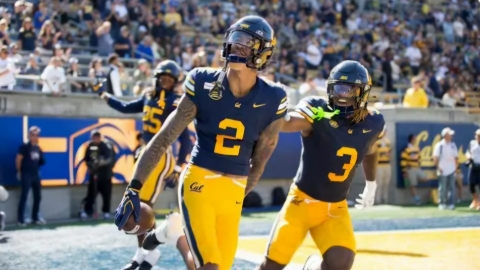
Then came the play against UNLV. A 91-yard touchdown reception. The second-longest pass play in Cal history. And I got to call it from the broadcast booth. So naturally, I wanted Taimane to walk me through it.
He described a relatively simple passing concept. He had a go route on the outside, with a five-yard out route from the slot receiver inside him.
The defense showed a cloud look, with Cover 2.
Taimane recognized the corner coming down. He thought the ball might be coming. He turned. Saw the football. Went up and made the catch.
Then he made a defender miss and raced to the end zone.
Ninety-one yards. Touchdown.
What I love about that play is how it connects to everything else he told me. Early in the season, he was thinking about not making mistakes.
But on that play, he recognized the coverage, reacted to the football and made something happen.
He wasn't worried about what could go wrong. He was playing. And the result was one of the longest pass plays in Cal history.
Now, I don't want to pretend one touchdown proves somebody has mastered the mental side of football. Taimane is still a freshman. He's still learning.
And there will be plenty of difficult moments ahead. But that play is a wonderful illustration of what happens when preparation, recognition and athletic ability come together.
The game gives you an opportunity. And you're ready to take it.
Finding His Place at Berkeley
Toward the end of our conversation, I asked Taimane how he's enjoying Cal.
His answer was encouraging.
He loves the people. He loves the coaching staff. He loves the culture.
And he loves Berkeley. He also understands that academics are part of the deal.
He came from a demanding academic environment in high school, so the expectations weren't entirely new. But balancing Berkeley classes with the demands of major college football has required some adjustment.
He's learning how to manage his time. How to prepare. How to handle the responsibilities that come with being a student-athlete. And he seems genuinely happy with the decision he made.
I think that's important. Because he's a long way from home. He's a young man who left Hawaiʻi early to pursue an opportunity.
He sacrificed time with family and friends. And now he's building a life for himself in Berkeley. Football is a big part of that experience.
1wwwwwq it isn't the whole experience.
He's developing relationships. Learning independence. Growing academically. And figuring out who he wants to become.
That's what college is supposed to be about.
The Best Is Still Ahead
As we finished the interview, Taimane was preparing for Cal's upcoming game against SMU.
He talked about focusing on the little things. Executing the game plan.
And concentrating on what the Bears could control. Nothing flashy. Nothing complicated. Just preparation and execution.
And that's probably appropriate for a young man who's learning that the best way to perform is to trust the work and play the game. I told him I was looking forward to watching him develop.
Because I really am.
He's got the size. He's got the movement skills. He's got the hands.
He's got the physicality. And he's learning the mental demands of one of football's most versatile positions.
But after our conversation, I think the thing that excites me most is his growing understanding of how to perform. He knows he doesn't have to be perfect. He knows he has teammates who support him. He knows he can make a mistake and still come back on the next play. And he's beginning to understand that the more comfortable he becomes with his responsibilities, the more freedom he has to use his abilities.
That's a powerful lesson.
In football. In business. And in life.
You can't play your best when you're consumed by everything that might go wrong. At some point, you have to trust the work. Trust yourself. And go make something happen. That's what Taimane Purcell is learning.
And if he continues down that path, I think Cal fans are going to have an awful lot of fun watching him.
Go Bears!