Bear Insider Ultimate Insider Podcast E142: Cal DB Cam Sidney
Cal defensive back Cam Sidney joins former Golden Bears HOF quarterback and radio color analyst Mike Pawlawski on Bear Insider's Ultimate Insider to talk about the art of playing nickel, preparing for success, and why mastering the fundamentals allows great athletes to play instinctively
One of the things I've always loved about football is watching somebody who's so well prepared that the game seems to slow down for him.
You know the player.
He's never out of position.
He's rarely surprised.
He's always around the football.
And when something happens, he seems to be moving before everybody else realizes what's going on.
As a quarterback, those were the defensive players I hated playing against.
And as an analyst, those are the guys I appreciate the most.
Cal defensive back Cam Sidney is one of those players.
I've watched Cam for years now, and there's always been something reassuring about seeing him line up at nickel.
My broadcast partner and I have talked about it.
When Cam is on the field, I feel pretty good about what's happening in that part of the secondary.
He's smart.
He's dependable.
He's physical.
And he understands what he's looking at.
But after sitting down with him for Ultimate Insider, I have a much better appreciation for why.
A Cal Guy in the Age of the Transfer Portal
Cam is something of a rarity in today's college football environment.
He's a fifth-year player at Cal.
Think about how unusual that has become.
Players transfer. Coaches leave. Rosters change. Opportunities appear elsewhere.
And Cam has been here through an awful lot of it.
He did enter the transfer portal briefly after the coaching changes, but ultimately decided to stay.
I asked him why.
His answer wasn't about playing time or statistics.
It was about belonging.
He loves Berkeley.
He has family in the Bay Area.
And over his years here, Cal has become home.
He told me that wherever he goes around the Bay, he feels welcomed.
That's powerful.
Because belonging does something important for a person.
It gives you a place where you can stop wondering whether you fit in and start concentrating on how you can contribute.
And for an athlete, that creates an opportunity to play with a little more freedom.
Cam came to Cal from Mater Dei, a program where he experienced championship football and developed lasting relationships with teammates.
He learned the importance of trusting the other ten guys on the field.
Doing your one-eleventh.
Knowing that if everybody handles his responsibility, the whole team becomes better.
He found that same sense of connection at Cal.
And I think that's a significant part of why he's been such a steadying presence for the Golden Bears.
The Nickel: A Small Game Within the Game
I love talking football with defensive backs.
Particularly nickelbacks.
Because it's one of the most demanding positions in modern football.
Offenses are constantly looking for ways to put that defender in conflict.
Motion.
Formation.
Run-pass options.
Different receiver splits.
Route combinations designed to create leverage.
When you're playing nickel, you can be involved in nearly every part of the play.
Run support.
Pass coverage.
Blitz responsibilities.
Recognizing formations.
Communicating with linebackers and safeties.
And occasionally matching up with some of the best athletes on the field.
Cam loves it.
He told me there's never a dull moment because he's always involved.
But one of the most interesting things he described was the chess match that happens before the snap.
As a quarterback, I'm trying to identify coverage.
I'm looking at the safeties.
I'm checking the nickel.
I'm trying to determine who's responsible for what and whether the defense is disguising something.
Cam knows that.
And he enjoys it.
He told me that he and the quarterback often make eye contact before the snap.
Both of them are trying to figure out what the other guy knows.
The quarterback is trying to recognize the coverage.
Cam is trying not to give it away.
Maybe he's showing one thing and preparing to do another.
Maybe he's trying to convince the quarterback that a particular route will be open when it won't be.
It's a small game within the bigger game.
And that's one of the reasons I love football.
There's so much happening before the ball is ever snapped.
When Preparation Becomes Instinct
Here's where our conversation really got interesting.
I asked Cam when assignment football stops and instinct takes over.
His answer was terrific.
He explained that when he's properly prepared, it doesn't necessarily feel like instinct.
It feels like recognition.
He's watched the film.
He's studied the formations.
He understands the receiver splits.
He's seen the route combinations.
He knows what the offense is likely to do from a particular look.
So when he lines up, he isn't spending all his attention thinking about his assignment.
He already knows it.
Now he's anticipating what might happen.
That's an enormous distinction.
The more thoroughly you prepare, the less you have to consciously process when it's time to perform.
I've spent a lot of time talking about this with the athletes and executives I coach.
People love to talk about instinct.
They describe somebody as a natural.
They say he's got a feel for the game.
But so often what we're seeing is the result of thousands of repetitions and an extraordinary amount of preparation.
The athlete recognizes something and reacts so quickly that it looks automatic.
That's not magic.
That's training.
As I've said for years, you are always training.
And what you repeat eventually becomes what you do without having to think about it.
Cam understands that.
He told me preparation makes the game feel slower.
That's exactly what I want to hear from a defensive back.
And it's exactly what I wanted as a quarterback.
When you can recognize what's coming rather than constantly trying to figure it out, you free yourself to play.
Confidence Is Contagious
I asked Cam another question about the way his consistency affects the players around him.
His response told me something about his understanding of team performance.
When one player in the secondary starts making plays, everybody else wants to get involved.
But there's an important catch.
You can't just abandon your assignment because you want to be the guy who makes the next tackle or interception.
You have to become better at your responsibility.
When each player does that, the defense operates together.
Now the entire group is faster.
More confident.
More aggressive.
And more connected.
That's what I think great team culture looks like.
Not eleven guys freelancing in pursuit of a highlight.
Eleven guys trusting one another enough to play freely within the structure of the defense.
And that's what the Power of Unit is really about.
Making the Football Come Out
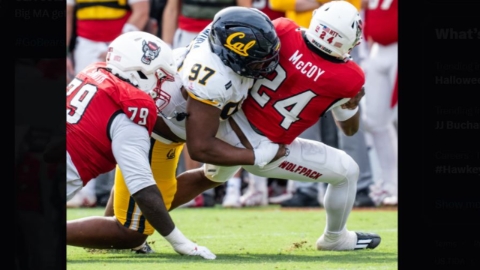
Cam had a productive game against Syracuse, and I wanted to talk about his forced fumble.
I asked him what he saw.
He said something that caught my attention.
When a ball carrier has the football in the wrong arm relative to the direction he's running, Cam notices.
And once he sees the opportunity, he's looking to get the ball out.
We talked about how stripping the football has evolved.
When I played, we talked constantly about raking and ripping at the football.
Today, you see more defenders punching at it.
Cam described how those techniques work together.
You punch at the football.
If you don't knock it free immediately, your arm can continue through the motion and rake at it.
And ideally you're still wrapping up and completing the tackle.
That requires timing.
It requires recognition.
And it requires practice.
Again, preparation becoming instinct.
One of the things I appreciate about Cam is that he's not simply trying to be in the right place.
He's looking for opportunities to make something happen once he gets there.
That's a difference maker.
The Power of Unit
We also talked about Tosh Lupoi's emphasis on the Power of Unit, ball excellence and relentless effort.
Cam described those principles as the team's foundation.
They're not just slogans to be discussed in meetings.
They're supposed to influence how the players practice, prepare and approach their responsibilities.
The little things matter.
And Cam believes having a clear foundation helps reduce uncertainty.
He said it alleviates anxiety and overthinking because players can rely on their preparation.
I think that's one of the most important things a coaching staff can give an athlete.
Clarity.
If a player is constantly wondering where he belongs, what he's supposed to do or whether he's about to make a mistake, he's not going to play as freely.
But when he understands the assignment and trusts the people around him, he can stop worrying about those things.
Now his attention goes where it belongs.
Onto the field.
Onto his opponent.
Onto the next opportunity.
That's how you build confidence.
Not by telling somebody to be confident.
By giving him the preparation and experience that make confidence possible.
Mastering the Mundane — On the Football Field and at the Piano
Here's something about Cam that I really enjoyed learning.
He's a piano player.
He started taking lessons when he was about 12 years old.
His parents wanted him to develop an interest outside sports, and Cam chose music.
He learned to read it.
Learned to play.
And gradually built the ability to recognize patterns and play by ear.
His favorite piece to return to?
The opening of Beethoven's Für Elise.
He knows it so well that when he sits down at a piano, his hands almost automatically know where to go.
Sound familiar?
That's exactly what we were talking about with football.
Repetition.
Recognition.
Preparation.
Performance.
Cam described it as “mastering the mundane.”
I love that.
Because there's nothing particularly glamorous about practicing the same musical passage repeatedly.
Just like there's nothing glamorous about running the same defensive assignment or studying the same route combination over and over.
But that's how you develop mastery.
You repeat the fundamentals until they become part of you.
And then you get to enjoy the freedom that comes from knowing your craft.
Cam said something else I liked.
He enjoys the process of trying to master something.
Not just the finished product.
The work itself.
I think that's a tremendous mindset for an athlete.
Because if you can learn to enjoy the work required to become excellent, you're no longer waiting for some distant result before you can appreciate what you're doing.
The work becomes part of the reward.
A Family of Performers
Cam also comes from an interesting family.
His younger sister is an actress who began pursuing that career when she was about five.
His older sister works as a doula, supporting families through childbirth.
Both of his parents have worked in law enforcement, and his father has retired from that profession.
Different careers.
Different interests.
But a common theme.
His parents encouraged their children to pursue what mattered to them and commit fully to it.
I asked Cam whether his younger sister's acting career had taught him anything about performing under pressure.
His answer was another great reminder that performance principles extend well beyond football.
An actress has to study.
Practice.
Prepare.
Learn her material.
And then perform when the moment arrives.
Sounds a lot like a football player, doesn't it?
Cam said watching his sister go through that process helps him appreciate his own.
They understand the demands on one another.
They support each other.
And they recognize that getting better requires effort.
I think there's a wonderful lesson in that.
Great performance may look different across different professions, but the underlying process often has an awful lot in common.
Preparation.
Repetition.
Trust.
Commitment.
And the ability to execute when it counts.
Letting His Game Do the Talking
One of the things I noticed during our interview is how calm Cam is.
He's not loud.
He's not constantly trying to command attention.
He's thoughtful.
Relaxed.
Pretty low-key.
That's not always the personality people imagine when they think about a physical defensive football player.
So I asked him about it.
He laughed and said he prefers to let his game do the talking.
He can get animated on the field.
But away from it, he's generally pretty even-keeled.
I like that.
Because it reminds us that there's no single personality required to become a great teammate or a dependable performer.
You don't have to be the loudest guy in the room to lead.
Sometimes you lead by knowing your job.
Doing it consistently.
Being where you're supposed to be.
And helping the guys around you succeed.
That's the version of leadership I've seen from Cam Sidney.
The Lesson: Train It Until You Trust It
At the end of our conversation, Cam talked about the importance of urgency and communication as Cal prepared for Clemson.
Two simple things.
But important ones.
Urgency means approaching each opportunity with the attention it deserves.
Communication means making sure the people around you know what you're seeing and what needs to happen.
Both are essential when you're playing a position as demanding as nickel.
But when I think back on the entire interview, I keep returning to his explanation of instinct.
We talk about great players as if they're born with an ability to recognize things nobody else can see.
And some people certainly have extraordinary physical gifts.
But there's another part of greatness that deserves far more attention.
The willingness to prepare.
To study.
To repeat.
To master the mundane.
Because eventually, if you do those things enough, the game begins to slow down.
And what looks like instinct to everybody else feels like understanding to you.
That's what I see when I watch Cam Sidney play.
A guy who's done the work.
Who trusts his preparation.
Who knows his responsibilities.
And who has learned to let the game come to him.
That's a pretty valuable player to have on your football team.
And a pretty good example of what it means to be a professional.
You are always training.
Go Bears.
We had production delays with this one that was recorded before the Clemson game but not more than a minute or two is devoted to the leadup to the game.
It's a great window into Cam's personality and game approach. Another really high-quality student athlete fans can be proud of.