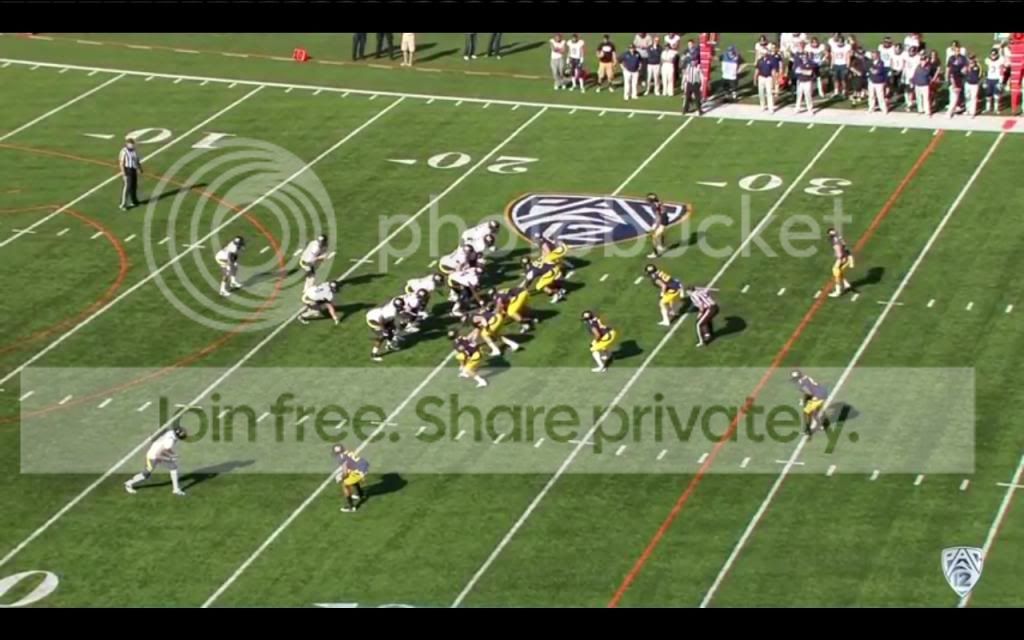
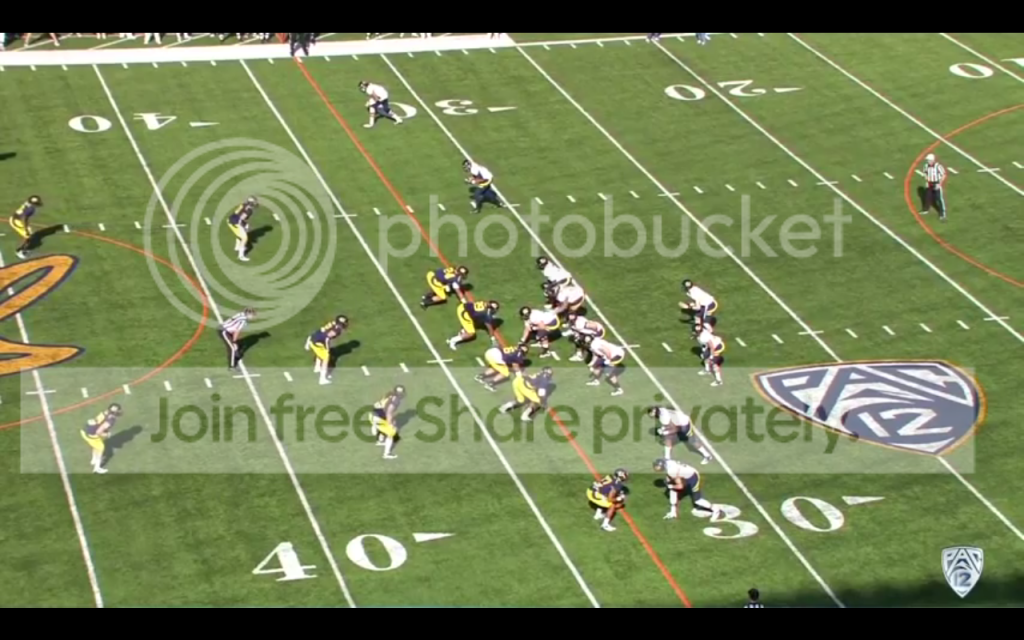
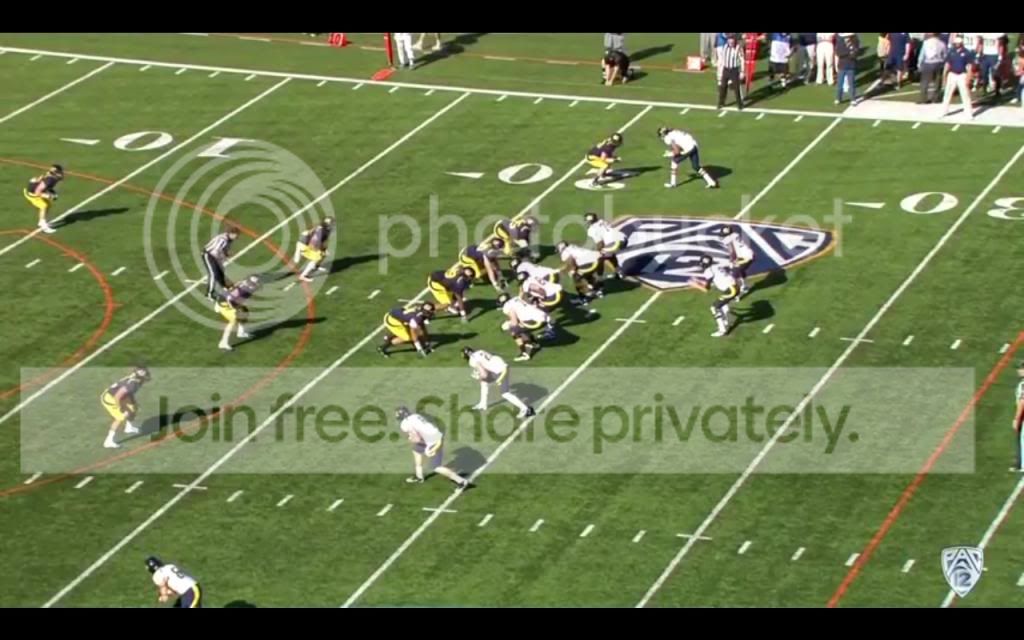
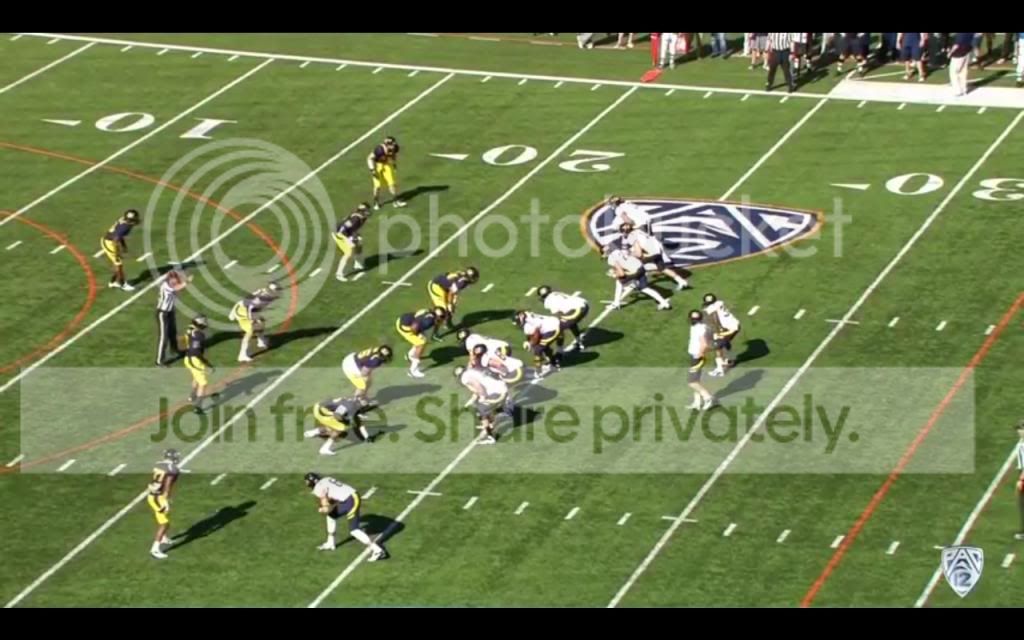
There's been a lot of talk about the Bear Raid, but so far no one's really talked about our defense. This post will serve as a quick introduction to our base front, and I'll talk about coverage in another post. Keep in mind that the looks our defense showed in the spring game were largely limited by the small number of formations and plays run by our offense, as well as by the fact that we're still at an early phase of installation (we'd only just installed a few blitzes before the spring game). At this point, we have a limited understanding of how the defense will adjust to play against pro-style teams and the like, and I'd imagine that we'll see more defensive line movement and a greater variety of blitzes and coverages in the fall. This post will give you a pretty cohesive view of our base defense, though, so you can be on the look-out for things that are different in the fall.
The Under Front
It looks like our base front is the “Under.” This is a solid front against most pro-style run games, and is pretty common throughout all levels of football. This was the front used by Pete Carroll at USC, for example. Perhaps less expected, our 3-4 under Clancy Pendergast was often aligned in an under, which is one reason you shouldn't worry about our switch to the 4-3. But more on that in a minute.
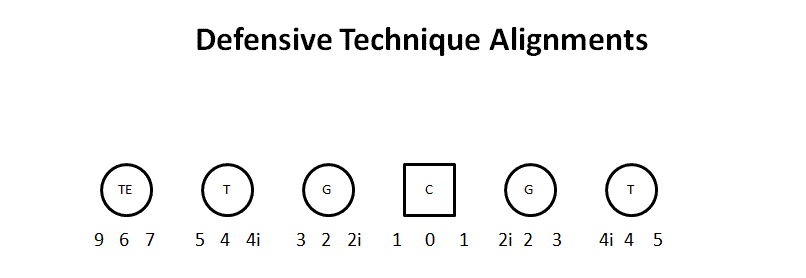
To understand what the under is and how it's different from other fronts, we need to talk about the numbering of defensive “techniques.” These aren't “techniques” like you're probably thinking about, but rather they just tell the defensive player where to line up relative to the offensive linemen. Even numbers tell the defender to line up heads-up over the offensive blocker. A defender playing heads-up over the center is a 0-tech, and the numbers get bigger as you work your way down the line. So, heads-up over the guard is a 2-tech, heads-up over the tackle is a 4-tech, and heads-up over a TE is a 6-tech. If you don't want the defender to line up heads-up over his blocker, you can shade him either inside or outside. Inside shades are designated with an “i.” So, a guy shaded inside a guard is a 2i, a guy shaded inside a tackle is a 4i, etc. Outside shades are odd numbers, so a guy shaded outside the center is a 1-tech, a guy shaded outside a guard is a 3-tech, etc. The TE numbering is a little different for no apparent reason, but that's not important. Here's a chart to help you visualize this:
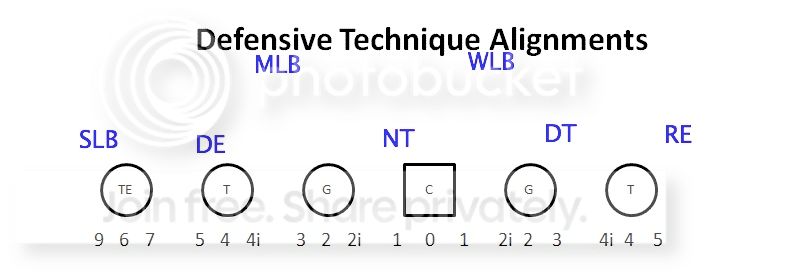
This gets us to the under front, and will help clear up some of the positions listed on our depth chart. Against normal 21 personnel (two backs, one TE = 21 personnel), the SAM linebacker is going to line up in a 9-tech to the TE side of the formation. Our SAM backers are Jalen Jefferson and Michael Barton. The defensive end lines up in a 5-tech to the same side. These guys are Brennan Scarlett and Todd Barr. The nose tackle lines up in a 1-tech to the TE side. Our NT's are Deandre Coleman and Viliami Moala. The defensive tackles (Mustafa Jalil and whoever replaces Keni Kaufusi) line up in a 3-tech away from the TE, and the rush ends (Chris McCain and Dan Camporeale) line up in a 5-tech away from the TE.
At the linebacker level, you just add a 0 to the technique number to show that they're off the line of scrimmage. So, the MIKE linebacker (Nick Forbes, Hardy Nickerson) will be in a 30-technique (shaded outside the guard, but a few yards off the line of scrimmage) toward the TE, and the WILL linebacker will be in a 20-technique away from the TE. Here's a diagram:
That's the under, which is one of about three fronts that are commonly used in college football and the NFL. Above I mentioned that this is a good front for stopping a pro-style running attack, and we can see why by a comparison with the other two common fronts, the over and the 3-4. Here's the over, which is what you probably think of when you think of the 4-3:
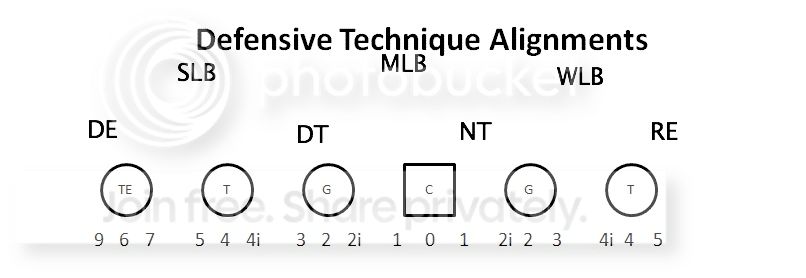
As you can see, the defensive lines in the “over” and the “under” look like mirror images of each other. In the over front, the defensive line is shifted toward the TE, and the DE lines up outside of him. In the under front, the defensive line is shifted away from the TE, and you bring down a linebacker to cover up the TE.
The last common front is the 3-4. The alignment for that is as follows:
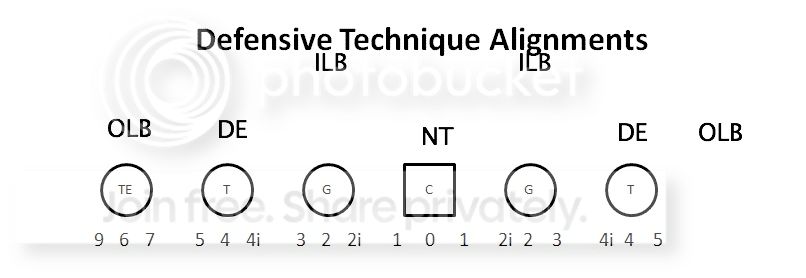
So, the DE's play 4-techs, and the NT plays a zero.
The last concept we need to introduce to see the difference between all these fronts is the concept of gap-responsibility. A “gap” is the space between any two offensive blockers. If the defense can cover all of the gaps between offensive blockers, than the RB will have nowhere to go. The gaps between the guards and the center are called the “A” gaps, between the guards and tackles are the “B” gaps, outside the tackles are the “C” gaps, and anything farther outside is the “D” gap:
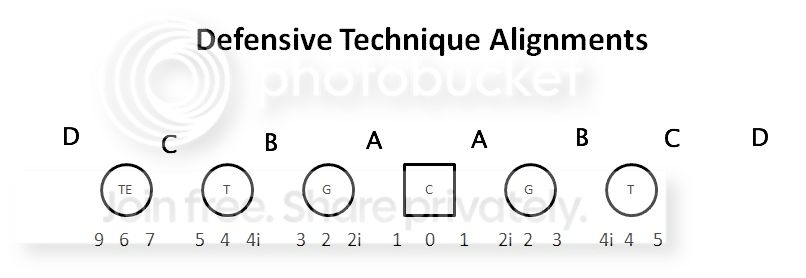
With all that terminology in place, we can see how these fronts work by looking at who is responsible for each gap in the different fronts. In the over and under fronts, the defensive linemen and linebackers are shaded into individual gaps, and they are responsible for stopping any run through that gap. So, in the under the NT is in a 1-tech, and so is shaded into and responsible for the strongside A-gap (the strongside is the side with the TE). In the over, the NT is in a 1-tech, and so is shaded into and responsible for the weak-side A-gap (the A-gap away from the TE). Each gap is covered by one player, whether it's a lineman or a linebacker, and each player is responsible for only one gap. In the over and under fronts, we say that the linemen are “1-gapping.” One gap defenses let the defenders aggressively fly to their assignment, making them especially disruptive.
The 3-4 is different. Here, the three defensive linemen are responsible for six gaps between them. They line up in even techniques (a 0-tech NT and two 4-tech DE's) and are “two-gapping.” The NT is responsible for both A-gaps, and the DE's are responsible for the B- and C-gaps. The defensive linemen in this scheme are inherently less aggressive because of their two-gap assignments. Their job is to engage the lineman across from them, to read the direction of the run, and to cover the gap that it goes toward. In reality, they aren't supposed to make many plays but rather are supposed to command double teams so that the four LB's can make the plays behind them. I should note that our defense under Pendergast hardly ever played this alignment, if they ever did. We actually based out of an under front and had everybody 1-gapping, which is why you shouldn't worry about our switch to the 4-3. In the old system we had a 9-tech OLB, a 5-tech DE, a 1-tech NT, a 3-tech DE, and a 5-tech OLB. We've left the 9-tech OLB's in the same spot (now called SAM), left our 5-tech DE's and 1-tech NT's where they were, changed the name of our 3-tech from “defensive end” to “defensive tackle”, and converted all of our 5-tech OLB's into 5-tech DE's. There's essentially no difference in the two systems.
Pendergast aside, we can see that the traditional two-gapping 3-4 is drastically different from the over and under fronts in terms of their gap assignments. The under and over are both 1-gap defenses, but they also have important differences. To understand them, we need to understand what offensive coordinators like to attack with the run. Essentially, the offense likes to run to the gaps that aren't covered by defensive linemen. Such uncovered gaps are called “bubbles.” Let's look at the under front again:
In the under, there's a nice bubble over the strongside B-gap between the DE and the NT. When you look at the alignment, you can see why the offense would want to attack that bubble: The OT should be able to seal the DE out of the B-gap while the OG should be able to seal the NT out of it. This leaves the MLB all alone to cover the B-gap, and you can take him out with a lead-blocker such as a FB or a pulling guard. Such a run would be much harder if it were going to either C-gap, because there's a massive DL blocking things up. So, offenses like to attack the bubbles. In the under front there's a bubble over the strongside B-gap and the weakside A-gap. Now we can look at the over by way of comparison:
Here, you can see that the over has a bubble over the strongside C-gap, the strongside A-gap, and the weakside B-gap, meaning that there's one more bubble than there is in the under. The under is tougher against the inside run because it has one fewer bubble for the offense to attack, thus reducing the number of different runs you're likely to see, and certainly limiting the number of runs that are likely to be effective against you.
The Under Front
It looks like our base front is the “Under.” This is a solid front against most pro-style run games, and is pretty common throughout all levels of football. This was the front used by Pete Carroll at USC, for example. Perhaps less expected, our 3-4 under Clancy Pendergast was often aligned in an under, which is one reason you shouldn't worry about our switch to the 4-3. But more on that in a minute.
To understand what the under is and how it's different from other fronts, we need to talk about the numbering of defensive “techniques.” These aren't “techniques” like you're probably thinking about, but rather they just tell the defensive player where to line up relative to the offensive linemen. Even numbers tell the defender to line up heads-up over the offensive blocker. A defender playing heads-up over the center is a 0-tech, and the numbers get bigger as you work your way down the line. So, heads-up over the guard is a 2-tech, heads-up over the tackle is a 4-tech, and heads-up over a TE is a 6-tech. If you don't want the defender to line up heads-up over his blocker, you can shade him either inside or outside. Inside shades are designated with an “i.” So, a guy shaded inside a guard is a 2i, a guy shaded inside a tackle is a 4i, etc. Outside shades are odd numbers, so a guy shaded outside the center is a 1-tech, a guy shaded outside a guard is a 3-tech, etc. The TE numbering is a little different for no apparent reason, but that's not important. Here's a chart to help you visualize this:
This gets us to the under front, and will help clear up some of the positions listed on our depth chart. Against normal 21 personnel (two backs, one TE = 21 personnel), the SAM linebacker is going to line up in a 9-tech to the TE side of the formation. Our SAM backers are Jalen Jefferson and Michael Barton. The defensive end lines up in a 5-tech to the same side. These guys are Brennan Scarlett and Todd Barr. The nose tackle lines up in a 1-tech to the TE side. Our NT's are Deandre Coleman and Viliami Moala. The defensive tackles (Mustafa Jalil and whoever replaces Keni Kaufusi) line up in a 3-tech away from the TE, and the rush ends (Chris McCain and Dan Camporeale) line up in a 5-tech away from the TE.
At the linebacker level, you just add a 0 to the technique number to show that they're off the line of scrimmage. So, the MIKE linebacker (Nick Forbes, Hardy Nickerson) will be in a 30-technique (shaded outside the guard, but a few yards off the line of scrimmage) toward the TE, and the WILL linebacker will be in a 20-technique away from the TE. Here's a diagram:
That's the under, which is one of about three fronts that are commonly used in college football and the NFL. Above I mentioned that this is a good front for stopping a pro-style running attack, and we can see why by a comparison with the other two common fronts, the over and the 3-4. Here's the over, which is what you probably think of when you think of the 4-3:
As you can see, the defensive lines in the “over” and the “under” look like mirror images of each other. In the over front, the defensive line is shifted toward the TE, and the DE lines up outside of him. In the under front, the defensive line is shifted away from the TE, and you bring down a linebacker to cover up the TE.
The last common front is the 3-4. The alignment for that is as follows:
So, the DE's play 4-techs, and the NT plays a zero.
The last concept we need to introduce to see the difference between all these fronts is the concept of gap-responsibility. A “gap” is the space between any two offensive blockers. If the defense can cover all of the gaps between offensive blockers, than the RB will have nowhere to go. The gaps between the guards and the center are called the “A” gaps, between the guards and tackles are the “B” gaps, outside the tackles are the “C” gaps, and anything farther outside is the “D” gap:
With all that terminology in place, we can see how these fronts work by looking at who is responsible for each gap in the different fronts. In the over and under fronts, the defensive linemen and linebackers are shaded into individual gaps, and they are responsible for stopping any run through that gap. So, in the under the NT is in a 1-tech, and so is shaded into and responsible for the strongside A-gap (the strongside is the side with the TE). In the over, the NT is in a 1-tech, and so is shaded into and responsible for the weak-side A-gap (the A-gap away from the TE). Each gap is covered by one player, whether it's a lineman or a linebacker, and each player is responsible for only one gap. In the over and under fronts, we say that the linemen are “1-gapping.” One gap defenses let the defenders aggressively fly to their assignment, making them especially disruptive.
The 3-4 is different. Here, the three defensive linemen are responsible for six gaps between them. They line up in even techniques (a 0-tech NT and two 4-tech DE's) and are “two-gapping.” The NT is responsible for both A-gaps, and the DE's are responsible for the B- and C-gaps. The defensive linemen in this scheme are inherently less aggressive because of their two-gap assignments. Their job is to engage the lineman across from them, to read the direction of the run, and to cover the gap that it goes toward. In reality, they aren't supposed to make many plays but rather are supposed to command double teams so that the four LB's can make the plays behind them. I should note that our defense under Pendergast hardly ever played this alignment, if they ever did. We actually based out of an under front and had everybody 1-gapping, which is why you shouldn't worry about our switch to the 4-3. In the old system we had a 9-tech OLB, a 5-tech DE, a 1-tech NT, a 3-tech DE, and a 5-tech OLB. We've left the 9-tech OLB's in the same spot (now called SAM), left our 5-tech DE's and 1-tech NT's where they were, changed the name of our 3-tech from “defensive end” to “defensive tackle”, and converted all of our 5-tech OLB's into 5-tech DE's. There's essentially no difference in the two systems.
Pendergast aside, we can see that the traditional two-gapping 3-4 is drastically different from the over and under fronts in terms of their gap assignments. The under and over are both 1-gap defenses, but they also have important differences. To understand them, we need to understand what offensive coordinators like to attack with the run. Essentially, the offense likes to run to the gaps that aren't covered by defensive linemen. Such uncovered gaps are called “bubbles.” Let's look at the under front again:
In the under, there's a nice bubble over the strongside B-gap between the DE and the NT. When you look at the alignment, you can see why the offense would want to attack that bubble: The OT should be able to seal the DE out of the B-gap while the OG should be able to seal the NT out of it. This leaves the MLB all alone to cover the B-gap, and you can take him out with a lead-blocker such as a FB or a pulling guard. Such a run would be much harder if it were going to either C-gap, because there's a massive DL blocking things up. So, offenses like to attack the bubbles. In the under front there's a bubble over the strongside B-gap and the weakside A-gap. Now we can look at the over by way of comparison:
Here, you can see that the over has a bubble over the strongside C-gap, the strongside A-gap, and the weakside B-gap, meaning that there's one more bubble than there is in the under. The under is tougher against the inside run because it has one fewer bubble for the offense to attack, thus reducing the number of different runs you're likely to see, and certainly limiting the number of runs that are likely to be effective against you.