wifeisafurd said:
concordtom said:
going4roses said:
I guess I just see the humanity vs the economics (can one be be humane and be a little capitalist?)…
Not just the numbers and theories supposedly at work, but the end result on the human race. what I see and deal with(others dealing with) on daily basis is race to bottom slavery (again)
I guess when the AI /robots are full deployed to the work force then what happens.
When robots are employed,
-Per capita productivity increases.
-Displaced workers are able to be employed in other areas.
These are overall positives for economic gains for humans.
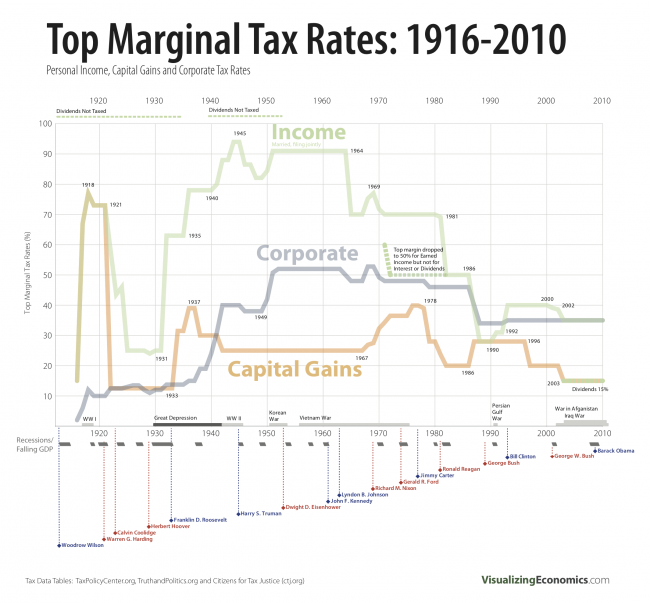
As for who gets the economic gains of said productivity increases? That all depends on tax rates and other public policies. And that was my point in posting my chart on tax rates.
It's clear that as the marginal tax rate has decreased (combined with an increase in various use taxes), incomes wealth gaps have increased during this era of lower top marginal tax rate. That's not a good thing, as Roses is pointing out with this thread.
As Cal professor Emmanuel Saenz has lectured, the US now has, effectively, a Flat Tax. If this adverse effect (wealth gaps) is what WIFE is referring to, whereas a flat tax (along with commonplace deductions most often used by the wealthy) increases an Effective Tax Rate, GREAT! (Unfortunately, he appears too tired of typing to say so, simply pointing to "other" threads that have addressed it. Please forgive if this reader hasn't memorized those threads - apparently, too tired of First Down victories to have done so.)
This is utter gibberish.
I pointed out you are using a meaningless number (marginal tax rates) thus your table really doesn't demonstrate anything. I never mentioned reverse wealth gaps or whatever stuff your making-up. The chart you provided was a discussion of marginal income tax rates for different types of income, and had no discussion of wealth gaps, productivity or anything else. Indeed, Roses was discussing minimum wage levels which is a completely different topic before you jumped in with your non-sequitur discussion of marginal tax rates. Yet, you just make up some BS that the intent you your wonderful first chart had to do with productivity increases? And then you probably misrepresented Rosses later post by saying that displacement of workers is positive for economic gains for humans. Where the hell does Rosses say that? I suspect he doesn't agree with you.
Then you said: "It's clear that as the marginal tax rate has decreased (combined with an increase in various use taxes), incomes wealth gaps have increased during this era of lower top marginal tax rate. That's not a good thing, as Roses is pointing out with this thread. " Actually Roses pointed out no such thing. He didn't discuss wealth gaps at all. But there is the substance of your comment. We now are back to you not understanding what marginal taxes represent. For example, wealth concentration went down for the top 1% from Q291 to Q297 according to the FED, nevertheless the top marginal income tax rate went up from 31% in 1991 to 39.6% in 1993, and stayed there through 1997. So in fact, during this period, the opposite of what you said happened, wealth concentration of top earners went down and marginal tax rates went up, only to demonstrate you just makes stuff-up
But let's take what you say Saenz says, to wit, "as Cal professor Emmanuel Saenz has lectured, the US now has, effectively, a Flat Tax. If this adverse effect (wealth gaps) is what WIFE is referring to, whereas a flat tax (along with commonplace deductions most often used by the wealthy) increases an Effective Tax Rate, GREAT! " That again is a complete misrepresentation of what Saenz said, which is the richest 400 families in the US paid an average effective tax rate [NOTE THE WORK EFFECTIVE NOT MARGINAL] of 23 percent in 2018, while the bottom half of US households paid 24.2 percent of their income in taxes. Now most economists, led Larry Summers and Janet Yellen, have said the numbers used by Saenz and his colleagues are wrong. But let's say they are right. Saenz also said the earners in the top 10% pay way higher effective tax rate that the top 400 families, and the bottom group, which means there is no flat tax. Then you add that I somehow talked about wealth gaps. I don't know whether you misquote people through ignorance, stupidly or intentionally.
At this point, I'm not sure it makes much sense to try and explain anything to you, but lets' discuss how the very wealthy typically avoid paying higher taxes. It is not through tax deductions as you claim, but that they avoid having taxable income. For example, they borrow against appreciated assets to generate cash flow rather than sale the assets for gain. This is why there is utter futility in expressing things about marginal tax rates. A higher marginal tax rate on no taxable income still yields the same tax burden. I don't expect you understand any of this. or the significance. Please tell me you didn't graduate from Cal.
Economics and social policies are multi-faceted. You and I both make assumptions when we enter into conversation about it. Since we are not in alignment with these prior posts, perhaps we can ask each other basic questions so as to clear things up. You've said statements I agree with, and some I question, but I'd like to go back to some base assumptions if that's okay.
1. Roses is complaining about how many cannot afford housing and minimum wage in this thread.
To wit, I am very skeptical about any minimum wage laws. I believe supply and demand should dictate the price of labor. I believe the US must compete globally and that min wage laws create a "market inefficiency". (Though I do accept market inefficiencies pertaining to health, safety, environment.)
We do not live in a 1-mill town where the mill company owns the store, the housing buildings, and won't allow workers to organize, thus trapping them.
2. That said, I believe that we definitely have a problematic wealth gap. Too much wealth is concentrated for the overall good of society. This is in agreement with Roses opening post - that not enough people can afford housing. However, I'm not concerned about people moving out of state. Supply and demand of location is fine, too. TX is cheaper, but then you have to live in TX. CA weather rules (except for recent fires!).
I have stated some of my base assumptions. The introduction of Saez and Zucman's chart is an attempt on my part to then raise solutions to the assumed problem of a shrinking middle class (concentration of wealth at the top).
Zucman proposes a wealth tax, picked up by Elizabeth Warren. I was proposing increasing the top marginal rate - but I'm no expert, it was a conversation starter pointing how how the rate has decreased over the long run (not the very specific short run of 91-97, cherry-picking), and how use taxes and payroll tax specifically according to zucman have replaced the higher tax brackets contributions. (Flat vs progressive)
...We can quibble about solutions, but you may not even believe there's a problem to be solved. So, perhaps you can make some open ended statements about your beliefs on things like
Min wage laws
Wealth concentration
Taxation policy
Other
We are not sitting down face to face, so there will be some misunderstandings. But today is a new day. Perhaps yesterday's frustrations will have faded into the night's dreams, and the need to insult is reduced.
As I've said many times here, I graduated American University in DC with an international affairs major - Econ concentration, Spanish minor. I worked briefly on Capitol Hill, moved to SF and worked as a stock trader a fund manager. I'm not the smartest guy in the room by any stretch, but I'm no idiot either. Your experience is in areas that I respect. You are much smarter, and wealthier, than me.
In essence, we could just cut to the chase - do you care about the fact that people of color have lower opportunities? Do you care about homelessness? Do you care about how productivity gains (which translates to economic gains) is distributed among the population? Do you think that distribution is healthiest as can be?
What do you propose policy-makers do about it?
What type of society would you like to see?
If all if perfect, then no answer is required.
If you'd like to see something improved, write about it.
Pick a problem, propose a solution.
Go for it.
Don't just tell me I'm gibberish and stupid. Waste of your energy. You have bigger things to do.
Feel free to use your post as a creative space within your own mind. "I'm king. I can create the type of society I think is most ideal." Then start painting. Never mind me, how intelligent I am, or where I graduated from.
I think that's the essence of what I'm exploring, what Roses is exploring. Is X a problem, and how to solve.