Lets debate SEIU's billionaire wealth tax ;-)

3,557 Views | 91 Replies | Last: 41 min ago by concordtom
socaltownie
How long do you want to ignore this user?
DiabloWags said:

socaltownie said:

DiabloWags said:

socaltownie said:

DiabloWags said:

tequila4kapp said:

Anarchistbear said:


Job insecurity, no health care, no child care, can't afford housing- true for a lot of Americans and related to inequality. The public is in favor of these things, the government is not.

Edit - I would add college affordability to your list.

There are nearly 1k billionaires in the US. Their net worth is @8.4 trillion. There are @350k US citizens. If we confiscated every single penny of billionaire wealth - which is not even where this thread started - we can spend @23k for every man, woman and child. That is not enough to do even one of the items on this list. A second problem with the wealth redistribution discussion - in our country at least - is that it starts with some version of "we need greater structural fairness" in the system - which is legitimate - but always works its way to be a laundry list of items the masses believe they deserve for free. So the source of money isn't big enough and the list of things to spend on always gets bigger. And this assumes that government is an efficient distributor of resources, which many would argue it is not. And humans have human nature, which in this context means they have some magic number where they seek to avoid paying taxes and exit the system, so our pool of available money to fix societal ills decreases, followed by the threshold for "rich" continuously being lowered..and the whole thing falls apart (see NY where Mandahmi is calling for an estate tax threshold of only $750k). These are the reasons why Socialism has always failed and will always fail.

Different response: point of order that the social programs are not Socialism.

Different response: the current era has corollaries to the guided era. I could be mistaken but I do not remember the Teddy Roosevelt Trust Busting that brought about social change being associated with pronounced violence.


And this is the crux of the issue.
Invariably, government is not effecient at all.
I've personally witnessed this when it comes to the City of San Jose and the State of California.

Why would anyone trust Government officials (who invariably weren't bright enough to get a job in the private sector) on how to allocate resources?

I've seen an awful lot of public servants that are not capable of serving the public because they are dumber than dumb.
And yet they're making 2, 3, and $400,000 a year.


I don't universally believe that. There is a LOT of government waste. Generally inefficient.


Diablo - I DO think that a core problem is accountability among senior staff. But in a lot of ways, Pogo, we have met the enemy and he is us. What they are getting paid 400,000 is to not create problems for their bosses (the electeds). And when electeds TRY to exert strong management principle voters often punish them for "chaos" and "firing nice people."


The City of San Jose is filled with Deputy City Managers that make $400,000 a year.

It's not clear to me what some of these people actually get done, given that I have had a lot of personal experience with them. They never fire anyone. They never hold anyone accountable. They come to work every day with the same lame mantra of "Hear no Evil, See No Evil, and Speak No Evil."

They don't want to speak up and upset the gravy train.

For example, homelessness is a mess.
Their Parks have over half a Billion dollars in deferred maintenance and taxpayers have given up. They won't even entertainment a small parcel tax on the ballot to fund the Park & Rec Dept.

They can't attract developers because their fees are too high and their animal shelter does nothing but decrease capacity to care while doubling its budget since 2021. The City got bailed out by a lot of Covid type federal funding from Biden, but that funding finally dried up in 2024 and now they have annual budget deficits.

And because there is no profit motive in Govt, it's much more difficult to define outcomes in order to measure progress. Invariably, these people will defer, deflect, dismiss, and discount the concerns of the public . . . kicking them down the road for as long as they can - - - and then pat each other on the back about how much PROGRESS was made during the year.

Matt Mahan is a perfect example of this.
It's absolutely mind-blowing to me that he thinks he has a resume that is good enough to become Governor.
Such is the entitled "bubble" that these people walk around in.

The only way that you can hold bureaucrats accountable is through legal action.
Ask me how I know.

Animal advocates claim inhumane conditions fester at San Jose shelter, threaten lawsuit - Local News Matters


There is a lot of truth to this. But I see the world from a different lense. Part of their job is to avoid making the politicians make hard choices.

Take animal shelters (and I going to make a ton of this up so I might miss some specifics).

Move away from no kill - well Peta protests
Use more 3rd party rescue groups - well gotta vet them to the nth degree so someone doesn't embarass you
Displace union workers by contracting out - that is a BAD idea ;-)
Embrace more no kill - who is going to pay to expand the thing?

All these create almost unsolvable gordian knots. There are solutions but like in the private sector there would have to be trade offs and choices. But making choices is BAD for politicians. The costs are concentrated and the benefits diffuse. And voters don't remember the diffuse stuff but they sure do remember when their sacred cow is gored.

Bureaucrats learn this. So not making decisions is actually what they are PAID to do. Because getting stuff to the point of decision gets you a big side eye from your bosses.


One of the biggest issues that I see is how the City believes it can solve a lot of its problems by hiring part time employees (and not having to pay benefits or deal with the Unions). This invariably leads to an extremely poor culture, which drives good people away and allows poor people to remain.


Sure...but have you looked at CALPERS benefits? I mean a 70K person fully loaded is like 120K depending on how underwater your pension is. And the reason they are so rich is that Grey Davis cut a deal with the CHP - and then local lawenforcement up and down the state leveraged THAT to get their own pension enhancements.

Take care of your Chicken
DiabloWags
How long do you want to ignore this user?
Yes, I'm aware.
If you've spent any time at all on Transparent California, it's downright depressing.

Transparent California


socaltownie
How long do you want to ignore this user?
DiabloWags said:

Yes, I'm aware.
If you've spent any time at all on Transparent California, it's downright depressing.

Transparent California


it was so awful. It really screwed the state and local government in a huge way. Add in the fact that California courts have said that you are fully vested from day 1 in the retirement plan and so local government can not reduce (but sure as can enhance). Such an AWFUL decision by the court.
Take care of your Chicken
DiabloWags
How long do you want to ignore this user?
socaltownie said:

DiabloWags said:

Yes, I'm aware.
If you've spent any time at all on Transparent California, it's downright depressing.

Transparent California


it was so awful. It really screwed the state and local government in a huge way. Add in the fact that California courts have said that you are fully vested from day 1 in the retirement plan and so local government can not reduce (but sure as can enhance). Such an AWFUL decision by the court.


Yeah.

There were so many City Manager's in CA around 2000 that were punch-drunk from the big rally before the Dot-Com bust (which took a couple of years to filter thru the system) that they literally gave police and fire everything they wanted in their contract negotiations.

They didn't care.
They probably knew they were gonna retire or be gone after a few years.

In 2015, there were 5 San Jose Police Officers that were making > $400,000 a year.

These pensions are killing the State.


concordtom
How long do you want to ignore this user?
Anarchistbear said:

concordtom said:

Anarchistbear said:

concordtom said:

Anarchistbear said:

concordtom said:

Anarchistbear said:

concordtom said:

Anarchistbear said:

The motive for billionaires to part with some money will increasingly be a growing Luigi factor


Well, that's obviously not the right motivation, threat or outcome


Self- preservation is often the best motive

Pertinent to your comment, Luigi Mangione murder had nothing to do with self preservation.
Pertinent to the thread, controlling anything beyond $10M has nothing to do with self preservation.


Zero social progress in this country has been accomplished without violence be it freeing us from the British, destroying the confederacy, workers, civil rights or addressing predatory capitalism


Are you saying you are Pro Violence and Pro Destruction as a means towards ProGress?

Or simply that it's an axiom of truth. Like, the only path forward is via death and demolition?

I'm not trying to put words in your mouth, just trying to understand you.

By the way, I disagree with either take, so perhaps you have something else in mind.


History teaches us that there has been little progress against tyranny, slavery, oppression of workers and blacks without violence or threat of same. It will decide this not gini coefficients


Fair enough.
But I don't think this wealth tax or associated issues being discussed rises to " tyranny, slavery, oppression of workers and blacks".


Job insecurity, no health care, no child care, can't afford housing- true for a lot of Americans and related to inequality. The public is in favor of these things, the government is not.


Do you realize the connecting lines you've drawn?
You've stated that violence is the only way to deal with " Job insecurity, no health care, no child care, can't afford housing".

At least that's what I'm interpreting.

No wonder your name is Anarchy.
Anarchistbear
How long do you want to ignore this user?
concordtom said:

Anarchistbear said:

concordtom said:

Anarchistbear said:

concordtom said:

Anarchistbear said:

concordtom said:

Anarchistbear said:

concordtom said:

Anarchistbear said:

The motive for billionaires to part with some money will increasingly be a growing Luigi factor


Well, that's obviously not the right motivation, threat or outcome


Self- preservation is often the best motive

Pertinent to your comment, Luigi Mangione murder had nothing to do with self preservation.
Pertinent to the thread, controlling anything beyond $10M has nothing to do with self preservation.


Zero social progress in this country has been accomplished without violence be it freeing us from the British, destroying the confederacy, workers, civil rights or addressing predatory capitalism


Are you saying you are Pro Violence and Pro Destruction as a means towards ProGress?

Or simply that it's an axiom of truth. Like, the only path forward is via death and demolition?

I'm not trying to put words in your mouth, just trying to understand you.

By the way, I disagree with either take, so perhaps you have something else in mind.


History teaches us that there has been little progress against tyranny, slavery, oppression of workers and blacks without violence or threat of same. It will decide this not gini coefficients


Fair enough.
But I don't think this wealth tax or associated issues being discussed rises to " tyranny, slavery, oppression of workers and blacks".


Job insecurity, no health care, no child care, can't afford housing- true for a lot of Americans and related to inequality. The public is in favor of these things, the government is not.


Do you realize the connecting lines you've drawn?
You've stated that violence is the only way to deal with " Job insecurity, no health care, no child care, can't afford housing".

At least that's what I'm interpreting.

No wonder your name is Anarchy.


Let me clarify. I don't think it is inevitable. Roosevelt was a traitor to his class and forestalled violence but, remember, there was a competing political/ economic philosophy then which he could leverage against the capitalist class. There isn't any now.

So, considering our current political class is dead and held in the lowest possible esteem, then, yes, more violence is possible. But as Jefferson said, " The tree of liberty must be refreshed from time to time with the blood of patriots & tyrants. It is its natural manure".
concordtom
How long do you want to ignore this user?
Well, the OP asked about a specific policy option to deal with issues in a way that doesn't include violence.

I'm going g to circle back around to reading the proposal.

I provided a link on page 1, and dm returning to it now:

https://www.seiu-uhw.org/ca-billionaire-tax-act/
Quote:


Our solution: The California Billionaire Tax Act
We're calling on California's billionaires to step up and pay a one-time, emergency 5% tax to prevent the collapse of California healthcare and help fund California public K-14 education and state food assistance programs. This would protect healthcare jobs and ensure working people and families can get the care they need. The tax would be paid only by Californians worth more than $1 billion which is about 200 people who hold a combined wealth of $2 trillion.


I didn't read that or realize that was the proposal we are talking about.

Uh, I thinking they'd just move.
This is a dumb nonstarter.

We need federal policies, and states need to align. Never going to happen. We're doomed.
wifeisafurd
How long do you want to ignore this user?
concordtom said:

wifeisafurd said:

concordtom said:

wifeisafurd said:

concordtom said:

wifeisafurd said:

concordtom said:

Ask Wife his opinion on reining in excess with disparities.

I think the State tax will be ineffective, and hurt CA's economy. I'm not sure it is legal. it is pretty clear from the standpoint of successful people this is the only the beginning with CA dramatically increasing spending despite having huge deficits. There will be more of these taxes and down to lower income or wealth levels. With a State this fiscally irresponsible, and funding political donor causes, such as the trains to nowhere, and not willing to adequately fund more basic government functions like education, there will be more initiatives to pay for these functions, and a declining tax base to pay them from. That is because when wealthy people do leave the State to become tax refugees, they take their business with them over time. First is the higher paid employees as the top level as headquarters move, but ultimately is the core business as well. What Musk did is being repeated. Just look where Spielberg will be doing his work in the future. It no longer is a blue verses red. The biggest beneficiaries of the tax are developers in Nevada, Texas, Florida, etc. and if I was Blue Herron and Four Seasons (residential division), I would be secretly pumping money to support these initiatives. Whey you are in real estate, you can see the trends before the media. As an example, the high end development in Henderson is exploding. There is a long waiting list of Washington tax refugees to get in on the Four Seasons Residences. Both capital and people go where it is best, based on financial decisions, not rhetoric.

As for a wealth tax at the federal level, this has been litigated here for some time. It is not going to happen politically. If the wealth tax did become law, it will found to be unconstitutional, and the process for an amendment likely will be decades. The alternative is increasing income tax rates, but the economically illiterate don't seem to understand that the super-wealthy generally have arranged their affairs to have little taxable income.

If you want to tax wealth in this country, you need to tax assets such as property, toys (e,g., yachts), etc. which typically is done on a state level. I suspect that people sorta shrugged at Dajo's post, but if you understand taxes, that probably is the most effective way to tax the wealthy.

If you look at tax policies they are based on income taxes, and they are designed to achieve political objectives, like incentives to provide for electric cars. That all goes to crap when you impose these broad overall taxes. Newsom probably says this a lot better than me, but the approach on this poorly drafted CA tax proposal is counter-productive. That also is another discussion.

I also question if demonizing and going after successful people will be in the long run good for the country's overall success. But that also is a different discussion.

I'm not sure much debating on this subject is productive. People here have their own views based on rhetoric and narrative, without a much understanding of the economic impacts of taxation.


Thx for your words.
I AM actually interested.
Each time we discuss this you tell me why it wouldn't work and such. And that's all fine.
But I'm asking your opinion on wealth aggregating in the hands of "the successful" as you phrased it.

I'm all for people becoming super rich. (I come from the self made super rich myself.) I'm concerned that this is not a great development for society. As you often point out, it's easy to hide income and keep growing wealth - so long as one pays attention and is not a spendthrift.

But what are the consequences, nationally? Culturally? Economically?

I want to know if you think we should just let natural forces continue, laizze-faire, or if we actively say no to that and actually want to curb natural forces wealth concentration.

I know you'll say, "we already have intervention in that, via the IRS "
But concentration is increasing. Do you care? At which level should the ideal social engineer step in?


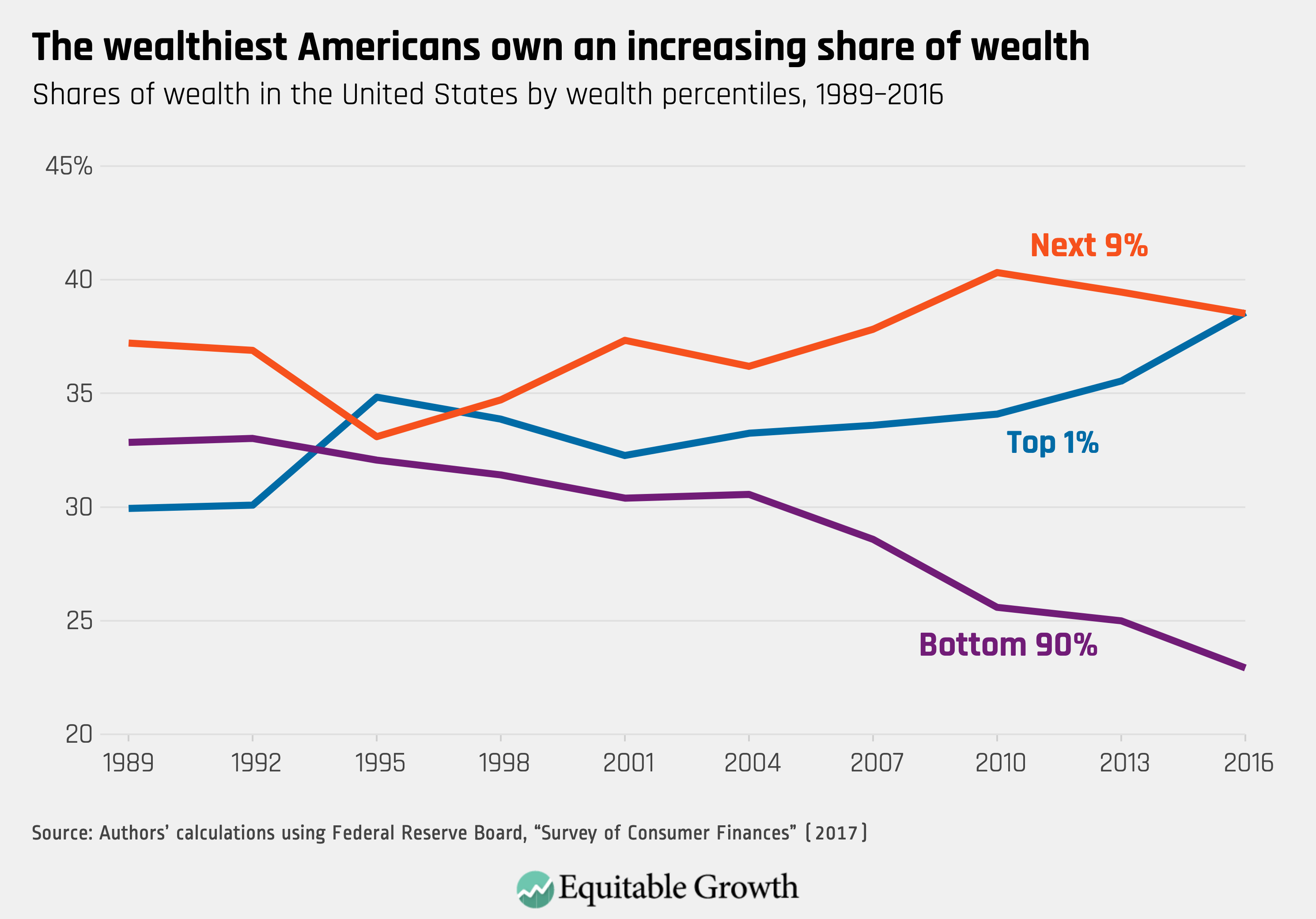
I think this is the type of graph I'm interested in. At what % should the various wealth deciles, say, be drawn?
Or, better asked, corralled?


You talking to me? I don't control things.


There is a lot of garbage numbers and economists with an agenda. This may come as a shock, but wealth is concentrated far less right now that other times in the country, and yet here we are all fat and happy, arguing about theoretical matters.

I guess having worked for governments and seen them in action, I don't think they automatically know what they are doing to be interfering whole heartedly in regulating the market beyond the basics of keeping people honest or health and safety regulation. I also agree with the role of the FED. I would point to the present administration in DC as a prime example of not knowing.

Unlike most here, I don't view wealth concentration as inherently evil. It can often reflects successful entrepreneurship, innovation, and value creation within a market economy and made the greater good better, and at the risk of backing evil tech types, I would say that is somewhat accurate today. However, at some point long term concentration can significantly harm economic growth, reduce social mobility, and wealth always distorts the democratic process. Don't ask me things like percentages, I don't know. So far a capitalistic approach has been a long term success in this country and so I lean for less intervention.


Yes, I was talking to you.
And yes, I know you don't control things.

You wrote
Quote:

This may come as a shock, but wealth is concentrated far less right now that other times in the country, and yet here we are all fat and happy, arguing about theoretical matters.

I didn't want to side step the topic by pointing out where it ranks historically.
I also didn't want to "argue". I did want to "explore" a topic theoretically. If you are not interested in doing so, that's okay if you decline. But I thought you might be able to participate.

No I debate the theoretical all the time here. Take the wealth tax as an example. I think it dies in the court system, but that doesn't stop me from debating. My concern was you phrased your questions and post like I was supposed to do something about wealth concentration or know the answers. You demanded I come up with a magic number where wealth concentration was not okay. Your tone was accusatory and personal.


I'm sorry you took me that way. I'll have to check my prose for self reflection.

I was trying to get you to submit an opinion on what levels you would design for society if you could be an architect for how society might best be structured.

I mean, isn't that what every politician ought be doing? And we all talk about politics here endlessly, so therefore, ought we all be striving for some ideals ?


Tom, why don't you give us your percentage of what exact level of wealth concentration is acceptable and why?
wifeisafurd
How long do you want to ignore this user?
socaltownie said:

dajo9 said:

concordtom said:

dajo9 said:

concordtom said:

dajo9 said:

concordtom said:

You definitely need the reward system to remain. It drives effort, innovation, production - all of it.

My thought has simply to change the reward structure. Culturally you could have a wall of honor where if you made so much, your wealth could then be used for various social purposes.

Like, rather than individuals continuing to amass more than is needed, ungodly sums, they could give to feed the hungry, to build homeless shelters, to retrain or rehabilitate, to provide needed healthcare.

Instead of being "hated" as you say they become revered and millions being grateful to them for their productivity.

The donors could choose which area they wanted to fund.

You could start either those who voluntarily give: Buffett and gates. Then make it a club that others want to join. Eventually the culture could change.

What do you give someone who has everything? Honor, praise, gratitude.

So many rich complain about taxation. But the state could create something that they might actually strive to have their name on.
Levels of lifetime taxes paid: wall of honor.

Elizabeth Warren plan just wants to take, and those targeted get nothing on the backside.
Warren et al want to demonize those targeted as "not paying their fair share". She's got it all wrong. Don't attack them. Make them want to join the exclusive club.


I disagree with your desire for us to be dependent on billionaire philanthropy.

And nobody is talking about getting rid of the reward system. It's not even part of the discussion.

Having billions of dollars even after paying a wealth tax is plenty of reward.


The entire republican attack on "wealth tax" and redistribution is entirely focused on claims that capitalism (and it's incumbent inherent reward system) is under attack in favor of socialism or communism.


Yes, well Republicans lie. I'm talking to you though , not Republicans.


It's an argument within myself own head I'm trying to sort out.

On the one hand, I believe in laizze-faire free enterprise (with exceptions for environmental degradation and safety regulations, off the top of my head). Capitalism.

On the other, there is this problem to do with societal illnesses regarding perceived wellbeing.
Yet, I wouldn't want any attempts at remedies to destroy the invisible hand or the engine of ingenuity or productivity.


The whole argument from the right is disingenuous. Bill Maher complains about socialism and points to South Korea and Poland as role models that rejected socialism. They both have universal healthcare and wouldn't dream of our more capitalist style of healthcare. Conservatives love to point at Margaret Thatcher as a bulwark against socialism. England had universal healthcare before, during, and after Thatcher. I think what American progressives want is the kind of not-socialism that England, South Korea, and Poland have.

Yeah. And that is because (I am not enough of a world traveler to know if a universal problem or a uniquely american) that socialism is used as a pejorative term in the US rather than a descriptive one.

A starting point would be that socialists believe in segments of the economy (your mileage will vary about which ones) should be under collective ownership. As DJO points out, many social-democratic states in the west believe that for basic healthcare (fun fact, we do to when it comes to health care for military veterans). In some cases they have segments of their banking sector under public ownership. Nearly every western country (including the US) has mass transit as a publicly owned service. Really that should be (I think ) distinct for how to PAY for it which varies tremendously. In some cases it is through high taxes on income. IN others it is through high taxes/revenues from natural resources which are owned by the public/as a public trust. Conflating policies and taxation and calling increasing taxes as "socialism" is just a way of the right demonizing revenue issues.

Most calls for public ownership of certain areas of the economy are when there are natural monopolies that make by competitors difficult. Usually also it is that those services are of such critical need that market failures would be costly.

And here is a thought exercise to show you that this isn't outside the norm. Even the most conservative people on this board - - do you want your water supply to be privately held by a purely unregulated utility? If not, why not and what does that say about your willingness to live with a little bit of socialism? And if you ARE comfortable what would that cost you in building in redudancies so the rapacious monopolist couldn't decide he likes your house and just arbitrarily cut your water off till you were forced to move.


Wait socialism where the government owns everything is not regulation. Really this is utter academic work play nonsense.

The problem in labeling arises because economists Picketty and company call themselves socialists (as opposed to Marxists) because tradtional capitalist economists were labelled as liberals (which as a completely different meaning politically). They generally do NOT argue for full state ownership or the abolition of private property. Instead, they desire potentially confiscatory 80% or more taxes to combat inequality. While acknowledging state ownership exists, they instead argue for state intervention and redistribution. Bear that in mind on my next post. The political side of this movement is people like Bernie Sanders, who again generally favors private ownership, but wants to massively redistribute wealth.
socaltownie
How long do you want to ignore this user?
wifeisafurd said:

socaltownie said:

dajo9 said:

concordtom said:

dajo9 said:

concordtom said:

dajo9 said:

concordtom said:

You definitely need the reward system to remain. It drives effort, innovation, production - all of it.

My thought has simply to change the reward structure. Culturally you could have a wall of honor where if you made so much, your wealth could then be used for various social purposes.

Like, rather than individuals continuing to amass more than is needed, ungodly sums, they could give to feed the hungry, to build homeless shelters, to retrain or rehabilitate, to provide needed healthcare.

Instead of being "hated" as you say they become revered and millions being grateful to them for their productivity.

The donors could choose which area they wanted to fund.

You could start either those who voluntarily give: Buffett and gates. Then make it a club that others want to join. Eventually the culture could change.

What do you give someone who has everything? Honor, praise, gratitude.

So many rich complain about taxation. But the state could create something that they might actually strive to have their name on.
Levels of lifetime taxes paid: wall of honor.

Elizabeth Warren plan just wants to take, and those targeted get nothing on the backside.
Warren et al want to demonize those targeted as "not paying their fair share". She's got it all wrong. Don't attack them. Make them want to join the exclusive club.


I disagree with your desire for us to be dependent on billionaire philanthropy.

And nobody is talking about getting rid of the reward system. It's not even part of the discussion.

Having billions of dollars even after paying a wealth tax is plenty of reward.


The entire republican attack on "wealth tax" and redistribution is entirely focused on claims that capitalism (and it's incumbent inherent reward system) is under attack in favor of socialism or communism.


Yes, well Republicans lie. I'm talking to you though , not Republicans.


It's an argument within myself own head I'm trying to sort out.

On the one hand, I believe in laizze-faire free enterprise (with exceptions for environmental degradation and safety regulations, off the top of my head). Capitalism.

On the other, there is this problem to do with societal illnesses regarding perceived wellbeing.
Yet, I wouldn't want any attempts at remedies to destroy the invisible hand or the engine of ingenuity or productivity.


The whole argument from the right is disingenuous. Bill Maher complains about socialism and points to South Korea and Poland as role models that rejected socialism. They both have universal healthcare and wouldn't dream of our more capitalist style of healthcare. Conservatives love to point at Margaret Thatcher as a bulwark against socialism. England had universal healthcare before, during, and after Thatcher. I think what American progressives want is the kind of not-socialism that England, South Korea, and Poland have.

Yeah. And that is because (I am not enough of a world traveler to know if a universal problem or a uniquely american) that socialism is used as a pejorative term in the US rather than a descriptive one.

A starting point would be that socialists believe in segments of the economy (your mileage will vary about which ones) should be under collective ownership. As DJO points out, many social-democratic states in the west believe that for basic healthcare (fun fact, we do to when it comes to health care for military veterans). In some cases they have segments of their banking sector under public ownership. Nearly every western country (including the US) has mass transit as a publicly owned service. Really that should be (I think ) distinct for how to PAY for it which varies tremendously. In some cases it is through high taxes on income. IN others it is through high taxes/revenues from natural resources which are owned by the public/as a public trust. Conflating policies and taxation and calling increasing taxes as "socialism" is just a way of the right demonizing revenue issues.

Most calls for public ownership of certain areas of the economy are when there are natural monopolies that make by competitors difficult. Usually also it is that those services are of such critical need that market failures would be costly.

And here is a thought exercise to show you that this isn't outside the norm. Even the most conservative people on this board - - do you want your water supply to be privately held by a purely unregulated utility? If not, why not and what does that say about your willingness to live with a little bit of socialism? And if you ARE comfortable what would that cost you in building in redudancies so the rapacious monopolist couldn't decide he likes your house and just arbitrarily cut your water off till you were forced to move.


Wait socialism where the government owns everything is not regulation. Really this is utter academic work play nonsense.

The problem in labeling arises because economists Picketty and company call themselves socialists (as opposed to Marxists) because tradtional capitalist economists were labelled as liberals (which as a completely different meaning politically). They generally do NOT argue for full state ownership or the abolition of private property. Instead, they desire potentially confiscatory 80% or more taxes to combat inequality. While acknowledging state ownership exists, they instead argue for state intervention and redistribution. Bear that in mind on my next post. The political side of this movement is people like Bernie Sanders, who again generally favors private ownership, but wants to massively redistribute wealth.

If we allow that terminology then Eisenhower was a socialist. Nixon was a socialist. FDR was a socialist because all three at times called for extremely high taxes and all noted challenges with the concentration of wealth. That is why it isn't word games at ALL because if everyone is "something" than no one is.

That is why public ownership feels like the right thing to FIRST start debating. What services should be delivered by the market and which should not?

With that framing we can move to a second question, what regulations should be applied in what markets and why?

And then a third question, given 1 and 2 who should pay and how?

Keeping those things seperate rather than conflated is critical. Because otherwise we start calling people socialists (or letting themselves call themselves socialist) not to debate but to silence because of the baggage (thanks cold war) that carreis.

For example, I am fairly libertarian when it comes to public services. Esepcially at the state and local level I want government to get out of things it shouldnt be in. I am also fairly skeptical of lots of regulations, which have become veto gates and the areas where interest groups lock in incumbent advantage.

However, I am all in favor of confiscatory levels of especially inheritance taxes because while Enlighted oligarchs give it all away and make their kids work there are WAY too many nepo babies out there which are not additive but drags on the economy.

Calling me a socialist because I think the Walton grandkids haven't really shown a track record of enlightened entrepreneurship or public stewardship is both meaningless and also just a way of defending the Kronke's and Spanoses of the world. Screw that.

Take care of your Chicken
wifeisafurd
How long do you want to ignore this user?
dajo9 said:

socaltownie said:

Slammed at work today so not a ton of BI time now that in the office but I just want to point out that MOST US criticism of billionaires (not all but most) focuses not on a belief that the state is better but that the current crop of billionaires (and the structure of the economy stiffles, not enhances) competition. That again is a criticism heard during the gilded age.

Example?

Amazon third party resellers. Like farmers being squeezed by robber barons these small entrepreneurs are subject to the monopoly pricing of amazon and its "legal" ability to swoop in, after market interest has been established, and price in a predatory fashion. If, after driving out the competition from the platform, it decides that it wants to be the monopoly seller in that space it simply restricts new entrants. That isn't capitalism in a free market sense but the worst of what we saw in the 19th century.

Much like that time I expect a progressive backlash. But that isn't socialism (which, funny, was the charge the robber barons leveled at progressives in the 19th century) but rather a sophsticated understanding that in some markets there is a natural tendency toward monopoly and that the state power isn't to seize assests but to open up markets for more robust private sector competition.


Good point. Healthcare for all Americans would be a great way to bust open the entrepreneurial spirit. Many people stay chained to bosses because they need the healthcare.

I endorse this post. As someone in a small business, if there was one change I would make...
wifeisafurd
How long do you want to ignore this user?
socaltownie said:

Again - not a lot of time but Gini coefficients can be used to measure EITHER the distribution of wealth or income. It is just math and data sets. I would agree that it is important not to mix apples and oranges. the fed study didn't and looked just at wealth.

NOT opining on the study - just the independent variable but here is a recent article on Gini WEALTH coefficients.

https://www.sciencedirect.com/science/article/pii/S0305750X25003365

And here is the data set/analysis fueling a few of the op eds recently about the .001%

https://www.federalreserve.gov/releases/z1/dataviz/dfa/index.html

And here is a popular article that argues that todays wealth concentrattion exceeds that of the gilded age. Haven't dug into methods to see if flawed.

https://finance.yahoo.com/news/super-richs-wealth-concentration-surpasses-gilded-age-levels-210802327.html?guccounter=1&guce_referrer=aHR0cHM6Ly93d3cuZ29vZ2xlLmNvbS8&guce_referrer_sig=AQAAAJp8gOVKdS8XAYHSsHEiTWeJEgux6f4DCsm3Uu4zGOa-9p8xiQzIX3qNK-vX30RkrY5ELOzcxO6heg_gZkEJ2aU24LQaJX-MIbU-mIrQGi3ZIMK98fAouWrT1K9PLW5XH65ADGQdkJkrw1f6kKIWgaeD5Z2mTRquEdhjjCe3cPB4

Cites and sources important. And no, op eds by bloggers don't count ;-)

The bottom line for me is the use of a flawed Gini income or wealth index to justify a wealth tax which penalizes and discourages the wealthy from living in CA. On a higher level, at least in theory, socialist economists and on the political level propagandists, improperly use the flawed Gini index to justify a whole range of interventions in the economy, without any thought to consequences thereof. In particular there is a cult of politicians and media (and people on chat boards) that often use Gini figures without realizing their historic numbers do not derive from any data, to fit specific narratives (I have done it). And why the differences between indexes on wealth concentration over time? Because there is no data and so you have to make-up data by modeling making the results subjective and designed to support a political narrative. You tell me what actual data exists from the late 1800s to measure wealth?

The Gini coefficient is by far the most popular measure of economic inequality and is often used to inform policy debates and to justify political decisions. Reasons for the widespread use of the Gini coefficient include its ease of interpretation since it is based on simplified data collection and the expense of accuracy, and access, as many political, governmental and research sources across the world use this summary statistic regularly. This could potentially result in a self-sustaining loop: because of the widespread availability of the Gini coefficient, researchers frequently use this inequality measure in their work; this may lead statistics bureaus to continue providing this measure to researchers instead of exploring potential alternative or additional inequality measures. The widespread prevalence of the Gini coefficient may even give the impression that this measure is the only or best way to capture inequality, However there are mixed results using Gini wealth coefficient to that result in questionable and contradictory outcomes. There are both data and technical issues which I discuss in another post (warning nerd alert). For example, studies using Gini wealth index have found that the relationship between economic inequality and obesity is both positive or negative. These contradicting findings in part stem from a predominant focus on the Gini coefficient without appreciating the index has known technical and data defects. And using Gini coefficients for comparisons to many years ago is a fools errand, as will be discussed.

Most non-socialist economists dislike the Gini index. There are many economic studies that reach far less wealth concentration growth than Gini (like 50% of what Gini wealth says).

Auten and Splinter, "Income Inequality";
Reynolds, "Optimal Top Tax Rates";
Early, "Reassessing the Facts about Inequality, Poverty, and Redistribution,"
Matthew Smith, Owen Zidar, and Eric Zwick, "Top Wealth in the United States: New Estimates and Implications for Taxing the Rich," July 19, 2019.
Auten and Splinter, "Income Inequality in the United States: Using Tax Data to Measure Long-Term Trends,"

To the extent you believe wealth inequality is a useful measure by examining Gini coefficients (which I doubt) and you believe there is too much wealth concentration, you need to explain why GINI wealth inequality is estimated to be high in the United States with a Gini coefficient of 85 and on the other hand, poor countries have much lower Gini coefficients, such as Ethiopia (61), Mynamar (58), and Pakistan (65). Candidly no one on this board wants to live in countries with lower Gini numbers. Countries with higher GINI such as the United States offer more opportunities and higher living standards. After China began adopting market reforms in the 1970s, its economy boomed and hundreds of millions of people lifted themselves out of poverty. One obvious (to me at least) result is that China's Gini coefficient (both income and wealth) is now getting high as the standard of living overall improves. Go figure. The Gini coefficients for many countries are probably not very accurate as Gailbrath suggests (see the other post), but nonetheless the data does not support the idea that wealth inequality is bad for general prosperity.

Just to share the conservative take, at least on self-made (as opposed to inherited wealth) people like Jobs, Musk and Gates make the pie larger (actually their companies do), as have many wealthy Americans. Market economies are positive sum, not negative sum. The billions of market transactions that take place every day are voluntary and thus mutually beneficialbuyers and sellers each gain value. Entrepreneurs who become wealthy have essentially found ways to generate more transactions and create wealth (for you classical liberal economist types, think of multipliers). They expanded the pie so they and everyone benefitted. Seems overly simple, but I have now made full disclosure.

The reality is that unless California address core issues regarding taxing imbalance, spending levels and priorities and its hostility against business and people who own business, it will be left with taxing an ever decreasing number of wealthy individuals and corporations, who will eventually either cease generating taxable wealth or who will move on elsewhere. Governments here cannot generate income to address these issues other than through taxes. Hence California will continue to borrow money at an unsustainable rate as its tax base decreases and try to cure deficits by imposing more taxes. The seemingly unpalatable consequence of this is that you may have to accept that you need to reign in spending at some point, make massive cuts to government and have a greater portion of your population actually pay taxes. The alternative is to acknowledge that you need the skills, expertise, spending, and capital of the wealthy, and make the State once again attractive for them to live in.

concordtom
How long do you want to ignore this user?
wifeisafurd said:

concordtom said:

wifeisafurd said:

concordtom said:

wifeisafurd said:

concordtom said:

wifeisafurd said:

concordtom said:

Ask Wife his opinion on reining in excess with disparities.

I think the State tax will be ineffective, and hurt CA's economy. I'm not sure it is legal. it is pretty clear from the standpoint of successful people this is the only the beginning with CA dramatically increasing spending despite having huge deficits. There will be more of these taxes and down to lower income or wealth levels. With a State this fiscally irresponsible, and funding political donor causes, such as the trains to nowhere, and not willing to adequately fund more basic government functions like education, there will be more initiatives to pay for these functions, and a declining tax base to pay them from. That is because when wealthy people do leave the State to become tax refugees, they take their business with them over time. First is the higher paid employees as the top level as headquarters move, but ultimately is the core business as well. What Musk did is being repeated. Just look where Spielberg will be doing his work in the future. It no longer is a blue verses red. The biggest beneficiaries of the tax are developers in Nevada, Texas, Florida, etc. and if I was Blue Herron and Four Seasons (residential division), I would be secretly pumping money to support these initiatives. Whey you are in real estate, you can see the trends before the media. As an example, the high end development in Henderson is exploding. There is a long waiting list of Washington tax refugees to get in on the Four Seasons Residences. Both capital and people go where it is best, based on financial decisions, not rhetoric.

As for a wealth tax at the federal level, this has been litigated here for some time. It is not going to happen politically. If the wealth tax did become law, it will found to be unconstitutional, and the process for an amendment likely will be decades. The alternative is increasing income tax rates, but the economically illiterate don't seem to understand that the super-wealthy generally have arranged their affairs to have little taxable income.

If you want to tax wealth in this country, you need to tax assets such as property, toys (e,g., yachts), etc. which typically is done on a state level. I suspect that people sorta shrugged at Dajo's post, but if you understand taxes, that probably is the most effective way to tax the wealthy.

If you look at tax policies they are based on income taxes, and they are designed to achieve political objectives, like incentives to provide for electric cars. That all goes to crap when you impose these broad overall taxes. Newsom probably says this a lot better than me, but the approach on this poorly drafted CA tax proposal is counter-productive. That also is another discussion.

I also question if demonizing and going after successful people will be in the long run good for the country's overall success. But that also is a different discussion.

I'm not sure much debating on this subject is productive. People here have their own views based on rhetoric and narrative, without a much understanding of the economic impacts of taxation.


Thx for your words.
I AM actually interested.
Each time we discuss this you tell me why it wouldn't work and such. And that's all fine.
But I'm asking your opinion on wealth aggregating in the hands of "the successful" as you phrased it.

I'm all for people becoming super rich. (I come from the self made super rich myself.) I'm concerned that this is not a great development for society. As you often point out, it's easy to hide income and keep growing wealth - so long as one pays attention and is not a spendthrift.

But what are the consequences, nationally? Culturally? Economically?

I want to know if you think we should just let natural forces continue, laizze-faire, or if we actively say no to that and actually want to curb natural forces wealth concentration.

I know you'll say, "we already have intervention in that, via the IRS "
But concentration is increasing. Do you care? At which level should the ideal social engineer step in?


I think this is the type of graph I'm interested in. At what % should the various wealth deciles, say, be drawn?
Or, better asked, corralled?


You talking to me? I don't control things.


There is a lot of garbage numbers and economists with an agenda. This may come as a shock, but wealth is concentrated far less right now that other times in the country, and yet here we are all fat and happy, arguing about theoretical matters.

I guess having worked for governments and seen them in action, I don't think they automatically know what they are doing to be interfering whole heartedly in regulating the market beyond the basics of keeping people honest or health and safety regulation. I also agree with the role of the FED. I would point to the present administration in DC as a prime example of not knowing.

Unlike most here, I don't view wealth concentration as inherently evil. It can often reflects successful entrepreneurship, innovation, and value creation within a market economy and made the greater good better, and at the risk of backing evil tech types, I would say that is somewhat accurate today. However, at some point long term concentration can significantly harm economic growth, reduce social mobility, and wealth always distorts the democratic process. Don't ask me things like percentages, I don't know. So far a capitalistic approach has been a long term success in this country and so I lean for less intervention.


Yes, I was talking to you.
And yes, I know you don't control things.

You wrote
Quote:

This may come as a shock, but wealth is concentrated far less right now that other times in the country, and yet here we are all fat and happy, arguing about theoretical matters.

I didn't want to side step the topic by pointing out where it ranks historically.
I also didn't want to "argue". I did want to "explore" a topic theoretically. If you are not interested in doing so, that's okay if you decline. But I thought you might be able to participate.

No I debate the theoretical all the time here. Take the wealth tax as an example. I think it dies in the court system, but that doesn't stop me from debating. My concern was you phrased your questions and post like I was supposed to do something about wealth concentration or know the answers. You demanded I come up with a magic number where wealth concentration was not okay. Your tone was accusatory and personal.


I'm sorry you took me that way. I'll have to check my prose for self reflection.

I was trying to get you to submit an opinion on what levels you would design for society if you could be an architect for how society might best be structured.

I mean, isn't that what every politician ought be doing? And we all talk about politics here endlessly, so therefore, ought we all be striving for some ideals ?


Tom, why don't you give us your percentage of what exact level of wealth concentration is acceptable and why?


Well, gosh, you'll be the first person to point out that I'm nothing more than a simpleton online hack with an oversized opinion of things, so I might as well give it a knee jerk response as if I were exactly that! I've got nothing to lose here, right?
Anonymity has its advantages!

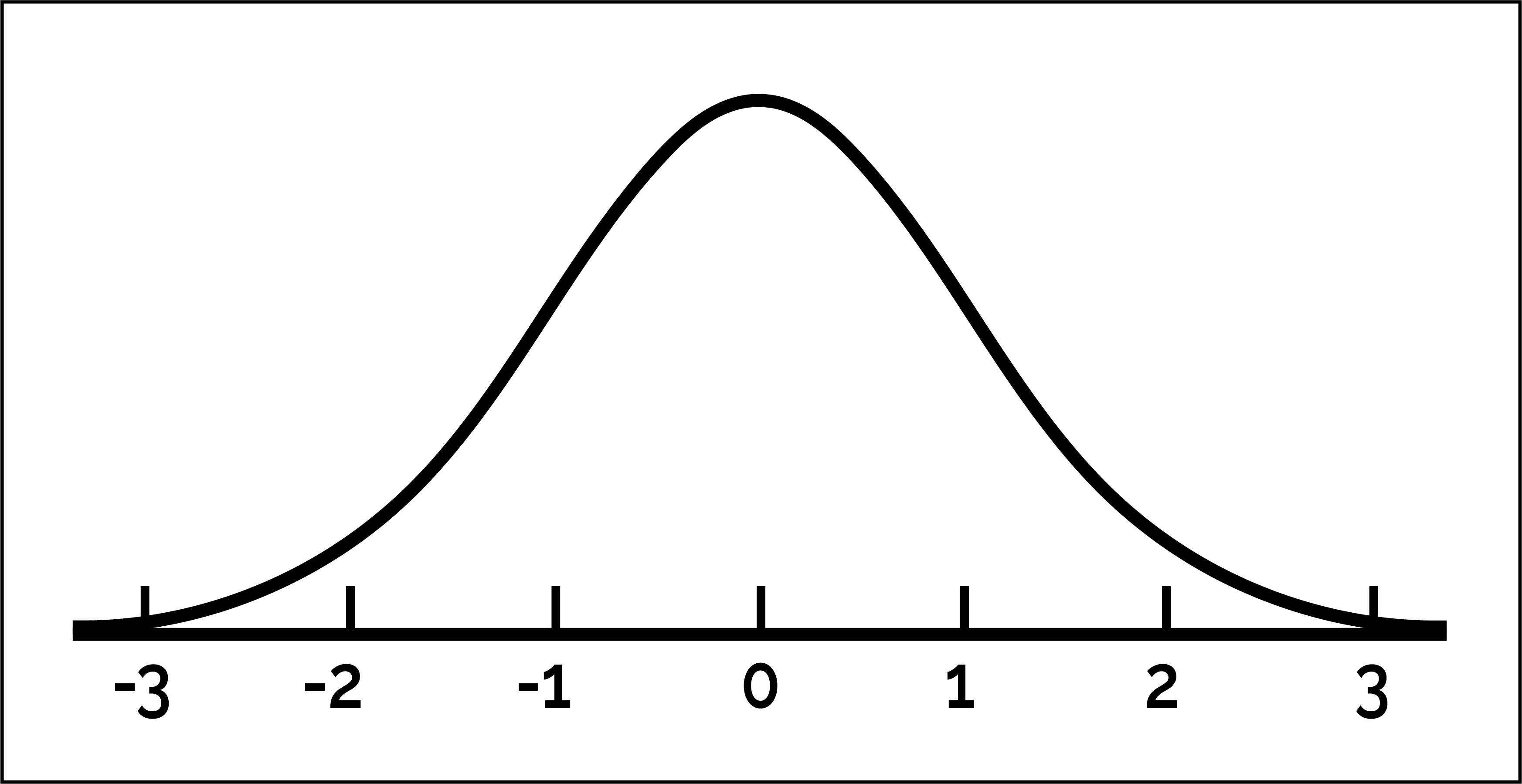
So, I first imagined here in my 5 AM brain of a normal distribution curve showing wealth distributed evenly. I was taught in school that a large middle class makes the strongest economy and society.


In the above distribution, y axis is # of people, x is wealth owned with the middle point being average. Standard deviations 1/2/3 on either side of average with fewer and fewer people straying from average.

That was a starting point to shape my thinking.

Now, we all know that's not the actual distribution. I found the following resources to help see where we are at:


2010 U.S. family wealth distribution (bars) and normal curve (dotted).


https://skepticsplay.blogspot.com/2011/04/wealth-distribution-model.html?m=1


Look, clearly I AM an online hack and not a professional policymaker. But I think the first thing for any of us to do here (and I suppose that's what I was hoping to get out of you) is to admit that this currently is way out of whack!

I have some very wealthy people in my family, and when we get together at various occasions I hear a lot of the same types of lines as I've read you type:

"I'm paying the same taxes as 'x' thousands of other people."

"We need everyone to pay their fair share! So many don't pay any taxes!"

"I'm going to move to (Arizona, Texas, Florida, Tennessee) so I don't have to pay any state taxes."

Hell, I get it!
Self interest!
And I'm self-interested, too! I want it all, too.

But I think if any of us step back and consider the actual wealth distribution curves, we can see that the society we have is kinda flocked up.

We've gone WAY beyond the extremes of rewarding the most talented among us.


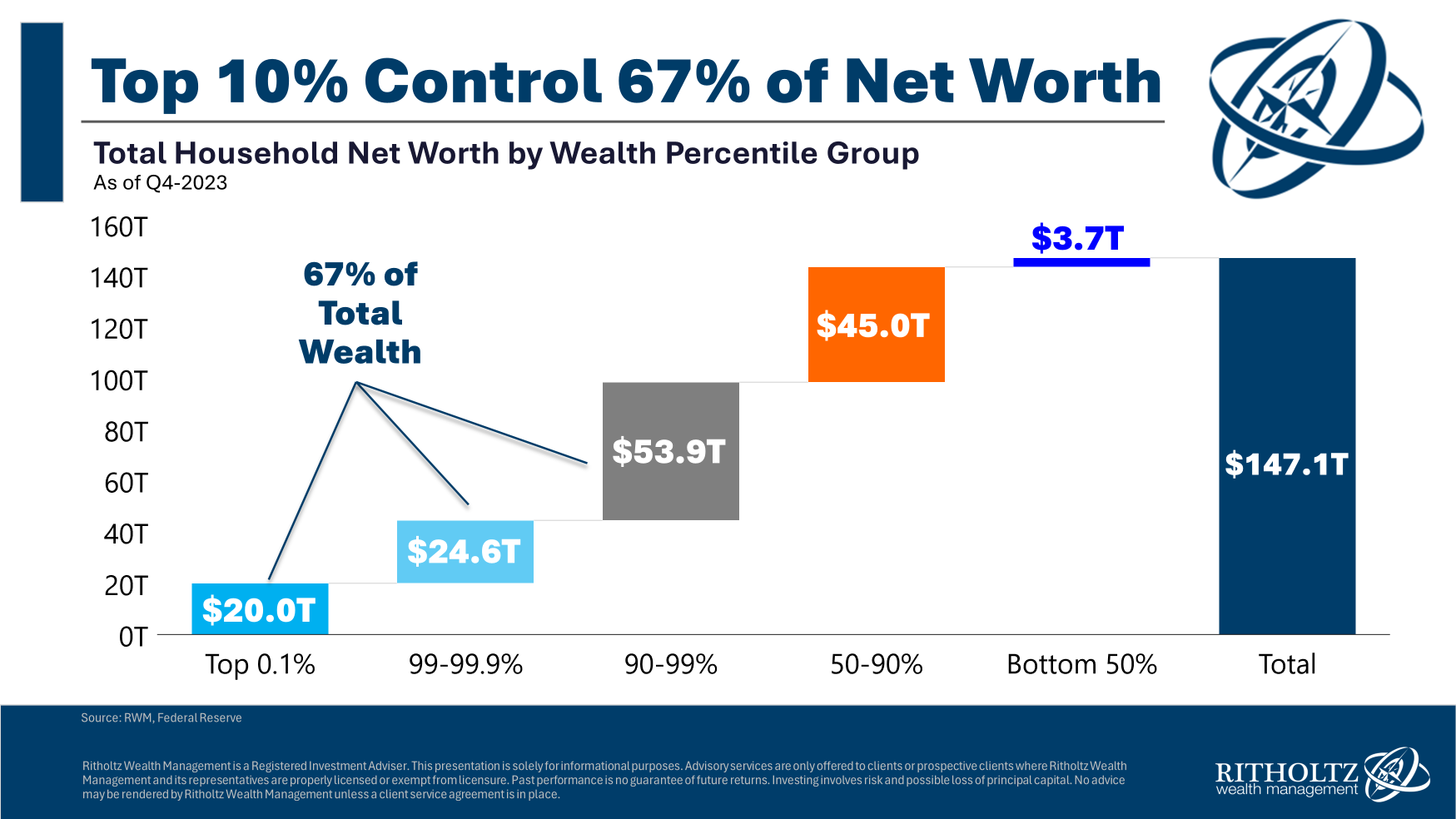
(AI added info: As of early 2026, the top 1% of households in the United States control approximately 31.7% of the nation's wealth, totaling over $55 trillion, which marks the highest concentration since World War II. Globally, the top 1% own 43% of financial assets, and in some metrics, own more wealth than the bottom 95% of humanity.)

I think we can do better to leave a better planet behind after our temporary stay on this sphere.


And I'll extend to another thought - the repercussions!
One repercussion is how the outsized wealth at the top translates to policy creation. I rail on it ALL THE TIME!!!

The landmark Citizens United case says a corporation has a voice in democracy and can donate an unlimited quantity of dollars to political campaigns - something which is restricted for individuals.

Well, companies are controlled by individuals. And as we saw in the video above, VERY few individuals control the lion's share of assets. We also know that dollars buys advertising and that ADVERTISING WORKS.

So, the result is that very few people control the political agenda, whether that's ta action policy or planet choking drill baby drill and wars to protect their special interests.

But I'm digressing, so I'll shut up for now.
bearister
How long do you want to ignore this user?
Jackson, Wyo., has long been a refuge for the rich. But the last five years saw a boom in wealth of a kind never before seen. Across the country, the 2017 tax cuts minted hundreds of new billionaires.

https://www.nytimes.com/2026/03/02/us/billionaire-boom-jackson-teton-wyoming.html?smid=em-share

*Great article but paywalled
Cancel my subscription to the Resurrection
Send my credentials to the House of Detention
I got some friends inside

“I love Cal deeply, by the way, what are the directions to The Portal from Sproul Plaza?”
wifeisafurd
How long do you want to ignore this user?
concordtom said:

wifeisafurd said:

concordtom said:

wifeisafurd said:

concordtom said:

wifeisafurd said:

concordtom said:

wifeisafurd said:

concordtom said:

Ask Wife his opinion on reining in excess with disparities.

I think the State tax will be ineffective, and hurt CA's economy. I'm not sure it is legal. it is pretty clear from the standpoint of successful people this is the only the beginning with CA dramatically increasing spending despite having huge deficits. There will be more of these taxes and down to lower income or wealth levels. With a State this fiscally irresponsible, and funding political donor causes, such as the trains to nowhere, and not willing to adequately fund more basic government functions like education, there will be more initiatives to pay for these functions, and a declining tax base to pay them from. That is because when wealthy people do leave the State to become tax refugees, they take their business with them over time. First is the higher paid employees as the top level as headquarters move, but ultimately is the core business as well. What Musk did is being repeated. Just look where Spielberg will be doing his work in the future. It no longer is a blue verses red. The biggest beneficiaries of the tax are developers in Nevada, Texas, Florida, etc. and if I was Blue Herron and Four Seasons (residential division), I would be secretly pumping money to support these initiatives. Whey you are in real estate, you can see the trends before the media. As an example, the high end development in Henderson is exploding. There is a long waiting list of Washington tax refugees to get in on the Four Seasons Residences. Both capital and people go where it is best, based on financial decisions, not rhetoric.

As for a wealth tax at the federal level, this has been litigated here for some time. It is not going to happen politically. If the wealth tax did become law, it will found to be unconstitutional, and the process for an amendment likely will be decades. The alternative is increasing income tax rates, but the economically illiterate don't seem to understand that the super-wealthy generally have arranged their affairs to have little taxable income.

If you want to tax wealth in this country, you need to tax assets such as property, toys (e,g., yachts), etc. which typically is done on a state level. I suspect that people sorta shrugged at Dajo's post, but if you understand taxes, that probably is the most effective way to tax the wealthy.

If you look at tax policies they are based on income taxes, and they are designed to achieve political objectives, like incentives to provide for electric cars. That all goes to crap when you impose these broad overall taxes. Newsom probably says this a lot better than me, but the approach on this poorly drafted CA tax proposal is counter-productive. That also is another discussion.

I also question if demonizing and going after successful people will be in the long run good for the country's overall success. But that also is a different discussion.

I'm not sure much debating on this subject is productive. People here have their own views based on rhetoric and narrative, without a much understanding of the economic impacts of taxation.


Thx for your words.
I AM actually interested.
Each time we discuss this you tell me why it wouldn't work and such. And that's all fine.
But I'm asking your opinion on wealth aggregating in the hands of "the successful" as you phrased it.

I'm all for people becoming super rich. (I come from the self made super rich myself.) I'm concerned that this is not a great development for society. As you often point out, it's easy to hide income and keep growing wealth - so long as one pays attention and is not a spendthrift.

But what are the consequences, nationally? Culturally? Economically?

I want to know if you think we should just let natural forces continue, laizze-faire, or if we actively say no to that and actually want to curb natural forces wealth concentration.

I know you'll say, "we already have intervention in that, via the IRS "
But concentration is increasing. Do you care? At which level should the ideal social engineer step in?


I think this is the type of graph I'm interested in. At what % should the various wealth deciles, say, be drawn?
Or, better asked, corralled?


You talking to me? I don't control things.


There is a lot of garbage numbers and economists with an agenda. This may come as a shock, but wealth is concentrated far less right now that other times in the country, and yet here we are all fat and happy, arguing about theoretical matters.

I guess having worked for governments and seen them in action, I don't think they automatically know what they are doing to be interfering whole heartedly in regulating the market beyond the basics of keeping people honest or health and safety regulation. I also agree with the role of the FED. I would point to the present administration in DC as a prime example of not knowing.

Unlike most here, I don't view wealth concentration as inherently evil. It can often reflects successful entrepreneurship, innovation, and value creation within a market economy and made the greater good better, and at the risk of backing evil tech types, I would say that is somewhat accurate today. However, at some point long term concentration can significantly harm economic growth, reduce social mobility, and wealth always distorts the democratic process. Don't ask me things like percentages, I don't know. So far a capitalistic approach has been a long term success in this country and so I lean for less intervention.


Yes, I was talking to you.
And yes, I know you don't control things.

You wrote
Quote:

This may come as a shock, but wealth is concentrated far less right now that other times in the country, and yet here we are all fat and happy, arguing about theoretical matters.

I didn't want to side step the topic by pointing out where it ranks historically.
I also didn't want to "argue". I did want to "explore" a topic theoretically. If you are not interested in doing so, that's okay if you decline. But I thought you might be able to participate.

No I debate the theoretical all the time here. Take the wealth tax as an example. I think it dies in the court system, but that doesn't stop me from debating. My concern was you phrased your questions and post like I was supposed to do something about wealth concentration or know the answers. You demanded I come up with a magic number where wealth concentration was not okay. Your tone was accusatory and personal.


I'm sorry you took me that way. I'll have to check my prose for self reflection.

I was trying to get you to submit an opinion on what levels you would design for society if you could be an architect for how society might best be structured.

I mean, isn't that what every politician ought be doing? And we all talk about politics here endlessly, so therefore, ought we all be striving for some ideals ?


Tom, why don't you give us your percentage of what exact level of wealth concentration is acceptable and why?


Well, gosh, you'll be the first person to point out that I'm nothing more than a simpleton online hack with an oversized opinion of things, so I might as well give it a knee jerk response as if I were exactly that! I've got nothing to lose here, right?
Anonymity has its advantages!

So, I first imagined here in my 5 AM brain of a normal distribution curve showing wealth distributed evenly. I was taught in school that a large middle class makes the strongest economy and society.


In the above distribution, y axis is # of people, x is wealth owned with the middle point being average. Standard deviations 1/2/3 on either side of average with fewer and fewer people straying from average.

That was a starting point to shape my thinking.

Now, we all know that's not the actual distribution. I found the following resources to help see where we are at:


2010 U.S. family wealth distribution (bars) and normal curve (dotted).


https://skepticsplay.blogspot.com/2011/04/wealth-distribution-model.html?m=1


Look, clearly I AM an online hack and not a professional policymaker. But I think the first thing for any of us to do here (and I suppose that's what I was hoping to get out of you) is to admit that this currently is way out of whack!

I have some very wealthy people in my family, and when we get together at various occasions I hear a lot of the same types of lines as I've read you type:

"I'm paying the same taxes as 'x' thousands of other people."

"We need everyone to pay their fair share! So many don't pay any taxes!"

"I'm going to move to (Arizona, Texas, Florida, Tennessee) so I don't have to pay any state taxes."

Hell, I get it!
Self interest!
And I'm self-interested, too! I want it all, too.

But I think if any of us step back and consider the actual wealth distribution curves, we can see that the society we have is kinda flocked up.

We've gone WAY beyond the extremes of rewarding the most talented among us.


(AI added info: As of early 2026, the top 1% of households in the United States control approximately 31.7% of the nation's wealth, totaling over $55 trillion, which marks the highest concentration since World War II. Globally, the top 1% own 43% of financial assets, and in some metrics, own more wealth than the bottom 95% of humanity.)

I think we can do better to leave a better planet behind after our temporary stay on this sphere.


And I'll extend to another thought - the repercussions!
One repercussion is how the outsized wealth at the top translates to policy creation. I rail on it ALL THE TIME!!!

The landmark Citizens United case says a corporation has a voice in democracy and can donate an unlimited quantity of dollars to political campaigns - something which is restricted for individuals.

Well, companies are controlled by individuals. And as we saw in the video above, VERY few individuals control the lion's share of assets. We also know that dollars buys advertising and that ADVERTISING WORKS.

So, the result is that very few people control the political agenda, whether that's ta action policy or planet choking drill baby drill and wars to protect their special interests.

But I'm digressing, so I'll shut up for now.

Well no where in that rambling whatever that was did I hear you indicate what was the top number of wealth concentration you think is unacceptable and why. Instead you posted a standard deviation curve and some propagandist inaccurate podcast. I'm not exactly sure of the points you are trying to make. But I will give you mine again:

The standard wealth concentration index used by propagandists is outdated and discredited and a lot of economists disagree with using it and many econometric studies come-up with very different numbers on the overall far less levels of wealth concentration (though they do show more concentration in recent years). I already cited just a few of those studies already. I will go into more details when I have time.

I don't view wealth concentration as a popularity contest like the podcast seems to think. I don't necessarily feel it is bad. To be repetitive, wealth inequality is estimated to be high in the United States and other wealthy countries and on the other hand, poor countries generally have much lower wealth concentration; although a lot famous economists think the country to country numbers are garbage. No one on this board wants to live in countries with lower wealth concentrations. Countries with high wealth concentrations, such as the United States offer more opportunities and higher living standards. After China began adopting market reforms in the 1970s, its economy boomed and hundreds of millions of people lifted themselves out of poverty. One obvious (to me at least) result is that China now finds itself with what you would call a wealth concentration problem. There is no data that support the idea that higher wealth inequality by itself is bad for general prosperity. In economic theory some level of wealth concentration creates bad outcomes, and you can ask yourself, no doubt using rigorous analysis (sarcasm intended), what that level would be, but I'm not expert enough to tell you. I asked you tell me what was not acceptable to you and I can't even begin to decipher what you said, but I do know that you didn't indicate what that level would be and why.

As to your comments about your rich relatives, in a free market system, both capital and people with wealth go where it is best, based primarily on financial decisions, not rhetoric or what some random classroom of undergrad students at Harvard thinks.


prospeCt
How long do you want to ignore this user?
https://www.sfchronicle.com/california/article/billionaire-tax-emmanuel-saez-21945946.php
concordtom
How long do you want to ignore this user?
Sigh.
You're a hard one, you know that?

Neither of us is going to give a number of, say "27.8 percent!" Because we are not pros.

But I think it's fair to say the current curve is not ideal.

You ripped on the video, but do you dispute its claims ? You seem to want to NOT state an opinion where I want you to by discrediting data. Like, "I don't have to answer that, your data is bad."

Similarly, you've sidestepped the query by saying "nobody wants to live in a shothole country where everyone is poor."

I'd be more impressed if you posited:
"Immense wealth gives people a vision which then drives them to innovate and achieve. Where there is no immense wealth, everyone accepts the standard and things continue as normal - subsistence."

I don't need you to go get data.
I'm looking at this:

Are you comfortable being served by people who make pennies while you sit back being served spending thousands?

I'm not.
I like to be an everyday man.
I'll roll up my sleeves and work alongside folks. I get uncomfortable when I've traveled to poor places and had them fawn over me as a rich westerner. It's depressing.

There, we take turns.
Now you can rip on me for a post or two.

Hahaha.
I mean no offense. I just… I don't like the arrogance of the rich. They think they are so much better than others that they deserve it and get real comfortable with it. They then formulate theories about their superiority, see Ayn Rand and her self centered philosophy.

In my mind, life hinges an awful lot of random chance that none of us have anything to do with, whether positive or negative.

What dna did you acquire?
What household were you raised in?
What schooling did you have?
What year were you born?
What country?
What paraplegic accidents did you narrowly avoid?
Who are the randomly influential people on your life?

Conscious brain vs subconscious brain - most of us has little to do with the prefrontal cortex decisions we made. Most of you, me, each one of us, is the result of stuff we had no control over.

Therefore, I'd expect humility and a giving spirit. But so many of the rich (you can speak for yourself - I'm not accusing you here) get very full of themselves and think they are special.

And I'm not a fan of that.


Maybe that will explain a bit more about me and where I'm coming from. You can take my words not as an attack on you, but as me explaining myself.

Still don't want to live in an impoverished country - and yes, the rich CAN choose to move to wherever they want.
HKBear97!
How long do you want to ignore this user?
wifeisafurd said:

socaltownie said:

Again - not a lot of time but Gini coefficients can be used to measure EITHER the distribution of wealth or income. It is just math and data sets. I would agree that it is important not to mix apples and oranges. the fed study didn't and looked just at wealth.

NOT opining on the study - just the independent variable but here is a recent article on Gini WEALTH coefficients.

https://www.sciencedirect.com/science/article/pii/S0305750X25003365

And here is the data set/analysis fueling a few of the op eds recently about the .001%

https://www.federalreserve.gov/releases/z1/dataviz/dfa/index.html

And here is a popular article that argues that todays wealth concentrattion exceeds that of the gilded age. Haven't dug into methods to see if flawed.

https://finance.yahoo.com/news/super-richs-wealth-concentration-surpasses-gilded-age-levels-210802327.html?guccounter=1&guce_referrer=aHR0cHM6Ly93d3cuZ29vZ2xlLmNvbS8&guce_referrer_sig=AQAAAJp8gOVKdS8XAYHSsHEiTWeJEgux6f4DCsm3Uu4zGOa-9p8xiQzIX3qNK-vX30RkrY5ELOzcxO6heg_gZkEJ2aU24LQaJX-MIbU-mIrQGi3ZIMK98fAouWrT1K9PLW5XH65ADGQdkJkrw1f6kKIWgaeD5Z2mTRquEdhjjCe3cPB4

Cites and sources important. And no, op eds by bloggers don't count ;-)

The bottom line for me is the use of a flawed Gini income or wealth index to justify a wealth tax which penalizes and discourages the wealthy from living in CA. On a higher level, at least in theory, socialist economists and on the political level propagandists, improperly use the flawed Gini index to justify a whole range of interventions in the economy, without any thought to consequences thereof. In particular there is a cult of politicians and media (and people on chat boards) that often use Gini figures without realizing their historic numbers do not derive from any data, to fit specific narratives (I have done it). And why the differences between indexes on wealth concentration over time? Because there is no data and so you have to make-up data by modeling making the results subjective and designed to support a political narrative. You tell me what actual data exists from the late 1800s to measure wealth?

The Gini coefficient is by far the most popular measure of economic inequality and is often used to inform policy debates and to justify political decisions. Reasons for the widespread use of the Gini coefficient include its ease of interpretation since it is based on simplified data collection and the expense of accuracy, and access, as many political, governmental and research sources across the world use this summary statistic regularly. This could potentially result in a self-sustaining loop: because of the widespread availability of the Gini coefficient, researchers frequently use this inequality measure in their work; this may lead statistics bureaus to continue providing this measure to researchers instead of exploring potential alternative or additional inequality measures. The widespread prevalence of the Gini coefficient may even give the impression that this measure is the only or best way to capture inequality, However there are mixed results using Gini wealth coefficient to that result in questionable and contradictory outcomes. There are both data and technical issues which I discuss in another post (warning nerd alert). For example, studies using Gini wealth index have found that the relationship between economic inequality and obesity is both positive or negative. These contradicting findings in part stem from a predominant focus on the Gini coefficient without appreciating the index has known technical and data defects. And using Gini coefficients for comparisons to many years ago is a fools errand, as will be discussed.

Most non-socialist economists dislike the Gini index. There are many economic studies that reach far less wealth concentration growth than Gini (like 50% of what Gini wealth says).

Auten and Splinter, "Income Inequality";
Reynolds, "Optimal Top Tax Rates";
Early, "Reassessing the Facts about Inequality, Poverty, and Redistribution,"
Matthew Smith, Owen Zidar, and Eric Zwick, "Top Wealth in the United States: New Estimates and Implications for Taxing the Rich," July 19, 2019.
Auten and Splinter, "Income Inequality in the United States: Using Tax Data to Measure Long-Term Trends,"

To the extent you believe wealth inequality is a useful measure by examining Gini coefficients (which I doubt) and you believe there is too much wealth concentration, you need to explain why GINI wealth inequality is estimated to be high in the United States with a Gini coefficient of 85 and on the other hand, poor countries have much lower Gini coefficients, such as Ethiopia (61), Mynamar (58), and Pakistan (65). Candidly no one on this board wants to live in countries with lower Gini numbers. Countries with higher GINI such as the United States offer more opportunities and higher living standards. After China began adopting market reforms in the 1970s, its economy boomed and hundreds of millions of people lifted themselves out of poverty. One obvious (to me at least) result is that China's Gini coefficient (both income and wealth) is now getting high as the standard of living overall improves. Go figure. The Gini coefficients for many countries are probably not very accurate as Gailbrath suggests (see the other post), but nonetheless the data does not support the idea that wealth inequality is bad for general prosperity.

Just to share the conservative take, at least on self-made (as opposed to inherited wealth) people like Jobs, Musk and Gates make the pie larger (actually their companies do), as have many wealthy Americans. Market economies are positive sum, not negative sum. The billions of market transactions that take place every day are voluntary and thus mutually beneficialbuyers and sellers each gain value. Entrepreneurs who become wealthy have essentially found ways to generate more transactions and create wealth (for you classical liberal economist types, think of multipliers). They expanded the pie so they and everyone benefitted. Seems overly simple, but I have now made full disclosure.

The reality is that unless California address core issues regarding taxing imbalance, spending levels and priorities and its hostility against business and people who own business, it will be left with taxing an ever decreasing number of wealthy individuals and corporations, who will eventually either cease generating taxable wealth or who will move on elsewhere. Governments here cannot generate income to address these issues other than through taxes. Hence California will continue to borrow money at an unsustainable rate as its tax base decreases and try to cure deficits by imposing more taxes. The seemingly unpalatable consequence of this is that you may have to accept that you need to reign in spending at some point, make massive cuts to government and have a greater portion of your population actually pay taxes. The alternative is to acknowledge that you need the skills, expertise, spending, and capital of the wealthy, and make the State once again attractive for them to live in.


Thank you for putting this together. I'm currently retired and pursuing a masters degree in history (for fun) at Cal State LA. I'm usually the oldest in the class, also the only one that has worked in finance, and I find myself debating this issue with other students and professors. As you point out, the data often cited, particularly from Piketty, is flawed and biased.

What terrifies me is the number of younger students who believe "capitalism" (sadly they don't bother to differentiate what types of capitalism) is bad and "socialism" (again, no exact definition) is the answer. There is simply a growing hatred of anyone who is financially successful. There are multiple booths/petitioners on campus seeking students' signatures for California's wealth tax proposal. Politicians like to place blame on someone else as the source/solution to all problems and currently the wealthy are a target. Sadly, the reality you suggest would require bipartisan cooperation and the way politicians are behaving that seems incredibly unlikely.
wifeisafurd
How long do you want to ignore this user?
concordtom said:

Sigh.
You're a hard one, you know that?

Neither of us is going to give a number of, say "27.8 percent!" Because we are not pros.

But I think it's fair to say the current curve is not ideal.

You ripped on the video, but do you dispute its claims ? You seem to want to NOT state an opinion where I want you to by discrediting data. Like, "I don't have to answer that, your data is bad."

Similarly, you've sidestepped the query by saying "nobody wants to live in a shothole country where everyone is poor."

I'd be more impressed if you posited:
"Immense wealth gives people a vision which then drives them to innovate and achieve. Where there is no immense wealth, everyone accepts the standard and things continue as normal - subsistence."

I don't need you to go get data.
I'm looking at this:

Are you comfortable being served by people who make pennies while you sit back being served spending thousands?

I'm not.
I like to be an everyday man.
I'll roll up my sleeves and work alongside folks. I get uncomfortable when I've traveled to poor places and had them fawn over me as a rich westerner. It's depressing.

There, we take turns.
Now you can rip on me for a post or two.

Hahaha.
I mean no offense. I just… I don't like the arrogance of the rich. They think they are so much better than others that they deserve it and get real comfortable with it. They then formulate theories about their superiority, see Ayn Rand and her self centered philosophy.

In my mind, life hinges an awful lot of random chance that none of us have anything to do with, whether positive or negative.

What dna did you acquire?
What household were you raised in?
What schooling did you have?
What year were you born?
What country?
What paraplegic accidents did you narrowly avoid?
Who are the randomly influential people on your life?

Conscious brain vs subconscious brain - most of us has little to do with the prefrontal cortex decisions we made. Most of you, me, each one of us, is the result of stuff we had no control over.

Therefore, I'd expect humility and a giving spirit. But so many of the rich (you can speak for yourself - I'm not accusing you here) get very full of themselves and think they are special.

And I'm not a fan of that.


Maybe that will explain a bit more about me and where I'm coming from. You can take my words not as an attack on you, but as me explaining myself.

Still don't want to live in an impoverished country - and yes, the rich CAN choose to move to wherever they want.

To repeat. The propagandist podcast used bad data, started with an elitist premise about a Harvard professor and that his students' views on concentration level representing current thought, and that his entire rationale is that wealth concentration had to be stopped because it was unpopular and so much worse than people understood. What he never got into was why the current wealth concentration was so bad.

Somewhere in the long manifesto you put in your own two cents about influence, because as you seem to infer the increased concentration of wealth has increases the influence of the wealthy on our political apparatus. Have you taken a good luck at the founding founders? They were the wealthiest people in the colonies as wealthy landowners, wealthy merchants and lawyers. Their financial situations varied from extreme wealth such as Morris, Franklin, Hancock and Washington to typically just plain rich with an exception or two (of interest Jefferson and Monroe died as debtors, having spent their fortune on building statement homes on large properties). The wealthy didn't have influence on the government, they were the government. This gets back to my first comment about whether debating on this subject is productive. People here have their own views based on rhetoric and narrative. The wealthy have controlled the government since the beginning of this country, and that has nothing to do with wealth concentration today. You just want to put forward a bunch of grievances and blame someone, usually Trump. Most issues are a lot more nuanced.
HKBear97!
How long do you want to ignore this user?
concordtom said:

Sigh.
You're a hard one, you know that?

Neither of us is going to give a number of, say "27.8 percent!" Because we are not pros.

But I think it's fair to say the current curve is not ideal.

You ripped on the video, but do you dispute its claims ? You seem to want to NOT state an opinion where I want you to by discrediting data. Like, "I don't have to answer that, your data is bad."

Similarly, you've sidestepped the query by saying "nobody wants to live in a shothole country where everyone is poor."

I'd be more impressed if you posited:
"Immense wealth gives people a vision which then drives them to innovate and achieve. Where there is no immense wealth, everyone accepts the standard and things continue as normal - subsistence."

I don't need you to go get data.
I'm looking at this:

Are you comfortable being served by people who make pennies while you sit back being served spending thousands?

I'm not.
I like to be an everyday man.
I'll roll up my sleeves and work alongside folks. I get uncomfortable when I've traveled to poor places and had them fawn over me as a rich westerner. It's depressing.

There, we take turns.
Now you can rip on me for a post or two.

Hahaha.
I mean no offense. I just… I don't like the arrogance of the rich. They think they are so much better than others that they deserve it and get real comfortable with it. They then formulate theories about their superiority, see Ayn Rand and her self centered philosophy.

In my mind, life hinges an awful lot of random chance that none of us have anything to do with, whether positive or negative.

What dna did you acquire?
What household were you raised in?
What schooling did you have?
What year were you born?
What country?
What paraplegic accidents did you narrowly avoid?
Who are the randomly influential people on your life?

Conscious brain vs subconscious brain - most of us has little to do with the prefrontal cortex decisions we made. Most of you, me, each one of us, is the result of stuff we had no control over.

Therefore, I'd expect humility and a giving spirit. But so many of the rich (you can speak for yourself - I'm not accusing you here) get very full of themselves and think they are special.

And I'm not a fan of that.


Maybe that will explain a bit more about me and where I'm coming from. You can take my words not as an attack on you, but as me explaining myself.

Still don't want to live in an impoverished country - and yes, the rich CAN choose to move to wherever they want.

Stereotyping is so much fun! Let me try!!!

No offense. I just… I don't like the excuses of the poor. They think they have it so much worse than others the system is out to get them and get real comfortable playing the victim. They then formulate theories about their plight never being their fault and they don't need to follow laws, see Alexandria Ocasio-Cortez and her claim that looters are just "hungry" people.

In my mind, life hinges an awful lot on the choices we make, either positive or negative.

What direction did you choose - the path of your lazy parents or did you actually work harder?
What neighborhood did you waste your time in, the poor neighborhood or did you go out and get a job?
What did you do in school - did you actually pay attention and go to class?
What time period you were born - doesn't matter - we have never had it better than right now, no?
What country you were born in doesn't matter if you were born in the US there are opportunities everywhere, no?
What almost terrible things almost happened to you that you can use to play the victim card?
Who did you actually listen to that would help you succeed or did you just play video games all the time?

Conscious brain vs subconscious brain - most of us have free will and we have the ability to make the right life choices. Most of you, me, each one of us, is the result of the actions and choices we've made.

Therefore, I'd expect humility and people that actually want to work hard. But so many of the poor(you can speak for yourself - I'm not accusing you here) blame everyone else for their problems while they make poor decisions and are nothing but lazy bums.

And I'm not a fan of that.

Maybe that will explain a bit more about me and where I'm coming from. You can take my words not as an attack on you, but as me explaining myself.

How did I do? About cover it? My point is I know and spend time with many people that are considered rich and not one of them fits your description. These stereotypes are just so unhelpful.
wifeisafurd
How long do you want to ignore this user?
bearister said:

Jackson, Wyo., has long been a refuge for the rich. But the last five years saw a boom in wealth of a kind never before seen. Across the country, the 2017 tax cuts minted hundreds of new billionaires.

https://www.nytimes.com/2026/03/02/us/billionaire-boom-jackson-teton-wyoming.html?smid=em-share

*Great article but paywalled

This seems like a great way for me to discuss mobility of jobs, capital and the wealthy. Jackson, Deer Valley,
Henderson (MacDonald Highlands now often being referred to as the "Hollywood Hills of Vegas"), Austin, certain Florida enclaves, etc.. are prime examples. These areas have grown rapidly with tax refugees from CA. This is a response to several posts.

CA is attempting a misguided experiment: seeing how much revenue it can raise by aiming a large income and wealth taxes at a small group of people who are superbly well-equipped to move themselves and their business and money somewhere else. It is easy to pass tax measures I suspect with so few people in the State having skin in the game. They don't pay income taxes and they will never have to worry about paying a billionaire's tax or whatever the wealth level is for the next round because the tax if is ever gets through the court system will never raise even close to the amount of money promised. It is the infamous someone else's money concept.

Forbes says CA has (had actually) about 200 billionaires who would be impacted by the wealth tax. There seem to be announcement almost every week of more high profile billionaires openly moving. Here's is just the list from 2025-6 to Nevada per Forbers again:
  • Don Hankey: The Los Angeles auto-lending billionaire purchased a $21 million penthouse at the Summit Club in Las Vegas, citing the proposed California tax.
  • Sergey Brin: The Google co-founder recently purchased a $42 million home in Lake Tahoe on the Nevada side. (Brin and Page may choose a Florida tex residence)
  • Larry Page: The Google co-founder has shifted assets out of California and is considered to be moving, with reports of converting California companies to Nevada entities.
  • Teddy Liaw: Founder of NexRep, who moved from the Bay Area.
  • Zain Aziz: Founder of technology firm Atom, who moved to Henderson, in 2025.
  • Andrew Cherng: Co-founder of Panda Express.
  • David Chao: Co-founder of DCM, a venture capital firm.
You can do AI or Google searches of those leaving or planning to leave of other places often with high profile names like Spielberg, Zuckerberg, etc. As an aside, it is just not billionaires, as people make location decisions primarily on fninanical consideratons. By the end of last year, over 23 percent of Realtor.com listing views in Las Vegas originated from Los Angeles, according to the real estate brokerage (another 10% from other SoCal areas).

Most billionaires are tying to go under the radar, but when cornered at least one admitted they are arranging their affairs to leave. The Uber guy fessed up yesterday. I am only aware of two out of the 200 who are willing to say on the record they will stay in CA, Jenson Huang and Steyer. Just two, and one is running or Governor. Or maybe three - crypto billionaire Chris Larsen per the NYT (though he won't commit on the record). We don't know who really is leaving, but I can name 15 billionaires who have left (or announced they are leaving) since the wealth tax initiative was announced.

There are those close to the Billion Dollar threshold are consulting on ways to bring their assets under $1 billion, potentially by reconfiguring investments, use massive philanthropic contributions and other legal mechanisms to minimize taxable wealth per the NYT and Cal Matters.

The only study I have seen cited by the legislation promoters is that only a small percentage millionaires moved when CA increased tax rates. Know who is a net worth millionaire in CA?. Anyone have home equity over $1 million. We are talking primality working class professionals whose job ties them to CA. They don't have the mobility that billionaires have.

Now for some impacts. When some decent level exodus, it would have impacts on the state's budget in the future. California's $350 billion budget for the upcoming fiscal year is funded largely by personal income taxes, with top earners contributing nearly half of that per the State. AI says the top 1% share of tax liability has been over 40% in many recent years, though it dipped slightly to roughly 39% in 2022 due to lower capital gains and average around $122 billon. The Hoover Tower, an academic group with a right bias, says the 200 billionaires contribute an estimated $3.3 billion to $5.8 billion a year in personal income taxes, based on data from the California Franchise Tax Board. They say California would forfeit more in future income-tax revenue than it would collect from the wealth tax. The drafters of the measure likely understood there would be a drain on collected income tax and thus made it so this is more than a one time measure lifting California's cap on taxes on intangible personal property, you know like appreciate stock. If you are a company founder holding a lot of appreciated stock, you would have be a real dumb bunny to stick around to get taxed repeatedly.

The other issue is how much the business the billionaires take with them. There already is some history.

  • Musk. Little by little Tesla, X, and Space X are leaving CA. The corporate headquarters left. Nevada produces electric motors, powertrains, battery packs, and the Tesla Semi. Texas produces the Y. The AI stuff and Fremont facility remain, but I doubt anything new occurs in CA. Space X remains, though Musk is treatening to move facilities related to the Space Force Base due to problems with the CA Coastal Commission (the programs are tied to the Vandenberg base which is the Commission's main beef). Remaining X employees for the most part are being moved to Texas. Contra: Musk's Nueralink start-up is in the Bay Area.
  • Peter Thiel: Billionaire Investor who moved to Miami, and moved his venture capita firms with him.
  • David Sacks: Venture capitalist who moved to Austin, TX and now to Nashville took his venture capital firms with him .
  • Larry Ellison: Oracle founder left CA. Oracle moved its corporate headquarters to Austin Texas .and now to Nashville. Oracle also is reducing its CA workforce (down 20 to 30,000 employees again some related to AI), but it will retain its Silicon Vally faculties. Beyond the huge Nashville campus which is being built, the company is expanding offices in states like Texas, Florida, Colorado, and Utah, where labor and operating costs are lower.
  • Larry Page & Sergey Brin: Google co-founders who relocated their business entities. Google has vacated over 5.6 million square feet of office space in the Bay Area and is laying off peopel in the Bay Area (some of this is AI related). The company recently began moving into a huge new space in Austin, Texas. Google then canceled all future CA projects, such as the major "Google Landings" development. The Texas expansion is the long-vacant Block 185 office tower that Google fully leased and now begins moving employees into the 35-story, 804,000-square-foot building. This is sorta the opposite effect, where Google is reducing its work force in CA and retaining its corporate headquarters in Mountain View.
  • Jeff Bezos: Amazon founder, left WA in 2024 due to the imposition of a capital gains tax. Amazon has significantly reduced its workforce in Washington state cutting nearly 2,200 corporate roles in early 2026, with most in Seattle and Bellevue. Combined with October 2025 cuts, over 4,500 Washington employees were laid off in less than a year. Amazon is continuing to expand its corporate workforce outside of Washington state, a trend that has been accelerating for years. While Washington remains a major hub, the company has actively decentralized its corporate and tech jobs by building regional hubs in Texas, Virgina and Canada.
  • Howard Schultz: Former Starbucks CEO, recently moved to Florida due to thretened imposition of a new income tax. Starbucks then announced plans to open its new corporate office in Nashville
There is one where the move didn't seem to impact any change
s in CA operations. In-N-Out President Lynsi Snyder has said that she and her family are moving to Tennessee, but that the corporate offices and chain owned locations will remain in CA.

There may be more moves that didn't cause headlines, and there simply is not information. There clearly is some risk that some billionares will in the long run shift their business outside CA, though a lot of the could already happen due to structural problems with conducting business in a highly regulated, taxed and expensive state like CA. Time well tell, but the risk seems very real.


concordtom
How long do you want to ignore this user?
Another dodge of my query.
We get that you left California for He detain to avoid taxes.
We get that it's possible to do this.

My query was how to create an ideal society.
No proposals of what policies we might have. No recognition of the inequality. Just poo poo'ing on statistics and saying how current proposals are trash and will never happen.

I should stop trying to be idealistic and start being strategic about saving mine for me.
No, seriously!
Though, I'd go to Reno instead. Where's the swank part of town?
Oh yeah, income village!!
 
×
subscribe Verify your student status
See Subscription Benefits
Trial only available to users who have never subscribed or participated in a previous trial.