California Court Rules Teacher Tenure Unconsitutional

26,632 Views | 216 Replies | Last: 11 yr ago by Unit2Sucks
dajo9
How long do you want to ignore this user?
wifeisafurd;842327672 said:

I am not a Republican. I did practice tax at a then Big 8 and also was in the tax department at a mega-law firm. I also represented many large governmental entities, including with respect to bond issuances.

We have a huge federal deficit, which can be dealt with because ultimately the federal government can print money and therefore has liquidity through borrowing that is worldwide (e.g., the Chinese buy our debt). That doesn't mean funding the deficit does not come without costs ultimately, but it is something that can be managed. None of this applies to CA. For starters, CA can't operate at deficit by law, which is why the pension liability is off books. By law, you have to show you have the funds to pay off all current obligations, including debt which is currently due. Gov. Arnie dealt with this by postponing the payments by pushing back the timing for same with long term borrowing. Of course if you borrow too much, the next Gov ends up with a problem.

And the problem is that when there is a huge current deficit, the capital market becomes unavailable, and you end up with draconian cuts to higher education in particular, and cuts to K-12 - like what just happened. This is what the pension "crises" (not my wording) is all about. When you have a liability that is predicted to be (when you add local governments) 10 to 15 times annual budgets in future years, and when the current portion of the existing bond debt and pension debt reaches a certain level, you can't borrow, and your choices are a bankruptcy cram down or massive cuts like what happened a few years ago. This isn't just from me, you can ask Governor Brown.

You ask a great question about GDP. Just a technical comment. GSP is the state counterpart to a country's gross domestic product (GDP). The United States Bureau of Economic Analysis (BEA) derives GSP for a state as the sum of the GSP originating in all the industries in the state. The BEA defines GSP, or its value added, as equal to its gross output (sales or receipts and other operating income, commodity taxes, and inventory change) minus its intermediate inputs (consumption of goods and services purchased from other U.S. industries or imported) of CA based companies and individuals. So we have state numbers by GSP. CA's annual GSP is slightly above $2 trillion depending on what source you use (for my money, the bond official statements are the best since investors can sue if the information is materially inaccurate). But I don't think either GDP or GSP is relevant for reasons I will discuss below

The other technical issue is that I can not find the cash flow requirements for the retirement payments anywhere. So I can't give you a direct answer to your question. But I can suggest why the question would be better phrased what percentage of taxable income is the pension overhang over time?

Now GSP is not even close to what is taxable income in California for purposes of income or sales tax. For example, companies are taxed on profit generally, and not gross receipts (that is not true for LLCs). Second, most businesses are taxed on sales where they take place, rather not where product was developed or manufactured (even though CA GSP will increase for these sales) under standard tax formulas that all states accept. So when Facebook sells data about you to an advertising company in New York, California gets credit for the sale from a GSP standpoint, but New York receives the tax on the transaction. Same with just a simple sale by a California manufacturer where their New York sales office takes the sales order from a New York customer. This works the other way as well, for example, when a Tennessee manufacturer (say a car company) sells in California. California may apply sales tax to the transaction, and ask the Tennessee company (assuming it has a "presence" in CA) for its share of the income tax on the transaction.

The problem is that what CA produces often is not taxable. Let's start with tech. There are huge worldwide sale outside of CA that CA can't tax for sales tax purposes. But what about the profits for income tax purposes? The problem is tech companies move their profit outside the country by placing the intellectual property rights in places like Geneva, and then charging huge royalties to their US affiliates. The same could be said for the entertainment business, which also moves its profits off shore. That is why there is such a huge amount of money offshore (a Presidential debate issue), and California businesses are at the forefront is developing these tax havens. The more you increase taxes, the more you incentivize companies to react like this.

But what about taxing individuals more, since they also contribute to GSP? Well according to '88, if people have less money, they consume less and your economy suffers. I don't disagree, but also suggest that a contracting economy caused by California consumers means less California taxes (see my post about how CA taxes above). Unemployment also has the same impact, unless you provide the unemployed with benefits to buy goods. (So consider I made a rant against Congress). California has the highest taxes and tex revenues in the country (again see my post above) and does as a great job, better than any other state, at going after taxable revenue. where it exists. Nevertheless, it often has huge current deficits without the overhang of paying these future obligations.

I can only assume that a good portion of the existing pension deficit will come due sooner, rather than later, as looks at retirees and fully vested pensioners (its 25 years in most governmental entities). Barring super inflation or a bankruptcy cram down of state employee pensions, where is the money coming from? Answer: like before, higher education and the K-12.

Just one edit. CA raises far more taxes than any other state, but is almost last in per capita speeding on K-12 and higher education right now. Why is that? Supply side economics? Is that what makes CA different from all these other states?

Second edit: we have had cities go BK in CA, and they did do cram downs. For example, Riverside no longer contributes to CALPERS (CALPERRS lost in court). I assume, but don't know, that CALPERS still will honor the full pension of the Riverside employees even though those pensions will not be funded. So other cities' taxpayers will be subsidizing Riverside.


Wow, that is a lot of obfuscation for getting away from answering my question, "can you tell me what percentage of California's GDP the unfunded pension liability is, applying the same timeframe to both?"

From a financial standpoint, I don't even know how you could begin to make claims about an entity's ability to pay off a liability without looking at the entities income over the same timeframe (whether you use GDP, GSP, taxable income, or something else). You use a lot of words but you don't get close to an answer.

I don't have an opinion on California's unfunded liabilities because I don't know the answer to my own question. I don't know how anyone else could credibly have an opinion on the matter without knowing the answer to my question, unless they are playing politics disguised as financial wisdom.

Also, I believe it is San Bernardino and not Riverside that went to court with Calpers.
Cal_Fan2
How long do you want to ignore this user?
dajo9;842327712 said:

Wow, that is a lot of obfuscation for getting away from answering my question, "can you tell me what percentage of California's GDP the unfunded pension liability is, applying the same timeframe to both?"

From a financial standpoint, I don't even know how you could begin to make claims about an entity's ability to pay off a liability without looking at the entities income over the same timeframe (whether you use GDP, GSP, taxable income, or something else). You use a lot of words but you don't get close to an answer.

I don't have an opinion on California's unfunded liabilities because I don't know the answer to my own question. I don't know how anyone else could credibly have an opinion on the matter without knowing the answer to my question, unless they are playing politics disguised as financial wisdom.

Also, I believe it is Than Bernardino and not Riverside that went to court with Calpers.


These two links might provide your with info you're seeking. The 2nd link seems to have a lot of info regarding all pension plans in Calif.

Quote:

As a share of total personal income, California's unfunded liability was 7.3 percent. The national average was 7.9 percent.

California's unfunded liability stood at 6.2 percent of the state's GDP. The national average was 6.8 percent.

Finally, California's unfunded liability represents $3,206 per capita, while the national average was $3,324.


Quote:

In looking at California's unfunded liability, the Wall Street credit firm used a 5.47 percent investment return assumption, tied to bond yields. That's significantly lower than the 7.50 percent rate now used by both CalPERS and CalSTRS, according to the state treasurer's office.

CalPERS and CalSTRS have reported a combined $80.1 billion unfunded liability as of the end of FY 2009-10. Moody's methodology put the total at $120.8 billion.

https://www.cabinetreport.com/budget-finance/moodys-ca-pension-obligations-enormous-but-better-than-most-nationally


Quote:

A 2012 report from the Pew Center on the States noted that California's pension system was funded at 78 percent at the close of fiscal year 2010, below the 80 precent funding level experts recommend. Consequently, Pew designated the state's pension system as cause for "serious concern."[6]

The funding ratio for the state's pension system decreased from 88.78 percent in fiscal year 2006 to 77.48 percent in fiscal year 2011, a decrease of 11.3 percentage points, or 12.7 percent. Likewise, unfunded liabilities increased from just over $47 billion in fiscal year 2006 to more than $133 billion in fiscal year 2011.


Quote:


The research found that, all states combined, state public employee pension plans have only 39 percent of the assets they need to cover their promised payments—a $4.1 trillion gap. According to the report, California's public pension plans were 42% funded, making it the 14th most funded state.

On June 27, 2013, Moody's Investor Service released its report on adjusted pension liabilities in the states. The Moody's report ranked states "based on ratios measuring the size of their adjusted net pension liabilities (ANPL) relative to several measures of economic capacity." In its calculations of net pension liabilities, Moody's employed market-determined discount rates (5.47 percent for California) instead of the state-reported assumed rates of return (7.75 percent for California's largest plan as of June 30, 2010).[33]

The report's authors found that adjusted net pension liabilities varied dramatically from state to state, from 6.8 percent (Nebraska) to 241 percent (Illinois) of governmental revenues in fiscal year 2011.[33]

The adjusted net pension liability for California in fiscal year 2011 was ranked the second highest in the nation.[33] The following table presents key state-specific findings from the Moody's report, as well as the state's national rank with respect to each indicator.


http://ballotpedia.org/Public_pensions_in_California
dajo9
How long do you want to ignore this user?
Thanks Cal Fan 2

Using the numbers provided, California's unfunded liability is $120.8 billion. That is going to be paid out over many years into the future, let's call it 20 years to be unfavorable to the pensions.

California's annual GDP is $1,959 billion (the unfunded liability is 6.2% of annual GDP). So, over 20 years, California's GDP will be $39,180 billion (not factoring in growth because I assume the unfunded liability is a present value calculation - I don't want to overestimate California GDP for purposes of this crude analysis)

Therefore, over the assumed 20 year life of the unfunded liability we are talking about 0.3% of state GDP ($120.8 billion / $39,180 billion).

There are good arguments to be had over public employee pensions (personally I think they are too high in some instances I've heard about), but crisis is not a word that should enter into the discussion. The unfunded liability is manageable and, according to Moody's is in better shape than most states. Let's stick to facts and avoid fearmongering.
southseasbear
How long do you want to ignore this user?
dajo9;842327667 said:

I'm not an expert on the California pension system but this excuse doesn't hold up to scrutiny. All those stock market downturns have been overcome and the stock market is at record levels. If the pension fund has insufficient stock market returns it is due to poor management, not the overall level of the market.


You sound like one of those kooks who believes one can time the market! While some have been successful at this (most notably John Maynard Keynes, according to legend) most respected analysts will tell you that only fools attempt to time the market and most lose big, and the key to success is diversification which prepares you for various unforeseeable contingencies. (We'll see if anyone on this Board contradicts this point.)

I will try to explain how the effects of the downturn persist despite the recovery by providing an illustration involving a friend of mine (I'll call him North Seas Bear) and me. We work for a company that has a defined contribution money purchase plan in which we are free to invest our portfolios in various American Funds. North is 10 years older than I and retired almost 10 years ago. By the terms of our plan, we designate a certain dollar amount to be paid monthly after retirement; the suggested amount is 4% of the portfolio's worth. Assuming conservative investments (cash and bonds), this will likely result in payout over 25 years (4% times 25 years = 100%). Of course, one hopes for some growth and for some income (ie. bond dividends taking the place of some principal in the monthly checks) so that the payout will continue beyond 25 years, but in the event of market retraction, the funds will evaporate before the expiration of 25 years.

Now, North retired about 10 years ago feeling comfortable with the income he would make for the next 25+ years. The problem is that in 2007-08 the market went into a nosedive. My portfolio, which was very well balanced, was literally cut in half. (All but one of the American funds had losses during that time, and while I was invested in the one [a government fund] that had very small growth, I was also invested in several other funds which sustained major losses.) In the meantime, monthly contributions from my employer and me went into buying more shares in the funds at cheaper prices. The market has recovered and I'm okay based on the zero cost averaging (having purchased shares at very low prices in the latter years of the last decade).

North, on the other hand, has a problem. His portfolio diminished (again, so did everyone's). While the value of his shares reverted back to higher levels during the recovery, he had significantly less money invested (meaning fewer shares) since he had received monthly retirement income checks. He did not benefit the way I did because he was not purchasing new shares at lower prices during and after the fall (since he was no longer employed). North is receiving the same monthly sums, but is not likely to continue doing so for the full remainder of the 25 years.

CalSTRS has a similar problem. Previously, they relied on income and growth to help pay the pension checks. With the crash, they had to pay out of what you might call the "principal" or the "general fund," meaning they had to dip into cash reserves and sell off investments. With the recovery, they have significantly less cash equivalents and therefore are approaching a crisis where their obligations (to retired teachers and administrators) may exceed their assets. If the market continues to surge (one cannot count on this) and if current employees delay retirement, then it's possible the crisis will be overcome, but one cannot count on this (and the State of California, for obvious reasons, wants more security). As I discussed previously, the plan is being restructured to ensure 100% funding.

Aside #1 - Do a "Google" search of CalSTRS and you will see that it almost always out performs index funds.

Aside #2 - Back to the situation with my employer: we have two secretaries (one retired) who based on a tip, cashed out their entire portfolios a few months before the crash but continued to have new contributions invested. Putting their money in "cash" provided no income (or COL adjustment) which is a net loss, but one significantly less than the loss the rest of us experienced during the crash. As the market recovered, they reinvested and are in great shape for retirement. (So I guess some people are lucky enough to time the market at least once, but can this be sustained over a greater period of time?)

Aside #3 - I got myself elected to our Pension Committee. We added a few other funds (one from Oppenheimer, one from Pimco, and one I just can't recall right now) but had to limit the number of American Funds one can select. Over all, most of us are doing well and have recovered, but there are some who remain petrified as a result of the crash and continue to keep their funds in cash at 0% interest. They feel they sleep better at night but their portfolios have not recovered.
Cal_Fan2
How long do you want to ignore this user?
dajo9;842327732 said:

Thanks Cal Fan 2

Using the numbers provided, California's unfunded liability is $120.8 billion. That is going to be paid out over many years into the future, let's call it 20 years to be unfavorable to the pensions.

California's annual GDP is $1,959 billion (the unfunded liability is 6.2% of annual GDP). So, over 20 years, California's GDP will be $39,180 billion (not factoring in growth because I assume the unfunded liability is a present value calculation - I don't want to overestimate California GDP for purposes of this crude analysis)

Therefore, over the assumed 20 year life of the unfunded liability we are talking about 0.3% of state GDP ($120.8 billion / $39,180 billion).

There are good arguments to be had over public employee pensions (personally I think they are too high in some instances I've heard about), but crisis is not a word that should enter into the discussion. The unfunded liability is manageable and, according to Moody's is in better shape than most states. Let's stick to facts and avoid fearmongering.


But what about the other debt?...I'm not nearly as versed on economics as many of you guys. I just read some articles that have to do with questions posed here...for instance, the links I provided were for one specific group. What about all the other debt being accrued?...Isn't that worrisome. I was however an investment adviser for many years and though I'm basic on economics, I'm pretty well versed on investments/portfolios/asset allocation etc...How the State can come up with a 7.54% rate of return is pretty daring. The historical return if you were in 100% equities USED to be 10%...It is less now not including tax and inflation. Being as they have a fiduciary responsibility, I doubt they are in more than 60% equities with bonds and alternatives making up the rest. Not saying they can't for sure because colleges have done quite well in the past hitting over 8% when they have guys who know what the hell they are doing. Many made a killing in fixed income over the last 30 years but that train has reached the station...no more semi high returns in in fixed income unless you are reaching for junk etc...Alternatives seem to go in and out of fashion with new trends introduced yearly....we'll see. I don't thing returns going forward will be anywhere near the last 30 years mainly because of interest rates being so low. Emerging markets will probably come back into fashion for some years....


Quote:

It is important to reiterate that compiling these numbers with absolute accuracy is nearly impossible with currently available data. It should be of concern to any citizen in California that not one entity in state government is officially tasked with consolidating the data on California’s total state and local government debt. Experts on this topic are invited to present their own data, or explain why any reasonable analysis of what we have uncovered here would contradict the following statement: California’s state and local government entities, combined, now owe over $1.0 trillion in outstanding debt.


http://californiapolicycenter.org/calculating-californias-total-state-and-local-government-debt/
jyamada
How long do you want to ignore this user?
wifeisafurd;842327699 said:

What you read was just the unfunded amount. That means you have to add the funded amount to realize the full amount of retirement payments this State has been willing to grant some of its employees. So what would the current full obligation be then. In the order of what 30 times the annual State budget? Its not at this level in any other state.

So why would California politicians be willing to grant public employees these unprecedented retirement benefits? Could it be the all the money their unions spend on politicians? Could it be they would be termed out when the impact of this give away hit?

But what I was talking about is the existing deficit, circa now, and not the future or past. Your spin about stock markets doesn't make sense to me in view of current market conditions. All your discussion about reforms doesn't apply to current or retired vested employees, as the State Supreme Court has declared any change in vested benefits is unconstitutional. What you are talking about means that the rate of growth of the deficit will grow at less pace, since the burden is falling on new employees, and with respect to teachers, maybe the state will pay more in if it gets concessions from teachers (see the article I posted about what Gov. Brown wants to do).

Teachers clearly are on a different system than other state employees. For starters, their deficit, is only 80 billion, and is a lot smaller (only 80 billion may not give teachers much comfort, especially when you divide that amount by the numbers of teachers in the State). Most State employees bail in their 50s because they can make the same amount of money (actually the average of their last five years) being retired due to full vesting. Its called the brain drain, and I represent several governmental agencies where this is an issue.

BTW, if the stock market tumbles from its current all time highs, the deficits likely grow considerably more. That is the problem with funding unprecedented retirement benefits with assumptions about growth rates in investments, when the investments are subject to business cycles. If you don't think this will have a perverse impact on our public schools and teachers your hiding you head in the sand. I urge to read the articles again. This is a crises now.


Let's take one Cal pension plan, Calprs, as an example and use the fiscal year ending June 30, 2013. Are you saying this pension plan is underfunded when you say "the existing deficit, circa now"? Payouts for retirement benefits were 16 billion while member and employer contributions were 12 billion and investment income was 30 billion for the fiscal year! For that year, there certainly was no shortfall. One other thing, the plan had 288 billion in assets, more than enough to cover their current years' benefits.

If you're using the 500 billion in deficits for the 3 state of Cal pension plans you mentioned in one of your other posts, that is not a current, circa now deficit but a deficit based on benefits owed to current AND FUTURE retirees using a reduced rate of return by whoever wrote the article you're citing from. Calprs has averaged over 9% over a 30 year period and the guy you're citing wants to reduce the rate of return to a risk free bond rate (4%?) to stir up some sh*t.

I agree with Southseasbear.....not sure there's much to be too worried about here.

Quotes from the other side:

http://www.letstalkpensions.com/newsroom/memos/182-public-pension-unfunded-liability-fact-versus-fiction
Cal_Fan2
How long do you want to ignore this user?
jyamada;842327755 said:

Let's take one Cal pension plan, Calprs, as an example and use the fiscal year ending June 30, 2013. Are you saying this pension plan is underfunded when you say "the existing deficit, circa now"? Payouts for retirement benefits were 16 billion while member and employer contributions were 12 billion and investment income was 30 billion for the fiscal year! For that year, there certainly was no shortfall. One other thing, the plan had 288 billion in assets, more than enough to cover their current years' benefits.

If you're using the 500 billion in deficits for the 3 state of Cal pension plans you mentioned in one of your other posts, that is not a current, circa now deficit but a deficit based on benefits owed to current AND FUTURE retirees using a reduced rate of return by whoever wrote the article you're citing from. Calprs has averaged over 9% over a 30 year period and the guy you're citing wants to reduce the rate of return to a risk free bond rate (4%?) to stir up some sh*t.

I agree with Southseasbear.....not sure there's much to be too worried about here.

Quotes from the other side:

http://www.letstalkpensions.com/newsroom/memos/182-public-pension-unfunded-liability-fact-versus-fiction


Not arguing with your points except the 9% return. The reason that was possible is that we were in a 30 year Bond Bull Market with interest tanking...you made almost as much in bonds as you did in stocks since 1980. That ship has sailed and even if rates don't rise all that fast, they have very little to go down anymore....To get 9% average return, they'll have to either bump up their equity allocation to levels quite a bit adding risk to the portfolio or get really lucky/good with alternatives...most are reducing their stakes to fixed income anyway to below 30% and decreasing durations with what they have.

dajo9
How long do you want to ignore this user?
southseasbear;842327733 said:

You sound like one of those kooks who believes one can time the market! While some have been successful at this (most notably John Maynard Keynes, according to legend) most respected analysts will tell you that only fools attempt to time the market and most lose big, and the key to success is diversification which prepares you for various unforeseeable contingencies. (We'll see if anyone on this Board contradicts this point.)

I will try to explain how the effects of the downturn persist despite the recovery by providing an illustration involving a friend of mine (I'll call him North Seas Bear) and me. We work for a company that has a defined contribution money purchase plan in which we are free to invest our portfolios in various American Funds. North is 10 years older than I and retired almost 10 years ago. By the terms of our plan, we designate a certain dollar amount to be paid monthly after retirement; the suggested amount is 4% of the portfolio's worth. Assuming conservative investments (cash and bonds), this will likely result in payout over 25 years (4% times 25 years = 100%). Of course, one hopes for some growth and for some income (ie. bond dividends taking the place of some principal in the monthly checks) so that the payout will continue beyond 25 years, but in the event of market retraction, the funds will evaporate before the expiration of 25 years.

Now, North retired about 10 years ago feeling comfortable with the income he would make for the next 25+ years. The problem is that in 2007-08 the market went into a nosedive. My portfolio, which was very well balanced, was literally cut in half. (All but one of the American funds had losses during that time, and while I was invested in the one [a government fund] that had very small growth, I was also invested in several other funds which sustained major losses.) In the meantime, monthly contributions from my employer and me went into buying more shares in the funds at cheaper prices. The market has recovered and I'm okay based on the zero cost averaging (having purchased shares at very low prices in the latter years of the last decade).

North, on the other hand, has a problem. His portfolio diminished (again, so did everyone's). While the value of his shares reverted back to higher levels during the recovery, he had significantly less money invested (meaning fewer shares) since he had received monthly retirement income checks. He did not benefit the way I did because he was not purchasing new shares at lower prices during and after the fall (since he was no longer employed). North is receiving the same monthly sums, but is not likely to continue doing so for the full remainder of the 25 years.

CalSTRS has a similar problem. Previously, they relied on income and growth to help pay the pension checks. With the crash, they had to pay out of what you might call the "principal" or the "general fund," meaning they had to dip into cash reserves and sell off investments. With the recovery, they have significantly less cash equivalents and therefore are approaching a crisis where their obligations (to retired teachers and administrators) may exceed their assets. If the market continues to surge (one cannot count on this) and if current employees delay retirement, then it's possible the crisis will be overcome, but one cannot count on this (and the State of California, for obvious reasons, wants more security). As I discussed previously, the plan is being restructured to ensure 100% funding.

Aside #1 - Do a "Google" search of CalSTRS and you will see that it almost always out performs index funds.

Aside #2 - Back to the situation with my employer: we have two secretaries (one retired) who based on a tip, cashed out their entire portfolios a few months before the crash but continued to have new contributions invested. Putting their money in "cash" provided no income (or COL adjustment) which is a net loss, but one significantly less than the loss the rest of us experienced during the crash. As the market recovered, they reinvested and are in great shape for retirement. (So I guess some people are lucky enough to time the market at least once, but can this be sustained over a greater period of time?)

Aside #3 - I got myself elected to our Pension Committee. We added a few other funds (one from Oppenheimer, one from Pimco, and one I just can't recall right now) but had to limit the number of American Funds one can select. Over all, most of us are doing well and have recovered, but there are some who remain petrified as a result of the crash and continue to keep their funds in cash at 0% interest. They feel they sleep better at night but their portfolios have not recovered.


Thanks for the insult. That helps the conversation greatly, I guess. Of course, my argument is exactly the opposite of what you are saying but I'll refrain from making an insult myself. If you bought and held through the crash and recovery you are ahead of the game. No timing about it. In the CalStrs situation you described they were forced to sell low, so yes, I could see how that timing could negatively affect their portfolio in the long run.

My personal anecdote: I am mostly an index fund buy and hold investor but in the fall of 2007 I was mostly in cash due to the housing bubble. As the market crashed I was thinking about my Kindleberger and looking for signs that the market psyche had bottomed out. I was watching Jim Cramer (who I don't usually watch) and he was marching around his studio with a picture of Lenin and saying Obama had destroyed more wealth than anybody since Vladimir Lenin. I took that as my sign to get back into the market. It was March 2009. But normally, I agree with you - timing the market generally doesn't work.
dajo9
How long do you want to ignore this user?
For that profession I think a 7.54% return is pretty modest at least in terms of goals - not necessarily what is achieved. I recently had the misfortune of working for a company that was owned by private equity. The private equity required rate of return was 22%.

These are all professional investors. If they aren't held to a standard higher than the average then what are they being paid for? They should expect to do better than me and my index funds - but all too often they don't.
Cal_Fan2
How long do you want to ignore this user?
dajo9;842327780 said:

For that profession I think a 7.54% return is pretty modest at least in terms of goals - not necessarily what is achieved. I recently had the misfortune of working for a company that was owned by private equity. The private equity required rate of return was 22%.

These are all professional investors. If they aren't held to a standard higher than the average then what are they being paid for? They should expect to do better than me and my index funds - but all too often they don't.


True, but hedge funds have different goals. Some don't even try to beat the market all the time if they lean towards market neutral or risk averse stuff...Pension funds have a higher fiduciary responsibility to NOT lose a ton of money because the consequences could be disastrous. Yes, they are all Ph.D's with all kinds of mathematical models which actually sometimes don't do a very good job...hell, just this year EVERYBODY and their mother said interest rates would rise and keep on rising...WRONG. There are some core things that most investors should do and then you tinker around the edges with alternatives, derivatives, durations etc to get those extra basis points. Getting fancier and more sophisticated many times doesn't do much better on a consistent bases over time. Seems to me it is about maximizing your risk/reward ratio, not necessarily making the most...
calbare
How long do you want to ignore this user?
A U.S. without unions? Sure, what could POSSIBLY go wrong there...it's always those pesky workers who cause all the economic problems in this country.
southseasbear
How long do you want to ignore this user?
dajo9;842327772 said:

Thanks for the insult. That helps the conversation greatly, I guess...


I'm sorry. I was trying to be funny and thought you'd laugh along with me. (There is a difference between "sounding like" a kook and being one! We all do the former at times, sometimes just for fun.) It wasn't meant to be an insult. I'm sorry the joke fell flat and didn't mean anything hostile about it. I think most people may dream of having the "sophistication" (ahem, luck) to time the market but know that it is too dangerous to try. Look how much the Harvard endowment (with all of their economists) fell during the Great Recession.
southseasbear
How long do you want to ignore this user?
dajo9;842327772 said:

...In the CalStrs situation you described they were forced to sell low, so yes, I could see how that timing could negatively affect their portfolio in the long run....


That's exactly what happened. They had obligations to pay (monthly retirement checks) which required them to sell in a declining market. It will take them much longer to recover than those of us who can buy and hold (and keep holding during the crisis). CalSTRS could not ride this out without defaulting on their obligations.
dajo9
How long do you want to ignore this user?
southseasbear;842327790 said:

I'm sorry. I was trying to be funny and thought you'd laugh along with me. (There is a difference between "sounding like" a kook and being one! We all do the former at times, sometimes just for fun.) It wasn't meant to be an insult. I'm sorry the joke fell flat and didn't mean anything hostile about it. I think most people may dream of having the "sophistication" (ahem, luck) to time the market but know that it is too dangerous to try. Look how much the Harvard endowment (with all of their economists) fell during the Great Recession.


No worries. Humor, sarcasm, etc. can have difficulties penetrating the screen.
wifeisafurd
How long do you want to ignore this user?
dajo9;842327732 said:

Thanks Cal Fan 2

Using the numbers provided, California's unfunded liability is $120.8 billion. That is going to be paid out over many years into the future, let's call it 20 years to be unfavorable to the pensions.

California's annual GDP is $1,959 billion (the unfunded liability is 6.2% of annual GDP). So, over 20 years, California's GDP will be $39,180 billion (not factoring in growth because I assume the unfunded liability is a present value calculation - I don't want to overestimate California GDP for purposes of this crude analysis)

Therefore, over the assumed 20 year life of the unfunded liability we are talking about 0.3% of state GDP ($120.8 billion / $39,180 billion).

There are good arguments to be had over public employee pensions (personally I think they are too high in some instances I've heard about), but crisis is not a word that should enter into the discussion. The unfunded liability is manageable and, according to Moody's is in better shape than most states. Let's stick to facts and avoid fearmongering.


Welcome to 2010. That is the year being reported on. Go to State Teasurer's website. There is a nice discussion on log term obligations and risks. It talks about recent investment losses and the risks now associated with pensions and other long term obligations. Order a recent OS from the Treasure or go on line and read the risk section and the footnotes to the state's financial statements. Among other things you can read about the returns that CALPERS has gotten for the last 8 years through 2012, which bounce all over the place not surprisingly. They don't include the recent losses the State Treasurer is talking about. The two articles I provided you were from 2014. The Governor has made speeches discussing the new shortfall. I don't no what else to say, other than there is no such thing as GDP for states, and the only number which made any sense whatsoever in the outdated Moody's report was the ratio of income (something that is taxable in theory, though again businesses are taxed on profit allocable to California). The last reported dates for pensions is ending fiscal 2012, and the state, not using pay as you go accounting rather than the new accounting rules on pensions, shows way more un-accrued long term obligations than Moody's projected. (BTW, thanks for then reducing the state credit rating Moody's). I get where you are coming from in the private sector looking a GDP, especially trying to make a decision on buying the debt of a specific county. But that doesn't work in municipal finance. That is why the investment community looks at tax revenues, not GDP or GSP, and I spent all that time on CA tax revenues. No one even bothers to put that stuff in the OS, so I wonder why you are fouled on it. A lot of CA GSP is not taxable in California due to the way tax allocations are made among states. The federal government does not have the issues.

Further, the second link leaves out several State pension plans (they are all listed in the OS or the State Accountant's report), not to mention all the pension plans of local governmental agencies that despite the name are considered State entities (e.g, the Metropolitan Water District), and all counties and cities, and subdivisions thereof. Its not a bad write-up however.

Your right its San Berdo in the court case (I should know this since my law firm represents San Berdo), and I was familiar with the case for reasons I can't get into. No more late night posting for me. Riverside is in the on deck circle unless the improving economy provides some relief.

Now to really make you angry. Look at the State Treasurer's website again, and look at the discussion about outstanding bond indebtedness. There are some interesting comparisons to other states, particularly the 10 most populated states. The debt level isn't great, but its not as bad as it seems on a relative basis. We have actually been refunding (a technical term) our high interest debt and doing a lot of things to reduce those debt service to revenues ratios.
wifeisafurd
How long do you want to ignore this user?
88Bear;842327621 said:

I suggest that you reread this thread as I have actually posted very little in the area of funding public education in California. The bulk of my posting has been in the area of union realities. Where have I assigned blame?

In addition, never once did I dispute the realities of the pension problems in this state, I simply said that it was incorrect to blame the unions for the poor management decisions which were made regarding state pensions.

As I admit that I haven't finished the book, I find it odd that you need to mock me over it. Again, strange that you feel the need to criticize someone who has conceded less than perfect understanding of economics for their lack of economic acumen.

That being said, you did not comment on the history of the union movement and its indisputably positive effects on the middle class. Your posts have been full of accusatory rhetoric which has castigated liberalism and unions in general - a position which I frankly feel to be idiotic. While not a 'conservative' under any modern notion of the term, I am relatively conservative in a fiscal sense. I object to any discussion which falsely assigns blanket ideals to individual ideologies which are invariably more complex than the simplistic versions which you seem to assign. I do understand the tendency to overstate when we are angry - something of which, I too, am often guilty.

As for the Piketty book, as I have it, direct me to the portions which support your thesis please. Again, WHERE are you getting that the book doesn't support the history I have laid out (being that I HAVEN'T done so)? The only history I've mentioned is the parallel strength of the union movement and the middle class in the past 70 years.


I was commenting on a post you commented on. My bad.
OdontoBear66
How long do you want to ignore this user?
majorursa;842327789 said:

A U.S. without unions? Sure, what could POSSIBLY go wrong there...it's always those pesky workers who cause all the economic problems in this country.


Absurd. I don't think anyone suggested a US without unions, but I think a lot question their overabundance of influence and wealth in current America as relates to their original purpose and need.
wifeisafurd
How long do you want to ignore this user?
jyamada;842327755 said:

Let's take one Cal pension plan, Calprs, as an example and use the fiscal year ending June 30, 2013. Are you saying this pension plan is underfunded when you say "the existing deficit, circa now"? Payouts for retirement benefits were 16 billion while member and employer contributions were 12 billion and investment income was 30 billion for the fiscal year! For that year, there certainly was no shortfall. One other thing, the plan had 288 billion in assets, more than enough to cover their current years' benefits.

If you're using the 500 billion in deficits for the 3 state of Cal pension plans you mentioned in one of your other posts, that is not a current, circa now deficit but a deficit based on benefits owed to current AND FUTURE retirees using a reduced rate of return by whoever wrote the article you're citing from. Calprs has averaged over 9% over a 30 year period and the guy you're citing wants to reduce the rate of return to a risk free bond rate (4%?) to stir up some sh*t.

I agree with Southseasbear.....not sure there's much to be too worried about here.

Quotes from the other side:

http://www.letstalkpensions.com/newsroom/memos/182-public-pension-unfunded-liability-fact-versus-fiction


I don't understand which specific plan you ares talking about.

CALPERS invests for a myriad of different pension plans, whether police, judges, legislators, local governmental agencies, which are the equivalent of state entities, like the DWP for those of us in SoCal, most counties and cities and various special districts, ALL OF WHICH HAVE THEIR OWN PENSION PLAN. THERE IS NO SUCH THING AS THE CALPERS PENSION PLAN. I THINK YOU ARE CONFUSING ADMINISTRATION OF THE STATE AND LOCAL GOVERNMENT PENSION SYSTEMS WITH ACUTAL PUBLIC EMPLOYER ENTITIES THAT HAVE PENSION PROGRAMS AND USE A CALPERS ADMINISTERED PLAN.

The $500 million number came from the 2014 SF Chronicle article (not me), which got the number from the Governor's office. What you were reading were two articles. I didn't write them. There is a discussion on the Treasurer's office website regarding large recent investment losses and a disclosure on the 2014 OS about a federal investigation of CALPERS. Read into that whatever you want.

There is a breakdown of assets by state pension plan in the State OS, but there is no breakdown of revenues, and only a report on the deficit of certain penison funds, adding up to about $150 million as of FY 2012. The numbers are based on the pay as you go system, which is not what current pension reporting requires, but incredibly there are no more recent numbers available, just disclosures about potential investment losses, and other general risks.

Let me further say that we are not talking about the payments for the current year, which I assume you are discussing for ???? plan. The current payout obligation to several State pension plans and the teachers (CalSTARS) is on the State balance sheet. What is not on the balance sheet is future obligations that are vested today and currently are not covered, which is the $500 billion number. There was an interesting post that this unfunded deficit for CA as of 2010 while large, was not particularly bad versus other states at the time, since all the states had been blind sided by the stock market collapse. That makes perfect sense to me in 2010, though again I assume the accounting was based on pay as you go (though that was probably true for other states as well). But those numbers are not what is being reported in the media now. Candidly, I can't envision such a large increase without malfeasance.
jyamada
How long do you want to ignore this user?
wifeisafurd;842327818 said:

I don't understand which specific plan you ares talking about.

CALPERS invests for a myriad of different pension plans, whether police, judges, legislators, local governmental agencies, which are the equivalent of state entities, like the DWP for those of us in SoCal, most counties and cities and various special districts, ALL OF WHICH HAVE THEIR OWN PENSION PLAN. THERE IS NO SUCH THING AS THE CALPERS PENSION PLAN. I THINK YOU ARE CONFUSING ADMINISTRATION OF THE STATE AND LOCAL GOVERNMENT PENSION SYSTEMS WITH ACUTAL PUBLIC EMPLOYER ENTITIES THAT HAVE PENSION PROGRAMS AND USE A CALPERS ADMINISTERED PLAN.

The $500 million number came from the 2014 SF Chronicle article (not me), which got the number from the Governor's office. What you were reading were two articles. I didn't write them. There is a discussion on the Treasurer's office website regarding large recent investment losses and a disclosure on the 2014 OS about a federal investigation of CALPERS. Read into that whatever you want.

There is a breakdown of assets by state pension plan in the State OS, but there is no breakdown of revenues, and only a report on the deficit of certain penison funds, adding up to about $150 million as of FY 2012. The numbers are based on the pay as you go system, which is not what current pension reporting requires, but incredibly there are no more recent numbers available, just disclosures about potential investment losses, and other general risks.

Let me further say that we are not talking about the payments for the current year, which I assume you are discussing for ???? plan. The current payout obligation to several State pension plans and the teachers (CalSTARS) is on the State balance sheet. What is not on the balance sheet is future obligations that are vested today and currently are not covered, which is the $500 billion number. There was an interesting post that this unfunded deficit for CA as of 2010 while large, was not particularly bad versus other states at the time, since all the states had been blind sided by the stock market collapse. That makes perfect sense to me in 2010, though again I assume the accounting was based on pay as you go (though that was probably true for other states as well). But those numbers are not what is being reported in the media now. Candidly, I can't envision such a large increase without malfeasance.


I believe the 3 plans which comprise the 500 billion deficit are Calprs, Calstrs and UCRP per the Chron articles you had listed.

Calprs assets as of June 2013 are 288 billion and Calstrs is 188 billion as of May 2014. I don't know what the assets of UCRP are so let's assume zero. If the unfunded liability is 500 billion, then in order to fund all current and future obligations in the year 2044 (30 years?), the assets of the. 3 plans need to double in 30 years or hit 976 billion from 476 billion in today's assets.

The average rate of return needs to be 2.5%. for the total assets to double in 30 years. For 20 years about 3.6%.
If we use the 7.5% rate, the unfunded liability would be much less than the. 500 billion projected per the articles.

Maybe the example is too simplistic but if you make slight adjustments to the rate of return %, the numbers do look pretty scary.
dajo9
How long do you want to ignore this user?
wifeisafurd;842327802 said:

Welcome to 2010. That is the year being reported on. Go to State Teasurer's website. There is a nice discussion on log term obligations and risks. It talks about recent investment losses and the risks now associated with pensions and other long term obligations. Order a recent OS from the Treasure or go on line and read the risk section and the footnotes to the state's financial statements. Among other things you can read about the returns that CALPERS has gotten for the last 8 years through 2012, which bounce all over the place not surprisingly. They don't include the recent losses the State Treasurer is talking about. The two articles I provided you were from 2014. The Governor has made speeches discussing the new shortfall. I don't no what else to say, other than there is no such thing as GDP for states, and the only number which made any sense whatsoever in the outdated Moody's report was the ratio of income (something that is taxable in theory, though again businesses are taxed on profit allocable to California). The last reported dates for pensions is ending fiscal 2012, and the state, not using pay as you go accounting rather than the new accounting rules on pensions, shows way more un-accrued long term obligations than Moody's projected. (BTW, thanks for then reducing the state credit rating Moody's). I get where you are coming from in the private sector looking a GDP, especially trying to make a decision on buying the debt of a specific county. But that doesn't work in municipal finance. That is why the investment community looks at tax revenues, not GDP or GSP, and I spent all that time on CA tax revenues. No one even bothers to put that stuff in the OS, so I wonder why you are fouled on it. A lot of CA GSP is not taxable in California due to the way tax allocations are made among states. The federal government does not have the issues.

Further, the second link leaves out several State pension plans (they are all listed in the OS or the State Accountant's report), not to mention all the pension plans of local governmental agencies that despite the name are considered State entities (e.g, the Metropolitan Water District), and all counties and cities, and subdivisions thereof. Its not a bad write-up however.

Your right its San Berdo in the court case (I should know this since my law firm represents San Berdo), and I was familiar with the case for reasons I can't get into. No more late night posting for me. Riverside is in the on deck circle unless the improving economy provides some relief.

Now to really make you angry. Look at the State Treasurer's website again, and look at the discussion about outstanding bond indebtedness. There are some interesting comparisons to other states, particularly the 10 most populated states. The debt level isn't great, but its not as bad as it seems on a relative basis. We have actually been refunding (a technical term) our high interest debt and doing a lot of things to reduce those debt service to revenues ratios.


Somehow I think if there was a real crisis (and not a phony political agenda claim of a crisis) that it would be reflected in the municipal bond rates - which doesn't appear to be the case.

But, I guess you know best. WIAF is right and the market is wrong. Nothing for you to do but make a fortune off the market imperfection.
wifeisafurd
How long do you want to ignore this user?
dajo9;842327843 said:

Somehow I think if there was a real crisis (and not a phony political agenda claim of a crisis) that it would be reflected in the municipal bond rates - which doesn't appear to be the case.

But, I guess you know best. WIAF is right and the market is wrong. Nothing for you to do but make a fortune off the market imperfection.


Since the last line makes it personal, here is where I sit. For the last twenty or so years I have acted as issuer's counsel for various CA special districts (including a school district) and a very large local governmental agency, which means a state agency by California statue (think like UC, but its not UC). I also sat on the firm's opinion committee, which means I was involved with essentially every bond issuance our firm was involved with, which means personally billions of dollars of bonds, and firm wide, several hundred billion in CA bonds. During this time I (with other counsel, the lead underwriters, and the financial advisor) have had to constantly deal with disclosing the financial condition and risks related to the State. For the last 10 years plus, that involved major discussions of pension liabilities, unfunded liabilities, budget problems, tax revenue allocations being taken by the State from local government, including school districts, the cyclical nature of State revenues, including the impact of Prop 8 reassessments, and on and on. Although my issuers were not the State per se, the State disclosures became one of the biggest sections in the disclosure documents (the POS and the OS) to the investment community, and what we told the rating agencies.

So where are we with disclosures on unfunded pensions? We have no current information for Calpers which is under federal investigation, we have the State Treasurer making veiled comments about investment losses, we have newspaper articles that seem to have over the top numbers (how do you get from around 125 billion in deficits to 500 million when the market is so strong?), you have Brown's office saying there is a crises and that he has to have more reform, and did I mention we don't have numbers for the last couple years from Calpers. So what do we disclose to the investment community? Some comment warning about potential losses and the FY 2012 numbers that are based on the old pay as you go regimen. How would you expect investors to react to these muted disclosures?

Glad I just retired this year because if this all blows-up, expect more than a muted reaction from investors and plaintiff attorneys. Is this unprecedented? Well the sub-prime market blew-up despite newspaper and economist warnings, and the market reacted a wee bit slowly. Where is Michael Lewis when we need him?
Unit2Sucks
How long do you want to ignore this user?
Couple of things. First to CF2 - CALPERS and CALSTRS allocate a lot of money to private funds and other illiquid assets (see here), so it's not just stocks and bonds.

Unrelated, I don't understand why we can't make a clean break with defined benefit plans. Everyone who is already in the system keeps their benefits, everyone else gets moved onto a normal defined contribution scheme. Have them pay into social security like everyone else and get 401(k)s. One of the problems with K-12 teaching is that you really handcuff people into the system. I know this won't fix existing underfunding but at least we'll be cutting off the problem at some point. Would also like for people to be able to compare teacher salaries to private compensation in an apples to apples way. Sounds like what they did a few years ago was to reduce payouts but they're still in a pension. What am I missing?
wifeisafurd
How long do you want to ignore this user?
dajo9;842327843 said:

Somehow I think if there was a real crisis (and not a phony political agenda claim of a crisis) that it would be reflected in the municipal bond rates - which doesn't appear to be the case.

But, I guess you know best. WIAF is right and the market is wrong. Nothing for you to do but make a fortune off the market imperfection.


Since the last line makes it personal, here is where I sit. For the last twenty or so years I have acted as issuer's counsel for various CA special districts (including a school district) and a very large local governmental agency, which means a state agency by California statue (think like UC, but its not UC). I also sat on the firm's opinion committee, which means I was involved with essentially every bond issuance our firm was involved with, which means personally billions of dollars of bonds, and firm wide, several hundred billion in CA bonds. During this time I (with other counsel, the lead underwriters, and the financial advisor) have had to constantly deal with disclosing the financial condition and risks related to the State. For the last 10 years plus, that involved major discussions of pension liabilities, unfunded liabilities, budget problems, tax revenue allocations being taken by the State from local government, including school districts, the cyclical nature of State revenues, including the impact of Prop 8 reassessments, and on and on. Although my issuers were not the State per se, the State disclosures became one of the biggest sections in the disclosure documents (the POS and the OS) to the investment community, and what we told the rating agencies.

So where are we with disclosures on unfunded pensions? We have no current information for Calpers which is under federal investigation, we have the State Treasurer making veiled comments about investment losses, we have newspaper articles starring in late 2013 that seem to have over the top numbers (how do you get from around 125 billion in deficits to 500 million when the market is so strong?), you have Brown's office saying there is a crises and that he has to have more reform, and did I mention we don't have numbers for the last couple years from Calpers. So what do we disclose to the investment community? Some generic comment warning about potential losses and the FY 2012 numbers that are based on the old pay as you go regimen. How would you expect investors to react to these muted disclosures?

Glad I just retired this year because if this all blows-up, expect more than a muted reaction from investors and plaintiff attorneys. Is this unprecedented? Well the sub-prime market blew-up despite newspaper and economist warnings, and the market reacted a wee bit slowly.
wifeisafurd
How long do you want to ignore this user?
dajo9;842327625 said:

Funny how Republicans always get hysterical about paying down the deficit when Democrats are President / Governor. Then, when their own are in charge, they fall silent. Hey, Reagan proved deficits don't matter, right Dick Cheney?

I'm all for fiscal responsibility. WIAF, can you tell me what percentage of California's GDP the unfunded pension liability is, applying the same timeframe to both? Honest question, you clearly know more about it than me.


Let's start with "applying the same time frames to both.' I said I can't find what the time frames are, and then you get an article that does no such thing, and you thank the poster for the article that answers your question. Then you accuse me of spinning. What gives? If you can find the amount of pension payments by time periods and do the discounting, you are a better man than me. But what you did is exactly what you accused me of.

You don't even understand while there may be future unfunded liabilities, the State constitution prohibits deficits. There is borrowing if you can, cutting spending or increasing revenues, but there is no annual State deficit. But thanks for the reference to Cheney who I hate.
Cal_Fan2
How long do you want to ignore this user?
Unit2Sucks;842327913 said:

Couple of things. First to CF2 - CALPERS and CALSTRS allocate a lot of money to private funds and other illiquid assets (see here), so it's not just stocks and bonds.

Unrelated, I don't understand why we can't make a clean break with defined benefit plans. Everyone who is already in the system keeps their benefits, everyone else gets moved onto a normal defined contribution scheme. Have them pay into social security like everyone else and get 401(k)s. One of the problems with K-12 teaching is that you really handcuff people into the system. I know this won't fix existing underfunding but at least we'll be cutting off the problem at some point. Would also like for people to be able to compare teacher salaries to private compensation in an apples to apples way. Sounds like what they did a few years ago was to reduce payouts but they're still in a pension. What am I missing?


Thanks...yes, I know they do. Those come under the heading of "alternatives" which I mentioned...anything from natural resources, private equity, derivatives of any type, commodities, managed futures etc.....The old Harvard Model had at upwards of 25% or more in this area. Very specialized and many very illiquid with not much of a market as you mentioned.
dajo9
How long do you want to ignore this user?
Unit2Sucks;842327913 said:

Couple of things. First to CF2 - CALPERS and CALSTRS allocate a lot of money to private funds and other illiquid assets (see here), so it's not just stocks and bonds.

Unrelated, I don't understand why we can't make a clean break with defined benefit plans. Everyone who is already in the system keeps their benefits, everyone else gets moved onto a normal defined contribution scheme. Have them pay into social security like everyone else and get 401(k)s. One of the problems with K-12 teaching is that you really handcuff people into the system. I know this won't fix existing underfunding but at least we'll be cutting off the problem at some point. Would also like for people to be able to compare teacher salaries to private compensation in an apples to apples way. Sounds like what they did a few years ago was to reduce payouts but they're still in a pension. What am I missing?


For the most part I agree with this. However, I believe, one difficulty that would need to be resolved is that current workers are needed to pay current pension benefits. Someone more familiar with the flow of funds could answer better as to the magnitude of this problem.
dajo9
How long do you want to ignore this user?
wifeisafurd;842327924 said:

Let's start with "applying the same time frames to both.' I said I can't find what the time frames are, and then you get an article that does no such thing, and you thank the poster for the article that answers your question. Then you accuse me of spinning. What gives? If you can find the amount of pension payments by time periods and do the discounting, you are a better man than me. But what you did is exactly what you accused me of.


I'm not spinning. Here is what I said, "Using the numbers provided, California's unfunded liability is $120.8 billion. That is going to be paid out over many years into the future, let's call it 20 years to be unfavorable to the pensions."

So, I made it clear I was using an assumption and I gave an assumption that seemed to me to be more favorable to your argument (I believe the payments will go over more than 20 years in reality). If you want to challenge my assumption, then fine. But don't call it what it isn't - spinning.

wifeisafurd;842327924 said:


You don't even understand while there may be future unfunded liabilities, the State constitution prohibits deficits. There is borrowing if you can, cutting spending or increasing revenues, but there is no annual State deficit. But thanks for the reference to Cheney who I hate.


Look, I'm sure in your field there is a vast sea of difference between a state having a deficit and a state issuing bonds to cover a deficit. However, as a taxpayer I fail to see how it is a big difference. Feel free to educate me on this point - seriously.
Unit2Sucks
How long do you want to ignore this user?
dajo9;842327938 said:

For the most part I agree with this. However, I believe, one difficulty that would need to be resolved is that current workers are needed to pay current pension benefits. Someone more familiar with the flow of funds could answer better as to the magnitude of this problem.


Agreed, that would certainly be an issue, but one that perhaps could be structured around. I think we're weaning ourselves off pensions by going to lower benefits but we should really be moving to defined contributions so that at some point in the future this issue goes away. Right now it's indefinite.
wifeisafurd
How long do you want to ignore this user?
cbbass1;842327052 said:

88Bear, I congratulate you for being an oasis of sanity in this discussion. What you assert is true -- the rise of the U.S. middle class, and the wealth of our nation, was driven by the New Deal and strong union membership, which helped to raise wages and salaries.

The economics are very simple: Workers = Consumers, and Wages & Salaries = Demand. When policies like the New Deal are implemented to keep wages & salaries high, as they were from the 1930s to the 1970s, the resulting demand drives the economy.

The essence of Reaganomics (aka 'Supply Side'/Voodoo/Trickle-Down Economics), and the ensuing War On The Middle Class, was that increasing corporate profits should be the policy goal, instead of high wages. To that end, high wages & salaries were seen as a problem -- not a positive....

.


I didn't print you whole post due to space constraints, but it has nothing to do with tenure, the court case or for that matter the teacher's union, all of which I have managed to restrain myself from commenting upon.

The lessons I got at Cal from the New Deal implementation were clearly different than what you envision. If you look at the numbers, FDR's own programs that were implemented were temporary and very low cost. His big increase is for military spending, with which multipliers (see Keynes) got us out of the depression and spurred substantial growth, but crowded out domestic spending (same as the evil RR). Which then gets us to who really spends more and creates bigger deficits. You are all blinded by your ideology.

The Big-Spending Presidents
C. Eugene Steuerle, Gordon Merder (Urban Institute)

Which presidents in the 20th century were the biggest domestic spenders? Contrary to expectation, domestic spending growth occurred under the watch of Republican rather than Democratic presidents. This is because domestic government activity has been less a result of presidential ideology than of opportunity or crisis. The point of our argument is not that the Republicans rather than the Democrats are the real "big government" party. We suggest, in fact, that domestic spending over the last century has had little relation to campaign promises to expand or contract government. Rather, it has been driven by more practical considerations: the expansion and contraction of available sources of financing for government activities.

Today, the easy financing mechanisms that fueled most of the 20th century domestic spending growth are no longer available. This, combined with high and automatic growth of entitlements, is driving our current long-term budget crunch. The floundering of government today is far more than an issue of changing ideologies or philosophies of government. A primary cause is the dramatic reversal in fiscal flexibility.

Over the last 100 years, of the five presidents who reigned over the largest domestic spending growth, four were Republicans. The line-up, in order, is Nixon, Hoover, Eisenhower, Truman, and Bush (see table). We obtained this ranking by measuring the change in domestic spending as a percentage of gross domestic product (GDP) between the fiscal year of a president's inauguration and the fiscal year of his successor's inauguration. For example, the measure for President Bush is the change in domestic spending as a percentage of GDP between fiscal years 1989 and 1993.

A striking aspect of our findings is that presidential ideology and political party do not appear to play a strong role in determining domestic spending. The top two domestic spending presidents Richard Nixon and Herbert Hoover are considered by some to be among the most conservative of the 20th century. Yet together they produced almost three-quarters of the domestic spending growth over the entire 100-year span.

In contrast, the liberal New Dealer, Franklin D. Roosevelt, is at the bottom of the list. Domestic spending actually fell by 3.6 percentage points of GDP during his tenure. How can this be? The massive World War II defense build-up crowded out domestic spending. Under FDR, defense increased by an enormous 37 percent of GDP. Domestic spending fell as the nation devoted over a third of its resources to the war effort. Perhaps more importantly, FDR's New Deal programs were primarily short-run or counter-cyclical in nature, and focused on unemployment compensation and jobs. Much of the spending was not intended to be permanent and, by the end of FDR's tenure, the nation had reached the full employment levels of World War II. Non-cyclical programs, such as retirement and health, remained quite small. Even at the end of the Truman administration, domestic spending was 1.6 percentage points lower than it had been when FDR took office two decades earlier. Finally, much of the increase in domestic spending in response to the Depression occurred prior to Roosevelt's presidency, under Hoover.

Also contrary to expectation, from the turn of the century until the end of the Wilson administration in 1921, the Progressive Era presidents did not increase their domestic spending by much. Spending on domestic programs fell under Taft and, when combined with spending under Theodore Roosevelt and Woodrow Wilson, yielded almost no growth for this era (a net increase of only 0.6 percentage points of GDP). During the Progressive years, activist governments focused on strengthening regulation of monopolies, food, drugs, railroads, and currency rather than increasing social spending. Government continued to concentrate domestic spending on veterans, as had been done since the Civil War. Outlays for veterans accounted for well over 40 percent of domestic spending for almost all of the Progressive era.

President Clinton is often considered a supporter of activist government, but domestic spending is not likely to rise under his administration, either. Over his first term, domestic spending only increased by a tenth of a percent of GDP, and under his budget proposal of February 1997 it would fall by that same amount over his two terms combined.

The Reagan administration performed closer to expectation. Domestic spending fell by a mere 2 percentage points of GDP, though the largest drop of all 20th century administrations other than that of FDR. The Reagan defense build-up added significantly to the pressure on domestic spending. The Reagan domestic cutbacks were quickly eliminated during the Bush presidency, at least in the aggregate. [me -same problem as FDR].

Regardless of the political party in the White House, domestic spending growth has usually occurred only when easy financing mechanisms were available. The most important factor affecting government spending over the last 50 years was the relative decline in the defense budget. Even since the Korean War, the defense budget has declined from about 14 percent to 3.4 percent of GDP.
The drop since then amounts to about $800 billion more annually roughly $8,000 per household that we can now spend on domestic programs. This is on top of the hundreds of billions provided by simple growth in the economy, even while there was no significant change in average tax rates when all federal taxes are taken into account. Now it's easy to understand why some presidents were big spenders. They got to spend peace dividends. Truman did so after World War II, Eisenhower after the Korean War, Nixon as the Vietnam War wound down, and Bush in the post -Cold War era.

Apart from defense, other methods of easy financing were available in the first few decades after World War II. These allowed Eisenhower, Kennedy, Johnson, and Nixon to increase domestic spending more easily than other presidents. Rising inflation from the end of the Korean War until the late 1970s eroded the value of government debt, acting like a large tax on holders of outstanding bonds. This allowed the government to run significant deficits even while its debt-to-GDP ratio was generally falling.

Bracket creep in the individual income tax was another method of easy financing: inflation and the strong economic growth of the period (at least until economic growth slowed in the mid-1970s) pushed taxpayers into higher tax brackets. These sources of funds allowed the government to increase support for many domestic programs without appearing to pay for them through legislated tax increases or reductions in other domestic programs.

Steady increases in Social Security taxes provided yet more easy financing. The payroll tax rate increased about 3 percentage points per decade from 1950 to 1990, from 3 percent to 15.3 percent of taxable wages. Payroll tax increases during most of this period were hardly noticed. The tax started out small, changes were deferred until years after legislation passed, and most voters at the time were promised lifetime benefits far in excess of taxes to be paid.

None of these methods of easy financing is readily available today...

This predicament is illustrated by the dramatic change in the composition of government spending over time... The shift from discretionary spending to entitlement and interest payments on the debt has severely curtailed our ability to address current needs or respond to current voter interests. Entitlements are not temporary.... Spending on today's entitlements, therefore, is intrinsically different from domestic spending of the New Deal, because FDR's programs were designed primarily to be temporary in nature.

The current fiscal straightjacket explains why recent Republican and Democratic balanced budget proposals have similar effects on the size and composition of government... domestic spending as a percentage of GDP would not grow, defense spending would remain on a decline, and entitlement spending would continue to crowd out discretionary spending.


[REMAINING ARTICLE AND PORTIONS OF ARTICLE ARE DELETED FOR SPACE COSTRAINTS]
wifeisafurd
How long do you want to ignore this user?
cbbass1;842327052 said:

88Bear, I congratulate you for being an oasis of sanity in this discussion. What you assert is true -- the rise of the U.S. middle class, and the wealth of our nation, was driven ... strong union membership, which helped to raise wages and salaries.

The economics are very simple: Workers = Consumers, and Wages & Salaries = Demand... the resulting demand drives the economy.

The essence of Reaganomics (aka 'Supply Side'/Voodoo/Trickle-Down Economics), and the ensuing War On The Middle Class, was that increasing corporate profits should be the policy goal, instead of high wages. To that end, high wages & salaries were seen as a problem -- not a positive.

The economy we have today is a direct result of these policies. Consumer demand is horribly low; small businesses are dying in towns everywhere because people can't afford what they used to buy.

Unfortunately, nearly our entire nation has bought into the Investor/Corporate view of the economy over the last 34 years, and we've collectively forgotten about what makes an economy work.

If you think that profits or investment drive the economy, then you've allowed yourself to be misled, and most likely, propagandized. And you would be [U]wrong[/U].

Does anyone actually think that by paying workers less, across the board, our consumer economy will improve?

A consumer economy is driven by the consumers' (i.e., workers') disposable income, their economic security, and their perception of future economic prospects. NOT the DJIA or the S&P 500 index.

.


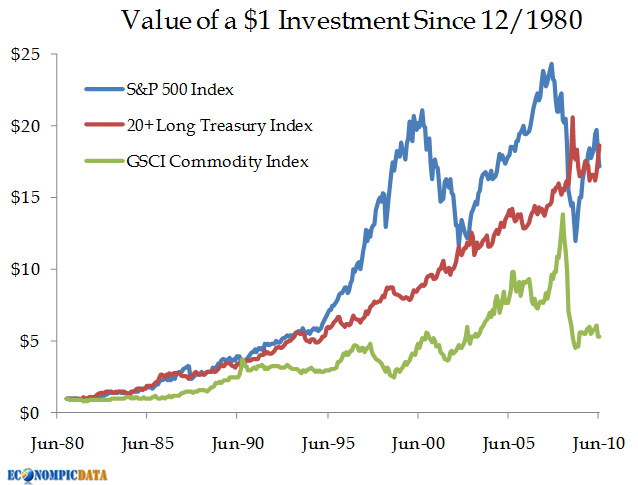
So when did the economy perform better, and who is invested in the stocks like the S&P 500?

I don't want to start loading-up more articles by economists. But economic growth tended to occur (not always) starting in the 20th century during Democratic regimes (RR is an exception). There are a few hundred articles discussing this. And if you read the last article I posted, you now know the last thing Democrats did compared to Republicans was domestic spending. As an example, Clinton reduced the level of domestic spending and the deficit in such a manner, that evil Wall Street responded as long term interest rates tumbled, and economic growth developed. Then came George Bush...

I completely agree that income is another of many important factors in economic growth, though where the income needs to be is a hotly debated issue. If you need capital to develop a business to employ more people in today's tight credit market, you may view the world differently than you do. You need income to reinvest to grow your business, even though as a business owner you likely are in the top 10% of earners. And you need consumers with income to buy your product, though as discussed below, income is just one criteria that economists look at. This gets us into another contentious area. In terms of income (excluding benefits, wealth and retirement assets), both public and private worker income have been stagnant. When I think of private sector unions which is what I assume you are talking about, I think of manufacturing jobs, though I know this is an oversimplification. And manufacturing jobs left because of many reasons, not just unions, and in fact unions often exist in other countries (e.g., other factors include environmental or other regulation, taxes, accounting rules, incentives offered by other locations, etc.) To blame jobs on economic theory or unions or any one factor is an gross over-simplification. (I would post more articles here to make the point). We also have a much better educated work force that is expecting different jobs than most unions provide. [assume another article regarding education levels was inserted]

Underemployment of the US workforce is a big issue, and one that developed more recently. [assume there are articles inserted about how long a policy impact from past presidents lasts was inserted]. Your microeconomic statements and who you revere or hate don't jive with data, unless you think that military spending is the way to go. Only economic growth in sectors that provide better paying jobs (e.g., not retail) is going to help. That is something are current leaders of both parties are unable to deliver, and candidly, both the President and Congress have some funny ideas about what they think will do that (e.g., cutting spending when interest rates are at historical lows).

Finally, who really owns the stock in US public companies? Assume I posted an article from Business Insider, but as of the end of 2012:

Households: 35%, Mutual Funds 20%, pension funds 9%, gov. retirement funds 8%, international investors (who could be any type of investor) 13%, Hedge Funds, ETFs and other professional investors 7% and other 8%.

I think one thing your analysis doesn't look at is that a lot more goes into consumer buying habits that just income. {Assume some more articles are posted here]. There is real estate values, and also investments and retirement benefits (as in 73% of the ownership of US stocks), the ability to borrow, government payments and the like. But to say that stock values don't matter, is to say at least 73% of the owners of stock don't matter, including most public employees.
calbare
How long do you want to ignore this user?
Meant to be tongue in cheek, but I find it funny that you use the words "overabundance of influence and wealth" to describe unions - those words apply with much more relevance to another group in this country.
wifeisafurd
How long do you want to ignore this user?
dajo9;842327942 said:

I'm not spinning. Here is what I said, "Using the numbers provided, California's unfunded liability is $120.8 billion. That is going to be paid out over many years into the future, let's call it 20 years to be unfavorable to the pensions."

So, I made it clear I was using an assumption and I gave an assumption that seemed to me to be more favorable to your argument (I believe the payments will go over more than 20 years in reality). If you want to challenge my assumption, then fine. But don't call it what it isn't - spinning.


Look, I'm sure in your field there is a vast sea of difference between a state having a deficit and a state issuing bonds to cover a deficit. However, as a taxpayer I fail to see how it is a big difference. Feel free to educate me on this point - seriously.


Actually take a look what you accused me of after I spent a lot of time looking for the answer to your "honest" question, which didn't exit, and then you went right ahead and made up some assumption out of the air to prove your point. I presume that made-up assumption calls for an even level of payments over 20 years without any discount rate, but who really knows other than is not what you asked for. Then your next response is to say go challenge my assumption. Great obfuscation

As for your other response, I agree that to most taxpayers, deferring payment looks like a deficit, and as a practical, but not legal, matter, it is. But go back and look at your original comment about Republicans, which I assume was another personal remark.

But even that really ignores what I was talking about. To repeat myself, when you run up the debt to high, you lose access to the credit market, and then you raise taxes in the short run (since you don't want to lose your tax base in the long run) and make cuts to public education (and other programs), and to add another thing, take money away from local governments. That is because there are no deficits by law. You just pulled out of the air that the state could always just run up the deficit. Just in case you were not paying attention a few years ago this is exactly what happened. So to get back to my original point, if you have large deficits on the horizon, public education is going to suffer. Of course, we could always find a way to tax GDP to make bond investors happy and ignore the concept of tax revenues versus expenditures or coverage ratios [sarcasm intended].
dajo9
How long do you want to ignore this user?
wifeisafurd;842327995 said:

Actually take a look what you accused me of after I spent a lot of time looking for the answer to your "honest" question, which didn't exit, and then you went right ahead and made up some assumption out of the air to prove your point. I presume that made-up assumption calls for an even level of payments over 20 years without any discount rate, but who really knows other than is not what you asked for. Then your next response is to say go challenge my assumption. Great obfuscation

As for your other response, I agree that to most taxpayers, deferring payment looks like a deficit, and as a practical, but not legal, matter, it is. But go back and look at your original comment about Republicans, which I assume was another personal remark.

But even that really ignores what I was talking about. To repeat myself, when you run up the debt to high, you lose access to the credit market, and then you raise taxes in the short run (since you don't want to lose your tax base in the long run) and make cuts to public education (and other programs), and to add another thing, take money away from local governments. That is because there are no deficits by law. You just pulled out of the air that the state could always just run up the deficit. Just in case you were not paying attention a few years ago this is exactly what happened. So to get back to my original point, if you have large deficits on the horizon, public education is going to suffer. Of course, we could always find a way to tax GDP to make bond investors happy and ignore the concept of tax revenues versus expenditures or coverage ratios [sarcasm intended].


There's nothing wrong with making reasonable assumptions about things when faced with incomplete information. I assumed the unfunded liabilities go for 20 years, which I think is pretty favorable to your argument. I also believe that unfunded liabilities are calculated using present value - meaning future payments are already discounted in the unfunded liability (correct me if I'm wrong about that). That's why I didn't grow the GDP, in order to err on the side of being unfavorable to pensions. This was all mentioned in my post. Nothing wrong with it. It's very rare in life that you are making a financial forecast with perfect information. Assumptions are part of what you factor in. As I tell the financial analysts who work for me, just be clear about them so everybody understands them.

We are going in circles here. You say borrowing can't go on forever, which I agree with. My point is, before borrowing is cut off, rates go up. There doesn't seem to be much of a crisis in regards to higher rates rate now, so if you think we are in a crisis situation, by all means, go and make a fortune off the markets.
wifeisafurd
How long do you want to ignore this user?
[

The incessant union-bashing and complaints about employee incompetence are coming from an Investor/Corporate viewpoint. The premise is that if the organization isn't performing well, the lazy, overpaid employees and their union are to blame; and the solution is to get rid of the union, fire the "lowest-performing" 1/3 of employees, hire great, young, motivated employees to replace the fired ones -- at a lower salary(!) -- and of course, funnel greater rewards toward the administrators & managers who are able to accomplish this.

When I see this in action, I'm reminded of the old adage, "It's a poor carpenter who blames his tools."

In California, we're getting -- precisely -- the K-12 performance that we're paying for. Thanks to Prop 13 and the Investors' Revolt, CA is well below the national median in per-pupil funding (only $8378/pupil/yr in 2011), with no extra $$ to accommodate the needs of the large population of immigrants (many non-English-speaking) who are encouraged to join the oversupply of workers in the State -- for the purpose of keeping wages & salaries down!

Prop 13 was sold to us in 1978 because many seniors were, in fact, getting taxed out of their homes. This was due to the meteoric rise in the value of those homes! Today, the valuation exemption only applies to about 1% of the residences in CA, but it applies to all of the commercial properties. Here's how it works: http://closetheloophole.com/sf-weekly-prop-13. This is yet another way in which large corporations evade taxes, and push the State's tax burden onto the backs of workers and individuals.

I think that $8378/pupil/yr is outrageous and inadequate for CA. If we moved up to #10 (Minnesota, at $12,500), we would have much better results. All we would need to do is
+ update assessments on all CA commercial properties, and
+ release all non-violent drug offenders from CA prisons (and save ~$47,100 per inmate per year)
+ return management of CA prisons to the State

I believe in having excellent Public Education. That's why I went to Cal. It's an investment that we make in our students because we need them to be educated, intelligent, and to have good judgment.

That includes NOT being misled.


The comment that valuation exemption only applies to 1% of the residences is just garbage. In fact, there are about 500,000 homeowners that rec'd Prop. 8 adjustment to go below the original prop. 13 valuation level since 2010. I don't know who made up this number, but its just wrong. One thing that happens when property taxes are pledged for bonds is the governmental issuer (or a consultant it pays) has to go through an analysis to determine how property taxes will grow, and a typical assumption is about 50% of the residences are on prop 13 limits, though this assumption typically varies by county. And then the comment that Prop 13 applies to all commercial properties is also garbage. Prop 13 eliminates various commercial properties from protection (e.g., investor owned utility property). Every time a property is sold to a third party whether a resident or commercial property, there is a reassessment based on the selling price typically. Now there are ways around this such as by merging with a company for example, but no one merges with a large company to simply buy a property. Three are also exceptions that have been promulgated to reassessment that the legislature thinks are a good thing either for the business climate or the affairs of people. For example, you can transfer a residence to your kids without triggering a reassessment. But a huge number of commercial properties that change hands are subject to reassessment.

There are objections to Prop 13 for various economic reasons, none of which you mentioned. But I don't see the usual tax regimen increasing the tax burden (typically property taxes are based on actual current value, though it well known the assessors deliberately favor certain properties over others). As I mentioned in another post, CA does collect a decent share of property taxes compared to other states, and I don't think there is much political will to change Prop 13 for residences. You did mention the tax role split concept, but the burden in a commercial setting almost always falls on the tenant, and therefore this concept also has become unacceptable in Sacramento for what should be obvious reasons. Also, I urge to you look my taxes post, lest you think there is big dollars in any of this, or that this will not make the state even more dependent on the business cycle, since property values can go down (again see my comments on Prop 8 reassessments).
The union, lazy employee, corporate greed stuff I am not touching. That I am sure is what your ideology says the world is like, and so be it. See where that gets you.

Finally, IMO you are absolutely right on school spending. CA is almost last in the nation, despite having more revenues than any other state, including on a per capita basis. I encourage you to look at the budget and see where the money is going, rather than start off on this economic theory stuff. In my view, our lack of spending on public education, including higher education, is a disgrace. My other point, which now seems rather controversial, is that it is going to get worse as the off balance sheet liabilities start coming due. With this I am withdrawing from the arguments, and let everyone start taking their shots.
dajo9
How long do you want to ignore this user?
wifeisafurd;842327948 said:

I didn't print you whole post due to space constraints, but it has nothing to do with tenure, the court case or for that matter the teacher's union, all of which I have managed to restrain myself from commenting upon.

The lessons I got at Cal from the New Deal implementation were clearly different than what you envision. If you look at the numbers, FDR's own programs that were implemented were temporary and very low cost. His big increase is for military spending, with which multipliers (see Keynes) got us out of the depression and spurred substantial growth, but crowded out domestic spending (same as the evil RR). Which then gets us to who really spends more and creates bigger deficits. You are all blinded by your ideology.

The Big-Spending Presidents
C. Eugene Steuerle, Gordon Merder (Urban Institute)


I've never read C. Eugene Steuerle before but I can add him to the list of people to ignore. How do you know when someone is trying to fool you with a biased agenda disguised as analysis? They write something like, "The massive World War II defense build-up crowded out domestic spending". Never mind that massive rationing due to the war effort massively cut domestic spending. No, this guy wants you to believe that expansionary fiscal policies curtailed domestic spending during World War 2, not laws that restricted people from buying things.

How else do you know someone is trying to fool you with statistics? They use spending as a % of gdp as the main metric to determine Presidential government spending. That way they can call Herbert Hoover one of the biggest spenders ever. What he doesn't explain is that a big part of the increase under Hoover is due to a lower denominator (gdp went down a bunch under Hoover). And spending went down under FDR? Well gdp went way up, but federal spending went up between 1933 and 1945 from $4.7 billion to $92.7 billion. You have to really take a blind eye to the stats to call that a spending decrease.

The story this guy is trying to bury is that FDR's policies worked to grow gdp and Hoover's policies failed. So he recasts the gdp story as a spending story.

This guy is a world class hack, but I'll add one more just for fun. He says, "Richard Nixon and Herbert Hoover are considered by some to be among the most conservative of the 20th century. Yet together they produced almost three-quarters of the domestic spending growth over the entire 100-year span." Federal spending, in current dollars, went from $3.1B to $4.6B under Hoover and from $183.6B to $269.4B under Nixon. Federal spending in 2013 was $3.5 trillion. Somehow those Hoover and Nixon increases are supposed to be 3/4's of the total increase. This guy either doesn't know how to use stats or he is trying to mislead you. Which do you think it is?
 
×
subscribe Verify your student status
See Subscription Benefits
Trial only available to users who have never subscribed or participated in a previous trial.