
Gavin Newsom weighs in

41,727 Views | 313 Replies | Last: 5 yr ago by Unit2Sucks
BearGoggles
How long do you want to ignore this user?
Unit2Sucks said:

BearGoggles said:


You keep posting this same drivel, without acknowledging that those (on the left and right) who advocate for SIP similarly cannot provide evidence of the unknown risk and unknown benefits of SIP. How many lives will be saved by continued SIP and how much economic damage will result (as compared to lifting SIP sooner, rather than later)? You don't know. NOBODY knows.

You have theories on demand shock - it is just a theory, not evidence. You have policy preferences and theories, not science.

What are the health risks of continued SIP? We don't know, but we know there will be deaths resulting from poverty and SIP. CNN says up to 75,000 https://www.cnn.com/2020/05/08/health/coronavirus-deaths-of-despair/index.html

For you, it always comes down to demonizing the right or conservatives. it is rather sad. There are some conservatives who want continued SIP (and are highly critical of Trump). And there are some progressives who want SIP removed in large part. But acknowledging that proven reality interferes with your "hate the right" narrative. So carry on.


You keep posting this same drivel, without acknowledging that those (on the left and right) who advocate against SIP similarly cannot provide evidence of the unknown risk and unknown benefits of ending SIP. How many lives will be saved by ending SIP and how much economic benefit will result (as compared to lifting SIP later, rather than sooner)? You don't know. NOBODY knows.

You have policy preferences and theories, not science or economics.

What are the health risks of ending SIP now? We don't know, but we know there will be deaths resulting from poverty and SIP because our economy will continue to be diminished just as it was before the SIP orders went into effect. CNN says up to 75,000 https://www.cnn.com/2020/05/08/health/coronavirus-deaths-of-despair/index.html but that's all completely made up with no science backing it and no reason to believe ending SIP will reduce it.

What are the economic benefits of ending SIP now? We don't know but you presume to believe that whatever those benefits are will outweigh the public health benefits of continuing SIP.

Stop pretending like you are something you aren't.

Actually, I admit that there is uncertainty with both approaches. I don't assume people who reach different conclusions are bad people or have bad motivations. That is the difference between me and you.

Yes, I 'presume" to have different beliefs then you. God forbid.

As someone else posted (I think here) there are still going to be deaths, as there are with many contagious diseases and other societal risks. But the question is what risk of mortality justifies shutting down our economy, bankrupting small businesses, putting so many younger people out of work, and depleting whatever savings they might have for their families?
BearGoggles
How long do you want to ignore this user?
71Bear said:

BearGoggles said:

Unit2Sucks said:

BearGoggles said:

You make a sweeping statement that "Conservatives who used to trumpet the rule of law now openly encourage people to ignore laws they find inconvenient" - only conservatives. I respond by pointing out that democrats (in fact our current governor ) often advocate breaking laws. And it wasn't just 2004 wedding licensees - but current sanctuary policies. And then you decry whataboutism. Laughable.


I guess I need to slow it down for you. Please pay attention because you seem to have missed this before. Republicans always talk about being the law and order party. Democrats don't. That's why I'm criticizing Republicans for their hypocrisy.
Let me slow it down for you. Many Democrats talk about breaking laws they, unilaterally, feel are unconstitutional or unjust. Newsom, in particular has done this. That's why I'm criticizing Newsom for his hypocrisy in insisting that people follow his unconstitutional and unjust orders.

And to be clear, unlike you, I don't paint in wide brushes. Not all democrats (or republicans) see things this way. But Newsom clearly does, as evidenced by his issuing illegal (at the time) gay marriage license and adopting sanctuary policies.
Did I miss something? Has the Supreme Court ruled that Newsom failed to adhere to the US constitution? Until such time, I think it is a tad presumptuous to suggest that Newsom's actions were unconstitutional. In time, the courts will decide that matter.

Secondly, the pages of American history are filled with examples of men and women who "broke the law" to advance a specific issue or a cause. In many, many cases, those actions led to a change in the law or a Supreme Court decision in their favor.

I don't think "breaking the law" in some instances is wrong (i.e., the issue of gay marriage). Obviously, subsequent court decisions confirmed that Newsom was on the right side of history. As for the sanctuary issue, it is currently working its way through the court system. Until a final verdict is reached, one cannot assume it is unconstitutional.

https://assets.documentcloud.org/documents/4403884/3-6-18-US-v-California-Complaint.pdf

Since it is too soon to tell who was "right" and who was "wrong" regarding the current situation, we can only surmise whether actions being taken today are a suppression of individual rights. As noted earlier, time will tell...
71bear - you're actually making my point. If someone - as a private citizen or company - wants to go to the beach, get arrested, and challenge the proclamation, that is their right. Or if cities/counties want to do the same in court, then they should. Elon Musk is doing that now.

The more difficult scenario is when public officials performing their official duties refuse to follow the clearly established current law - as Newsom did in 2004 and the Riverside Sheriff is doing now -- based on their personal interpretation of the constitution which is at odds with binding court authority. That is wrong. If their personal view of the constitution doesn't permit the official to follow the then-existing law, they should resign (or step aside). And just to be clear, I said that about Newsom in 2004 and the clerks in the south who refused to issue gay marriage licenses after Obergefell.

You're correct - Newsom's policies have not yet been adjudicated unconstitutional - I should have said Newsom insists that people follow his edicts that "those people believe" are unconstitutional. The hypocrisy is that we know what Newsom did (and would do) if he had a personal belief that the laws were unconstitutional - he would break them. So he's not really in a position to criticize the Riverside Sheriff or anyone else acting "in accordance with their conscience."

In terms of the current pandemic, the cases are making their way through the court and time will tell. As wife posted elsewhere, the courts will be very deferential for emergencies, as they probably should. But the longer this goes on, the emergency justification diminishes.
Unit2Sucks
How long do you want to ignore this user?
BearGoggles said:

Unit2Sucks said:

BearGoggles said:


You keep posting this same drivel, without acknowledging that those (on the left and right) who advocate for SIP similarly cannot provide evidence of the unknown risk and unknown benefits of SIP. How many lives will be saved by continued SIP and how much economic damage will result (as compared to lifting SIP sooner, rather than later)? You don't know. NOBODY knows.

You have theories on demand shock - it is just a theory, not evidence. You have policy preferences and theories, not science.

What are the health risks of continued SIP? We don't know, but we know there will be deaths resulting from poverty and SIP. CNN says up to 75,000 https://www.cnn.com/2020/05/08/health/coronavirus-deaths-of-despair/index.html

For you, it always comes down to demonizing the right or conservatives. it is rather sad. There are some conservatives who want continued SIP (and are highly critical of Trump). And there are some progressives who want SIP removed in large part. But acknowledging that proven reality interferes with your "hate the right" narrative. So carry on.


You keep posting this same drivel, without acknowledging that those (on the left and right) who advocate against SIP similarly cannot provide evidence of the unknown risk and unknown benefits of ending SIP. How many lives will be saved by ending SIP and how much economic benefit will result (as compared to lifting SIP later, rather than sooner)? You don't know. NOBODY knows.

You have policy preferences and theories, not science or economics.

What are the health risks of ending SIP now? We don't know, but we know there will be deaths resulting from poverty and SIP because our economy will continue to be diminished just as it was before the SIP orders went into effect. CNN says up to 75,000 https://www.cnn.com/2020/05/08/health/coronavirus-deaths-of-despair/index.html but that's all completely made up with no science backing it and no reason to believe ending SIP will reduce it.

What are the economic benefits of ending SIP now? We don't know but you presume to believe that whatever those benefits are will outweigh the public health benefits of continuing SIP.

Stop pretending like you are something you aren't.

Actually, I admit that there is uncertainty with both approaches. I don't assume people who reach different conclusions are bad people or have bad motivations. That is the difference between me and you.

Yes, I 'presume" to have different beliefs then you. God forbid.

As someone else posted (I think here) there are still going to be deaths, as there are with many contagious diseases and other societal risks. But the question is what risk of mortality justifies shutting down our economy, bankrupting small businesses, putting so many younger people out of work, and depleting whatever savings they might have for their families?


You seem to be overly concerned with what I think about you but honestly neither I nor anyone else here cares and you should move on.

I will just leave you with this, since debating you is a waste of everyone's time: our economy will be devastated regardless of SIP if people feel unsafe to engage in public commerce.

And guess what: people feel unsafe right now which is why across the nation you have greatly reduced mobility and in person commerce, regardless of SIP orders. This is true across every state in the US for which I've seen data. If you took the time to review the data, you would see that.

Maybe it will help you feel less bad about the SIP order. The question of what level of risk justifies shutting down our economy isn't entirely up to the politicians to decide and we cannot escape the economic consequences of an infectious disease merely by trying to convince our leaders to pretend that it doesn't exist.
rkt88edmo
How long do you want to ignore this user?
AunBear89 said:

Civil Bear said:

AunBear89 said:

Unit2Sucks said:

<big snip>
Stop pretending like you are something you aren't.


He can't help himself. He's a conservative white male with an opinion. In his mind, that makes him an expert.
I am curious as to your label, because clearly CWM's don't hold the market on self-proclaimed experts.


True, but they hold the largest share of the market.


jk...sorta
71Bear
How long do you want to ignore this user?
BearGoggles said:

71Bear said:

BearGoggles said:

Unit2Sucks said:

BearGoggles said:

You make a sweeping statement that "Conservatives who used to trumpet the rule of law now openly encourage people to ignore laws they find inconvenient" - only conservatives. I respond by pointing out that democrats (in fact our current governor ) often advocate breaking laws. And it wasn't just 2004 wedding licensees - but current sanctuary policies. And then you decry whataboutism. Laughable.


I guess I need to slow it down for you. Please pay attention because you seem to have missed this before. Republicans always talk about being the law and order party. Democrats don't. That's why I'm criticizing Republicans for their hypocrisy.
Let me slow it down for you. Many Democrats talk about breaking laws they, unilaterally, feel are unconstitutional or unjust. Newsom, in particular has done this. That's why I'm criticizing Newsom for his hypocrisy in insisting that people follow his unconstitutional and unjust orders.

And to be clear, unlike you, I don't paint in wide brushes. Not all democrats (or republicans) see things this way. But Newsom clearly does, as evidenced by his issuing illegal (at the time) gay marriage license and adopting sanctuary policies.
Did I miss something? Has the Supreme Court ruled that Newsom failed to adhere to the US constitution? Until such time, I think it is a tad presumptuous to suggest that Newsom's actions were unconstitutional. In time, the courts will decide that matter.

Secondly, the pages of American history are filled with examples of men and women who "broke the law" to advance a specific issue or a cause. In many, many cases, those actions led to a change in the law or a Supreme Court decision in their favor.

I don't think "breaking the law" in some instances is wrong (i.e., the issue of gay marriage). Obviously, subsequent court decisions confirmed that Newsom was on the right side of history. As for the sanctuary issue, it is currently working its way through the court system. Until a final verdict is reached, one cannot assume it is unconstitutional.

https://assets.documentcloud.org/documents/4403884/3-6-18-US-v-California-Complaint.pdf

Since it is too soon to tell who was "right" and who was "wrong" regarding the current situation, we can only surmise whether actions being taken today are a suppression of individual rights. As noted earlier, time will tell...
71bear - you're actually making my point. If someone - as a private citizen or company - wants to go to the beach, get arrested, and challenge the proclamation, that is their right. Or if cities/counties want to do the same in court, then they should. Elon Musk is doing that now.

The more difficult scenario is when public officials performing their official duties refuse to follow the clearly established current law - as Newsom did in 2004 and the Riverside Sheriff is doing now -- based on their personal interpretation of the constitution which is at odds with binding court authority. That is wrong. If their personal view of the constitution doesn't permit the official to follow the then-existing law, they should resign (or step aside). And just to be clear, I said that about Newsom in 2004 and the clerks in the south who refused to issue gay marriage licenses after Obergefell.

You're correct - Newsom's policies have not yet been adjudicated unconstitutional - I should have said Newsom insists that people follow his edicts that "those people believe" are unconstitutional. The hypocrisy is that we know what Newsom did (and would do) if he had a personal belief that the laws were unconstitutional - he would break them. So he's not really in a position to criticize the Riverside Sheriff or anyone else acting "in accordance with their conscience."

In terms of the current pandemic, the cases are making their way through the court and time will tell. As wife posted elsewhere, the courts will be very deferential for emergencies, as they probably should. But the longer this goes on, the emergency justification diminishes.
Just for the record, regarding paragraph 1 - I never suggested otherwise. Others did.

I believe in the concept of civil disobedience. I learned from the experts while attending our Alma Mater......
mbBear
How long do you want to ignore this user?
BearGoggles said:

Unit2Sucks said:

There seems to be a lot of cognitive dissonance on the right regarding the nation-wide response to COVID.

Many blame Newsom for not "opening up" California (and leaders in other states) but they fail to acknowledge that leadership either needs to come from the states or the federal government. The federal government alternates between telling us that it's up to the states, and promulgating federal guidelines. The feds came up with their own "plan" and even had the CDC draw up more detailed guidelines, but rejected those because they were too focused on protecting the nation's public health. The right says the SIP plan has changed without acknowledging that the White House response has changed innumerable times since the SIP orders were in place. I still don't know what Trump is pretending to believe today - is it that he's in charge or that the states are in charge? If someone can make sense of his contradictory logorrhea, please let me know.

The right seems to agree that they want the economy to be better and that whatever the resultant excess death amount is would definitely be acceptable to them, but they haven't presented any compelling reason to convince people to take on unknown risk for unknown benefit. We are making a beeline for 200k dead from the virus in the next few months when just weeks ago we were assured it would be under 60k. Can someone on the right tell me what number would make this bad? And don't talk about how the death counts are inflated. There were only something like 2,500 confirmed H1N1 deaths in the US but the right has no problem with the official number of 12,500 (or in Trump's case, using the maximum end of the range at 17,000+). Is 200k acceptable? Is 500k? 1M?

This is a demand shock and the demand won't increase until people feel safe interacting face to face in our economy. As has been demonstrated amply on this forum, the demand shock began without regard to whether SIP orders were in place, and are likely to continue regardless of "reopening". When we see an increase in daily death counts as a result of more and more people participating in the economy, will anyone be surprised if we see another drop in demand as people choose to sit it out until they feel safe again?

If you want the economy to improve on a national level, the reality is that you need to have coordinated efforts - which means you need a focused white house taking measured steps. Instead we have a chaotic one which constantly folds back on itself and can't determine whether it has any power to do anything or whether anyone else does. If the federal government can't stay on message and govern in a disciplined manner, it will continue to harm our country and blame the governors.

You want Gavin Newsom to "open" but we don't yet meet the minimum criteria to re-open according to the Trump plan which has not been officially disavowed. Further, I think Gavin has been fairly consistent. He shut it down on March 20 and 3 weeks later announced the 6 indicators needed to modify the SIP order.

And just a reminder that President Trump said on April 23 that the shutdown saved at least a million lives and probably many times that number. Same President that Ben Shapiro and all of the other conservative celebrities continue to support for his role in this pandemic.
You keep posting this same drivel, without acknowledging that those (on the left and right) who advocate for SIP similarly cannot provide evidence of the unknown risk and unknown benefits of SIP. How many lives will be saved by continued SIP and how much economic damage will result (as compared to lifting SIP sooner, rather than later)? You don't know. NOBODY knows.

You have theories on demand shock - it is just a theory, not evidence. You have policy preferences and theories, not science.

What are the health risks of continued SIP? We don't know, but we know there will be deaths resulting from poverty and SIP. CNN says up to 75,000 https://www.cnn.com/2020/05/08/health/coronavirus-deaths-of-despair/index.html

For you, it always comes down to demonizing the right or conservatives. it is rather sad. There are some conservatives who want continued SIP (and are highly critical of Trump). And there are some progressives who want SIP removed in large part. But acknowledging that proven reality interferes with your "hate the right" narrative. So carry on.


I don't know why any of this has become political. People are both sides making tough decisions. The Republican Ohio governor Wine has done some great things, not always popular things. The NJ and NY governors, though both Democrats, are up against incredible challenges from the Virus.

The only political comment I will make is that the White House came out with guidelines to follow to opening up (yes, I realize its still a state issue) but now the President is acting like he never made those statements. I think leading from the front on the whole Virus deal, carefully keeping a specific and direct course, would have won him the White House easily. Honestly, those around him had to follow some basic Poli Sci 1 direction, and this was race was over.
The only other political observation I will make is that the President is banking on (no pun intended) that states opening up and the economy getting going will be a key to victory. I can see that strategy. But if there is a relapse of the virus, then he has to avoid taking a hit from that, and I guess try to blame the Governors for that....it will be interesting how that plays out.

LMK5
How long do you want to ignore this user?
Unit2Sucks said:

BearGoggles said:

Unit2Sucks said:

BearGoggles said:


You keep posting this same drivel, without acknowledging that those (on the left and right) who advocate for SIP similarly cannot provide evidence of the unknown risk and unknown benefits of SIP. How many lives will be saved by continued SIP and how much economic damage will result (as compared to lifting SIP sooner, rather than later)? You don't know. NOBODY knows.

You have theories on demand shock - it is just a theory, not evidence. You have policy preferences and theories, not science.

What are the health risks of continued SIP? We don't know, but we know there will be deaths resulting from poverty and SIP. CNN says up to 75,000 https://www.cnn.com/2020/05/08/health/coronavirus-deaths-of-despair/index.html

For you, it always comes down to demonizing the right or conservatives. it is rather sad. There are some conservatives who want continued SIP (and are highly critical of Trump). And there are some progressives who want SIP removed in large part. But acknowledging that proven reality interferes with your "hate the right" narrative. So carry on.


You keep posting this same drivel, without acknowledging that those (on the left and right) who advocate against SIP similarly cannot provide evidence of the unknown risk and unknown benefits of ending SIP. How many lives will be saved by ending SIP and how much economic benefit will result (as compared to lifting SIP later, rather than sooner)? You don't know. NOBODY knows.

You have policy preferences and theories, not science or economics.

What are the health risks of ending SIP now? We don't know, but we know there will be deaths resulting from poverty and SIP because our economy will continue to be diminished just as it was before the SIP orders went into effect. CNN says up to 75,000 https://www.cnn.com/2020/05/08/health/coronavirus-deaths-of-despair/index.html but that's all completely made up with no science backing it and no reason to believe ending SIP will reduce it.

What are the economic benefits of ending SIP now? We don't know but you presume to believe that whatever those benefits are will outweigh the public health benefits of continuing SIP.

Stop pretending like you are something you aren't.

Actually, I admit that there is uncertainty with both approaches. I don't assume people who reach different conclusions are bad people or have bad motivations. That is the difference between me and you.

Yes, I 'presume" to have different beliefs then you. God forbid.

As someone else posted (I think here) there are still going to be deaths, as there are with many contagious diseases and other societal risks. But the question is what risk of mortality justifies shutting down our economy, bankrupting small businesses, putting so many younger people out of work, and depleting whatever savings they might have for their families?



You seem to be overly concerned with what I think about you but honestly neither I nor anyone else here cares and you should move on.

I will just leave you with this, since debating you is a waste of everyone's time: our economy will be devastated regardless of SIP if people feel unsafe to engage in public commerce.

And guess what: people feel unsafe right now which is why across the nation you have greatly reduced mobility and in person commerce, regardless of SIP orders. This is true across every state in the US for which I've seen data. If you took the time to review the data, you would see that.

Maybe it will help you feel less bad about the SIP order. The question of what level of risk justifies shutting down our economy isn't entirely up to the politicians to decide and we cannot escape the economic consequences of an infectious disease merely by trying to convince our leaders to pretend that it doesn't exist.
Unit2, what makes you say people are afraid to engage in in-person commerce? Have you been to a Home Depot, Target, or Trader Joe's lately? They are all crowded and there can be lines to get in these stores. My daughter lives in Arizona where restaurants just opened yesterday. They wouldn't even let anyone in unless they had a reservation. When Gavin Newsom allows us to get hair cuts, do you think they'll be no lines outside Supercuts?

We can calculate only the economic toll of continuing SIP, but the societal toll will come out later. On the other hand, I have not seen anyone tell us what the expected material gains are from 4 more weeks of lockdown over and above what has already been achieved in the past 7. We are badly in need of a modified approach that lets people resume life with reasonable precautions, and those that want to shelter continue to have the freedom to do so.

Beware of policies enacted by those who have zero prospect of losing their income from said policies.
The truth lies somewhere between CNN and Fox.
Unit2Sucks
How long do you want to ignore this user?
LMK5 said:


Unit2, what makes you say people are afraid to engage in in-person commerce?
I can't tell if you are just asking questions or if you actually care about the answers. I've already posted about this topic in this very thread.

To recap, I'm basing it on data I've seen and which I've already posted in this thread. Here's an article that digs into it. I suggest you read it because it may answer other questions you have. I've seen some other non-public data that is along the same lines that I have access to professionally.

Anecdotally what you are seeing is that when access is restricted, there are going to be bottlenecks, but that doesn't mean that if our economy became unrestricted over night that we would see a return to 100% of activity. The question is really around the margins - how much more activity converts from online to offline without the SIP in place and does the economic benefit of that outweigh the negative public health consequences. As you can see from the NYT article (or other data if you care to look for it), the economy is being ravaged because of the virus, and not just because some governors have chosen to put SIP orders in place to attempt to further prevent the spread of COVID.


71Bear
How long do you want to ignore this user?
LMK5 said:

Unit2Sucks said:

BearGoggles said:

Unit2Sucks said:

BearGoggles said:


You keep posting this same drivel, without acknowledging that those (on the left and right) who advocate for SIP similarly cannot provide evidence of the unknown risk and unknown benefits of SIP. How many lives will be saved by continued SIP and how much economic damage will result (as compared to lifting SIP sooner, rather than later)? You don't know. NOBODY knows.

You have theories on demand shock - it is just a theory, not evidence. You have policy preferences and theories, not science.

What are the health risks of continued SIP? We don't know, but we know there will be deaths resulting from poverty and SIP. CNN says up to 75,000 https://www.cnn.com/2020/05/08/health/coronavirus-deaths-of-despair/index.html

For you, it always comes down to demonizing the right or conservatives. it is rather sad. There are some conservatives who want continued SIP (and are highly critical of Trump). And there are some progressives who want SIP removed in large part. But acknowledging that proven reality interferes with your "hate the right" narrative. So carry on.


You keep posting this same drivel, without acknowledging that those (on the left and right) who advocate against SIP similarly cannot provide evidence of the unknown risk and unknown benefits of ending SIP. How many lives will be saved by ending SIP and how much economic benefit will result (as compared to lifting SIP later, rather than sooner)? You don't know. NOBODY knows.

You have policy preferences and theories, not science or economics.

What are the health risks of ending SIP now? We don't know, but we know there will be deaths resulting from poverty and SIP because our economy will continue to be diminished just as it was before the SIP orders went into effect. CNN says up to 75,000 https://www.cnn.com/2020/05/08/health/coronavirus-deaths-of-despair/index.html but that's all completely made up with no science backing it and no reason to believe ending SIP will reduce it.

What are the economic benefits of ending SIP now? We don't know but you presume to believe that whatever those benefits are will outweigh the public health benefits of continuing SIP.

Stop pretending like you are something you aren't.

Actually, I admit that there is uncertainty with both approaches. I don't assume people who reach different conclusions are bad people or have bad motivations. That is the difference between me and you.

Yes, I 'presume" to have different beliefs then you. God forbid.

As someone else posted (I think here) there are still going to be deaths, as there are with many contagious diseases and other societal risks. But the question is what risk of mortality justifies shutting down our economy, bankrupting small businesses, putting so many younger people out of work, and depleting whatever savings they might have for their families?


You seem to be overly concerned with what I think about you but honestly neither I nor anyone else here cares and you should move on.

I will just leave you with this, since debating you is a waste of everyone's time: our economy will be devastated regardless of SIP if people feel unsafe to engage in public commerce.

And guess what: people feel unsafe right now which is why across the nation you have greatly reduced mobility and in person commerce, regardless of SIP orders. This is true across every state in the US for which I've seen data. If you took the time to review the data, you would see that.

Maybe it will help you feel less bad about the SIP order. The question of what level of risk justifies shutting down our economy isn't entirely up to the politicians to decide and we cannot escape the economic consequences of an infectious disease merely by trying to convince our leaders to pretend that it doesn't exist.
Unit2, what makes you say people are afraid to engage in in-person commerce? Have you been to a Home Depot, Target, or Trader Joe's lately? They are all crowded and there can be lines to get in these stores. My daughter lives in Arizona where restaurants just opened yesterday. They wouldn't even let anyone in unless they had a reservation. When Gavin Newsom allows us to get hair cuts, do you think they'll be no lines outside Supercuts?

We can calculate only the economic toll of continuing SIP, but the societal toll will come out later. On the other hand, I have not seen anyone tell us what the expected material gains are from 4 more weeks of lockdown over and above what has already been achieved in the past 7. We are badly in need of a modified approach that lets people resume life with reasonable precautions, and those that want to shelter continue to have the freedom to do so.

Beware of policies enacted by those who have zero prospect of losing their income from said policies.
Your comment prompted me to think about what I will miss once everything begins to return to "normal".

Senior hour at Target and the grocery store (few shoppers, no check stand lines and everything you need is available), no traffic and, of course, easy money from the government......

oskidunker
How long do you want to ignore this user?
Restaurants operate on a very thin line. I don't see how they can stay in business only allowing 50% patrons. I rarely go anyway as I can cook better at home most of the time. Paying over $100 for a piece of meat thrown on a grill with little preparation doesn't appeal to me. I do go out to lunch once in a while. When their were classic French restaurants I went out a-lot. Not so much now that a Cesar Salad has Kale in it.
Bring back It’s It’s to Haas Pavillion!
sycasey
How long do you want to ignore this user?
LMK5 said:

Unit2Sucks said:

BearGoggles said:

Unit2Sucks said:

BearGoggles said:


You keep posting this same drivel, without acknowledging that those (on the left and right) who advocate for SIP similarly cannot provide evidence of the unknown risk and unknown benefits of SIP. How many lives will be saved by continued SIP and how much economic damage will result (as compared to lifting SIP sooner, rather than later)? You don't know. NOBODY knows.

You have theories on demand shock - it is just a theory, not evidence. You have policy preferences and theories, not science.

What are the health risks of continued SIP? We don't know, but we know there will be deaths resulting from poverty and SIP. CNN says up to 75,000 https://www.cnn.com/2020/05/08/health/coronavirus-deaths-of-despair/index.html

For you, it always comes down to demonizing the right or conservatives. it is rather sad. There are some conservatives who want continued SIP (and are highly critical of Trump). And there are some progressives who want SIP removed in large part. But acknowledging that proven reality interferes with your "hate the right" narrative. So carry on.


You keep posting this same drivel, without acknowledging that those (on the left and right) who advocate against SIP similarly cannot provide evidence of the unknown risk and unknown benefits of ending SIP. How many lives will be saved by ending SIP and how much economic benefit will result (as compared to lifting SIP later, rather than sooner)? You don't know. NOBODY knows.

You have policy preferences and theories, not science or economics.

What are the health risks of ending SIP now? We don't know, but we know there will be deaths resulting from poverty and SIP because our economy will continue to be diminished just as it was before the SIP orders went into effect. CNN says up to 75,000 https://www.cnn.com/2020/05/08/health/coronavirus-deaths-of-despair/index.html but that's all completely made up with no science backing it and no reason to believe ending SIP will reduce it.

What are the economic benefits of ending SIP now? We don't know but you presume to believe that whatever those benefits are will outweigh the public health benefits of continuing SIP.

Stop pretending like you are something you aren't.

Actually, I admit that there is uncertainty with both approaches. I don't assume people who reach different conclusions are bad people or have bad motivations. That is the difference between me and you.

Yes, I 'presume" to have different beliefs then you. God forbid.

As someone else posted (I think here) there are still going to be deaths, as there are with many contagious diseases and other societal risks. But the question is what risk of mortality justifies shutting down our economy, bankrupting small businesses, putting so many younger people out of work, and depleting whatever savings they might have for their families?


You seem to be overly concerned with what I think about you but honestly neither I nor anyone else here cares and you should move on.

I will just leave you with this, since debating you is a waste of everyone's time: our economy will be devastated regardless of SIP if people feel unsafe to engage in public commerce.

And guess what: people feel unsafe right now which is why across the nation you have greatly reduced mobility and in person commerce, regardless of SIP orders. This is true across every state in the US for which I've seen data. If you took the time to review the data, you would see that.

Maybe it will help you feel less bad about the SIP order. The question of what level of risk justifies shutting down our economy isn't entirely up to the politicians to decide and we cannot escape the economic consequences of an infectious disease merely by trying to convince our leaders to pretend that it doesn't exist.
Unit2, what makes you say people are afraid to engage in in-person commerce? Have you been to a Home Depot, Target, or Trader Joe's lately? They are all crowded and there can be lines to get in these stores. My daughter lives in Arizona where restaurants just opened yesterday. They wouldn't even let anyone in unless they had a reservation. When Gavin Newsom allows us to get hair cuts, do you think they'll be no lines outside Supercuts.
Are you sure these stores are crowded INSIDE? There are lines outside because they are limiting how many people can go in.
BearGoggles
How long do you want to ignore this user?
Unit2Sucks said:

LMK5 said:


Unit2, what makes you say people are afraid to engage in in-person commerce?
I can't tell if you are just asking questions or if you actually care about the answers. I've already posted about this topic in this very thread.

To recap, I'm basing it on data I've seen and which I've already posted in this thread. Here's an article that digs into it. I suggest you read it because it may answer other questions you have. I've seen some other non-public data that is along the same lines that I have access to professionally.

Anecdotally what you are seeing is that when access is restricted, there are going to be bottlenecks, but that doesn't mean that if our economy became unrestricted over night that we would see a return to 100% of activity. The question is really around the margins - how much more activity converts from online to offline without the SIP in place and does the economic benefit of that outweigh the negative public health consequences. As you can see from the NYT article (or other data if you care to look for it), the economy is being ravaged because of the virus, and not just because some governors have chosen to put SIP orders in place to attempt to further prevent the spread of COVID.


You seem to be claiming that the benefits of reopening are not worth the risks. But what are the risks of doing nothing, both in the short and long term?

From the LA Times "The economic devastation wrought by the pandemic could ultimately kill more people than the virus itself" https://www.latimes.com/world-nation/story/2020-05-11/more-than-a-billion-people-escaped-poverty-in-the-last-20-years-the-coronavirus-could-erase-those-gains

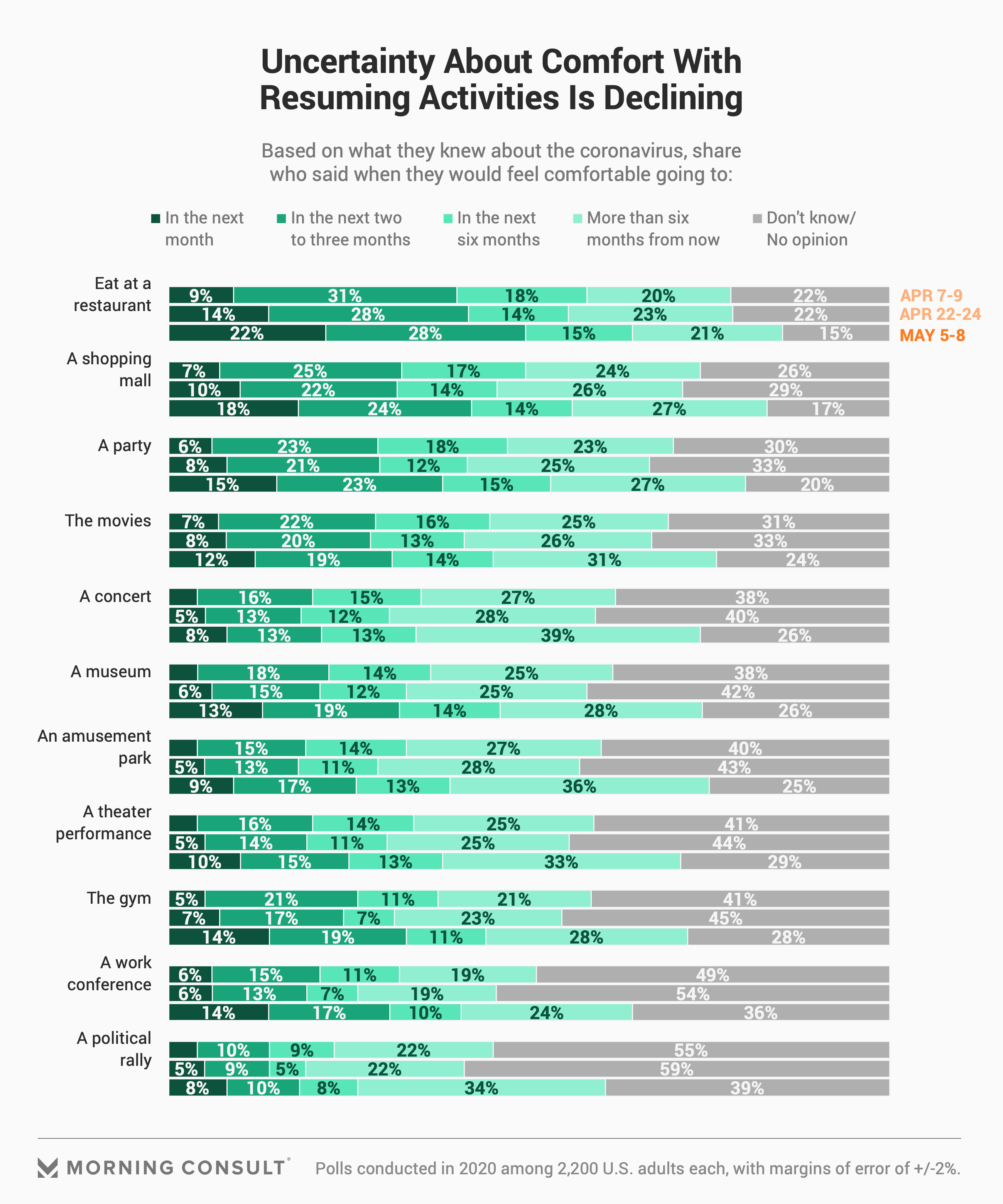
The models and economic predictions have not been accurate. What we do know with 100% certainty is that stopping the economy is terribly destructive. And polls like the one above are just a picture in time.

Even the polling data you posted - which is 2-3 weeks old - shows a substantial amount of economic activity would resume immediately. And those polls were taken before death rates plateaued/dropped and businesses adopted mitigation measures that will only increase public confidence (e.g., the airlines new policies). We will not immediately resume to 100% of activity. But that is not the standard.

The short terms benefits of reopening with mitigation are clear - there will be at least some short term economic benefits. The long terms benefits and risks are uncertain (and subject to intervening events, like vaccines, treatments, and unrelated circumstances such as oil shocks and elections).

People are scared and that is reflected in the polls. But polls/people are notoriously fickle. There were similar polls in 2007-8 related to the housing meltdown (i.e., people claiming they would never again purchase homes and the real estate market would take decades to recover). On the whole, those were not accurate and within a few years, things had returned to normal.

People are scared to the point of some irrationality - such as not going to the dentist when all dentists use PPE. But as death rates decline, the risks are better understood (e.g., low infection/death rates), PPE and other mitigation measures become commonplace, and other societal adjustments are made, many (not all) people will resume economic activity very quickly. People's memories are short and the desire to engage in commerce is strong. If you don't believe that, go to any beach, park, or other place where activity is permitted. And those who don't reengage, probably should not (elderly/sick).

You keep saying that people will not engage if they feel unsafe. That's true to a large extent. But you've not said what is going to happen in the next few weeks or months to make people feel more safe. The truth is that in the short run, there's unlikely to be a single event that restores confidence - even a vaccine will not be perfect.

What is the risk of reopening now? Presumably a spike in infection. But unless we wait for a vaccine or magic treatment, that is going to happen no matter what.

There is a process in place to reopen with mitigation measures which is the best way to restore confidence. Doing nothing - and continuing to fear monger - won't restore confidence. It just perpetuates suffering and the other real costs.
LMK5
How long do you want to ignore this user?
Unit2Sucks said:

LMK5 said:


Unit2, what makes you say people are afraid to engage in in-person commerce?
I can't tell if you are just asking questions or if you actually care about the answers. I've already posted about this topic in this very thread.

To recap, I'm basing it on data I've seen and which I've already posted in this thread. Here's an article that digs into it. I suggest you read it because it may answer other questions you have. I've seen some other non-public data that is along the same lines that I have access to professionally.

Anecdotally what you are seeing is that when access is restricted, there are going to be bottlenecks, but that doesn't mean that if our economy became unrestricted over night that we would see a return to 100% of activity. The question is really around the margins - how much more activity converts from online to offline without the SIP in place and does the economic benefit of that outweigh the negative public health consequences. As you can see from the NYT article (or other data if you care to look for it), the economy is being ravaged because of the virus, and not just because some governors have chosen to put SIP orders in place to attempt to further prevent the spread of COVID.


You somehow just can't stop yourself from saying crap like "I can't tell if you are just asking questions or if you actually care about the answers." It's a clear indication that you've been presented with a reasonable argument. Why not just address the issues instead of evading and insulting?

Who for the love of God said "if our economy became unrestricted over night that we would see a return to 100% of activity." No one said that. Yet another straw man on your tally. Because business comes back initially at something less than 100% it's not worth it? I almost wonder if you're afraid we'll succeed.

No matter what anyone says, there is pent up demand and sitting in SIP is not an option for a vibrant society. Let's leave it up to the business people and their customers. If it's not worth it, they'll close and try again later. Personal accountability. I was at the beach in San Clemente on Saturday and it was crowded. Bumper-to-bumper traffic. Stores have been and continue to be crowded everywhere I go. I don't need an article to tell me otherwise. Not everyone is afraid. Some of us are familiar with the infection rates where we live, and know how to filter out the media when necessary. France is opening up; Italy is opening up; the UK is opening up; and so is Spain. All of those countries have higher death rates per capita than the US. What calculations have they made that you see as pure folly? Is it also in your "non-public data" that you won't share?

The truth lies somewhere between CNN and Fox.
LMK5
How long do you want to ignore this user?
71Bear said:

LMK5 said:

Unit2Sucks said:

BearGoggles said:

Unit2Sucks said:

BearGoggles said:


You keep posting this same drivel, without acknowledging that those (on the left and right) who advocate for SIP similarly cannot provide evidence of the unknown risk and unknown benefits of SIP. How many lives will be saved by continued SIP and how much economic damage will result (as compared to lifting SIP sooner, rather than later)? You don't know. NOBODY knows.

You have theories on demand shock - it is just a theory, not evidence. You have policy preferences and theories, not science.

What are the health risks of continued SIP? We don't know, but we know there will be deaths resulting from poverty and SIP. CNN says up to 75,000 https://www.cnn.com/2020/05/08/health/coronavirus-deaths-of-despair/index.html

For you, it always comes down to demonizing the right or conservatives. it is rather sad. There are some conservatives who want continued SIP (and are highly critical of Trump). And there are some progressives who want SIP removed in large part. But acknowledging that proven reality interferes with your "hate the right" narrative. So carry on.


You keep posting this same drivel, without acknowledging that those (on the left and right) who advocate against SIP similarly cannot provide evidence of the unknown risk and unknown benefits of ending SIP. How many lives will be saved by ending SIP and how much economic benefit will result (as compared to lifting SIP later, rather than sooner)? You don't know. NOBODY knows.

You have policy preferences and theories, not science or economics.

What are the health risks of ending SIP now? We don't know, but we know there will be deaths resulting from poverty and SIP because our economy will continue to be diminished just as it was before the SIP orders went into effect. CNN says up to 75,000 https://www.cnn.com/2020/05/08/health/coronavirus-deaths-of-despair/index.html but that's all completely made up with no science backing it and no reason to believe ending SIP will reduce it.

What are the economic benefits of ending SIP now? We don't know but you presume to believe that whatever those benefits are will outweigh the public health benefits of continuing SIP.

Stop pretending like you are something you aren't.

Actually, I admit that there is uncertainty with both approaches. I don't assume people who reach different conclusions are bad people or have bad motivations. That is the difference between me and you.

Yes, I 'presume" to have different beliefs then you. God forbid.

As someone else posted (I think here) there are still going to be deaths, as there are with many contagious diseases and other societal risks. But the question is what risk of mortality justifies shutting down our economy, bankrupting small businesses, putting so many younger people out of work, and depleting whatever savings they might have for their families?


You seem to be overly concerned with what I think about you but honestly neither I nor anyone else here cares and you should move on.

I will just leave you with this, since debating you is a waste of everyone's time: our economy will be devastated regardless of SIP if people feel unsafe to engage in public commerce.

And guess what: people feel unsafe right now which is why across the nation you have greatly reduced mobility and in person commerce, regardless of SIP orders. This is true across every state in the US for which I've seen data. If you took the time to review the data, you would see that.

Maybe it will help you feel less bad about the SIP order. The question of what level of risk justifies shutting down our economy isn't entirely up to the politicians to decide and we cannot escape the economic consequences of an infectious disease merely by trying to convince our leaders to pretend that it doesn't exist.
Unit2, what makes you say people are afraid to engage in in-person commerce? Have you been to a Home Depot, Target, or Trader Joe's lately? They are all crowded and there can be lines to get in these stores. My daughter lives in Arizona where restaurants just opened yesterday. They wouldn't even let anyone in unless they had a reservation. When Gavin Newsom allows us to get hair cuts, do you think they'll be no lines outside Supercuts?

We can calculate only the economic toll of continuing SIP, but the societal toll will come out later. On the other hand, I have not seen anyone tell us what the expected material gains are from 4 more weeks of lockdown over and above what has already been achieved in the past 7. We are badly in need of a modified approach that lets people resume life with reasonable precautions, and those that want to shelter continue to have the freedom to do so.

Beware of policies enacted by those who have zero prospect of losing their income from said policies.
Your comment prompted me to think about what I will miss once everything begins to return to "normal".

Senior hour at Target and the grocery store (few shoppers, no check stand lines and everything you need is available), no traffic and, of course, easy money from the government......


Ah, there's a silver lining in everything if you look close enough, no?
The truth lies somewhere between CNN and Fox.
LMK5
How long do you want to ignore this user?
sycasey said:

LMK5 said:

Unit2Sucks said:

BearGoggles said:

Unit2Sucks said:

BearGoggles said:


You keep posting this same drivel, without acknowledging that those (on the left and right) who advocate for SIP similarly cannot provide evidence of the unknown risk and unknown benefits of SIP. How many lives will be saved by continued SIP and how much economic damage will result (as compared to lifting SIP sooner, rather than later)? You don't know. NOBODY knows.

You have theories on demand shock - it is just a theory, not evidence. You have policy preferences and theories, not science.

What are the health risks of continued SIP? We don't know, but we know there will be deaths resulting from poverty and SIP. CNN says up to 75,000 https://www.cnn.com/2020/05/08/health/coronavirus-deaths-of-despair/index.html

For you, it always comes down to demonizing the right or conservatives. it is rather sad. There are some conservatives who want continued SIP (and are highly critical of Trump). And there are some progressives who want SIP removed in large part. But acknowledging that proven reality interferes with your "hate the right" narrative. So carry on.


You keep posting this same drivel, without acknowledging that those (on the left and right) who advocate against SIP similarly cannot provide evidence of the unknown risk and unknown benefits of ending SIP. How many lives will be saved by ending SIP and how much economic benefit will result (as compared to lifting SIP later, rather than sooner)? You don't know. NOBODY knows.

You have policy preferences and theories, not science or economics.

What are the health risks of ending SIP now? We don't know, but we know there will be deaths resulting from poverty and SIP because our economy will continue to be diminished just as it was before the SIP orders went into effect. CNN says up to 75,000 https://www.cnn.com/2020/05/08/health/coronavirus-deaths-of-despair/index.html but that's all completely made up with no science backing it and no reason to believe ending SIP will reduce it.

What are the economic benefits of ending SIP now? We don't know but you presume to believe that whatever those benefits are will outweigh the public health benefits of continuing SIP.

Stop pretending like you are something you aren't.

Actually, I admit that there is uncertainty with both approaches. I don't assume people who reach different conclusions are bad people or have bad motivations. That is the difference between me and you.

Yes, I 'presume" to have different beliefs then you. God forbid.

As someone else posted (I think here) there are still going to be deaths, as there are with many contagious diseases and other societal risks. But the question is what risk of mortality justifies shutting down our economy, bankrupting small businesses, putting so many younger people out of work, and depleting whatever savings they might have for their families?


You seem to be overly concerned with what I think about you but honestly neither I nor anyone else here cares and you should move on.

I will just leave you with this, since debating you is a waste of everyone's time: our economy will be devastated regardless of SIP if people feel unsafe to engage in public commerce.

And guess what: people feel unsafe right now which is why across the nation you have greatly reduced mobility and in person commerce, regardless of SIP orders. This is true across every state in the US for which I've seen data. If you took the time to review the data, you would see that.

Maybe it will help you feel less bad about the SIP order. The question of what level of risk justifies shutting down our economy isn't entirely up to the politicians to decide and we cannot escape the economic consequences of an infectious disease merely by trying to convince our leaders to pretend that it doesn't exist.
Unit2, what makes you say people are afraid to engage in in-person commerce? Have you been to a Home Depot, Target, or Trader Joe's lately? They are all crowded and there can be lines to get in these stores. My daughter lives in Arizona where restaurants just opened yesterday. They wouldn't even let anyone in unless they had a reservation. When Gavin Newsom allows us to get hair cuts, do you think they'll be no lines outside Supercuts.
Are you sure these stores are crowded INSIDE? There are lines outside because they are limiting how many people can go in.
Yes, they are trying to limit occupation somewhat. Have you not been in a Costco, Home Depot, or Target? Go in and you tell me if they aren't well-patronized.
The truth lies somewhere between CNN and Fox.
LMK5
How long do you want to ignore this user?
BearGoggles said:

Unit2Sucks said:

LMK5 said:


Unit2, what makes you say people are afraid to engage in in-person commerce?
I can't tell if you are just asking questions or if you actually care about the answers. I've already posted about this topic in this very thread.

To recap, I'm basing it on data I've seen and which I've already posted in this thread. Here's an article that digs into it. I suggest you read it because it may answer other questions you have. I've seen some other non-public data that is along the same lines that I have access to professionally.

Anecdotally what you are seeing is that when access is restricted, there are going to be bottlenecks, but that doesn't mean that if our economy became unrestricted over night that we would see a return to 100% of activity. The question is really around the margins - how much more activity converts from online to offline without the SIP in place and does the economic benefit of that outweigh the negative public health consequences. As you can see from the NYT article (or other data if you care to look for it), the economy is being ravaged because of the virus, and not just because some governors have chosen to put SIP orders in place to attempt to further prevent the spread of COVID.


You seem to be claiming that the benefits of reopening are not worth the risks. But what are the risks of doing nothing, both in the short and long term?

From the LA Times "The economic devastation wrought by the pandemic could ultimately kill more people than the virus itself" https://www.latimes.com/world-nation/story/2020-05-11/more-than-a-billion-people-escaped-poverty-in-the-last-20-years-the-coronavirus-could-erase-those-gains

The models and economic predictions have not been accurate. What we do know with 100% certainty is that stopping the economy is terribly destructive. And polls like the one above are just a picture in time.

Even the polling data you posted - which is 2-3 weeks old - shows a substantial amount of economic activity would resume immediately. And those polls were taken before death rates plateaued/dropped and businesses adopted mitigation measures that will only increase public confidence (e.g., the airlines new policies). We will not immediately resume to 100% of activity. But that is not the standard.

The short terms benefits of reopening with mitigation are clear - there will be at least some short term economic benefits. The long terms benefits and risks are uncertain (and subject to intervening events, like vaccines, treatments, and unrelated circumstances such as oil shocks and elections).

People are scared and that is reflected in the polls. But polls/people are notoriously fickle. There were similar polls in 2007-8 related to the housing meltdown (i.e., people claiming they would never again purchase homes and the real estate market would take decades to recover). On the whole, those were not accurate and within a few years, things had returned to normal.

People are scared to the point of some irrationality - such as not going to the dentist when all dentists use PPE. But as death rates decline, the risks are better understood (e.g., low infection/death rates), PPE and other mitigation measures become commonplace, and other societal adjustments are made, many (not all) people will resume economic activity very quickly. People's memories are short and the desire to engage in commerce is strong. If you don't believe that, go to any beach, park, or other place where activity is permitted. And those who don't reengage, probably should not (elderly/sick).

You keep saying that people will not engage if they feel unsafe. That's true to a large extent. But you've not said what is going to happen in the next few weeks or months to make people feel more safe. The truth is that in the short run, there's unlikely to be a single event that restores confidence - even a vaccine will not be perfect.

What is the risk of reopening now? Presumably a spike in infection. But unless we wait for a vaccine or magic treatment, that is going to happen no matter what.

There is a process in place to reopen with mitigation measures which is the best way to restore confidence. Doing nothing - and continuing to fear monger - won't restore confidence. It just perpetuates suffering and the other real costs.
Certainly a candidate for post of the year. Sir, I high-five you in a virtual manner.
The truth lies somewhere between CNN and Fox.
Chabbear
How long do you want to ignore this user?
"To allow the recovery to begin, the United States must implement the kind of strategy that other countries have used to defeat the coronavirus. It must test widely to find infected people; trace their contacts, who might themselves have been infected; and isolate that potentially infectious group from the rest of the susceptible population. ...More than 10 weeks into the coronavirus crisis, too few Americans are being tested for the coronavirus, and the country's testing capacity is not growing fast enough, according to data collected by the COVID Tracking Project, a volunteer initiative housed within The Atlantic. This week, the U.S. tested about 264,000 people a day, the highest level in the pandemic so far. But experts say that if the country hopes to get its outbreak under control, it must double or triple the number of daily tests. " The Atlantic 5/8/2020
https://www.theatlantic.com/science/archive/2020/05/theres-only-one-way-out-of-this-mess/611431/?utm_source=pocket-newtab


There is more in this article but I think that this gets to the heart of the issue.

sycasey
How long do you want to ignore this user?
LMK5 said:

sycasey said:

LMK5 said:

Unit2Sucks said:

BearGoggles said:

Unit2Sucks said:

BearGoggles said:


You keep posting this same drivel, without acknowledging that those (on the left and right) who advocate for SIP similarly cannot provide evidence of the unknown risk and unknown benefits of SIP. How many lives will be saved by continued SIP and how much economic damage will result (as compared to lifting SIP sooner, rather than later)? You don't know. NOBODY knows.

You have theories on demand shock - it is just a theory, not evidence. You have policy preferences and theories, not science.

What are the health risks of continued SIP? We don't know, but we know there will be deaths resulting from poverty and SIP. CNN says up to 75,000 https://www.cnn.com/2020/05/08/health/coronavirus-deaths-of-despair/index.html

For you, it always comes down to demonizing the right or conservatives. it is rather sad. There are some conservatives who want continued SIP (and are highly critical of Trump). And there are some progressives who want SIP removed in large part. But acknowledging that proven reality interferes with your "hate the right" narrative. So carry on.


You keep posting this same drivel, without acknowledging that those (on the left and right) who advocate against SIP similarly cannot provide evidence of the unknown risk and unknown benefits of ending SIP. How many lives will be saved by ending SIP and how much economic benefit will result (as compared to lifting SIP later, rather than sooner)? You don't know. NOBODY knows.

You have policy preferences and theories, not science or economics.

What are the health risks of ending SIP now? We don't know, but we know there will be deaths resulting from poverty and SIP because our economy will continue to be diminished just as it was before the SIP orders went into effect. CNN says up to 75,000 https://www.cnn.com/2020/05/08/health/coronavirus-deaths-of-despair/index.html but that's all completely made up with no science backing it and no reason to believe ending SIP will reduce it.

What are the economic benefits of ending SIP now? We don't know but you presume to believe that whatever those benefits are will outweigh the public health benefits of continuing SIP.

Stop pretending like you are something you aren't.

Actually, I admit that there is uncertainty with both approaches. I don't assume people who reach different conclusions are bad people or have bad motivations. That is the difference between me and you.

Yes, I 'presume" to have different beliefs then you. God forbid.

As someone else posted (I think here) there are still going to be deaths, as there are with many contagious diseases and other societal risks. But the question is what risk of mortality justifies shutting down our economy, bankrupting small businesses, putting so many younger people out of work, and depleting whatever savings they might have for their families?


You seem to be overly concerned with what I think about you but honestly neither I nor anyone else here cares and you should move on.

I will just leave you with this, since debating you is a waste of everyone's time: our economy will be devastated regardless of SIP if people feel unsafe to engage in public commerce.

And guess what: people feel unsafe right now which is why across the nation you have greatly reduced mobility and in person commerce, regardless of SIP orders. This is true across every state in the US for which I've seen data. If you took the time to review the data, you would see that.

Maybe it will help you feel less bad about the SIP order. The question of what level of risk justifies shutting down our economy isn't entirely up to the politicians to decide and we cannot escape the economic consequences of an infectious disease merely by trying to convince our leaders to pretend that it doesn't exist.
Unit2, what makes you say people are afraid to engage in in-person commerce? Have you been to a Home Depot, Target, or Trader Joe's lately? They are all crowded and there can be lines to get in these stores. My daughter lives in Arizona where restaurants just opened yesterday. They wouldn't even let anyone in unless they had a reservation. When Gavin Newsom allows us to get hair cuts, do you think they'll be no lines outside Supercuts.
Are you sure these stores are crowded INSIDE? There are lines outside because they are limiting how many people can go in.
Yes, they are trying to limit occupation somewhat. Have you not been in a Costco, Home Depot, or Target? Go in and you tell me if they aren't well-patronized.
Not those stores specifically, but other grocery stores yes. There are definitely people in them but they're not "packed" (because the stores are limiting how many people can go in).
LMK5
How long do you want to ignore this user?
sycasey said:

LMK5 said:

sycasey said:

LMK5 said:

Unit2Sucks said:

BearGoggles said:

Unit2Sucks said:

BearGoggles said:


You keep posting this same drivel, without acknowledging that those (on the left and right) who advocate for SIP similarly cannot provide evidence of the unknown risk and unknown benefits of SIP. How many lives will be saved by continued SIP and how much economic damage will result (as compared to lifting SIP sooner, rather than later)? You don't know. NOBODY knows.

You have theories on demand shock - it is just a theory, not evidence. You have policy preferences and theories, not science.

What are the health risks of continued SIP? We don't know, but we know there will be deaths resulting from poverty and SIP. CNN says up to 75,000 https://www.cnn.com/2020/05/08/health/coronavirus-deaths-of-despair/index.html

For you, it always comes down to demonizing the right or conservatives. it is rather sad. There are some conservatives who want continued SIP (and are highly critical of Trump). And there are some progressives who want SIP removed in large part. But acknowledging that proven reality interferes with your "hate the right" narrative. So carry on.


You keep posting this same drivel, without acknowledging that those (on the left and right) who advocate against SIP similarly cannot provide evidence of the unknown risk and unknown benefits of ending SIP. How many lives will be saved by ending SIP and how much economic benefit will result (as compared to lifting SIP later, rather than sooner)? You don't know. NOBODY knows.

You have policy preferences and theories, not science or economics.

What are the health risks of ending SIP now? We don't know, but we know there will be deaths resulting from poverty and SIP because our economy will continue to be diminished just as it was before the SIP orders went into effect. CNN says up to 75,000 https://www.cnn.com/2020/05/08/health/coronavirus-deaths-of-despair/index.html but that's all completely made up with no science backing it and no reason to believe ending SIP will reduce it.

What are the economic benefits of ending SIP now? We don't know but you presume to believe that whatever those benefits are will outweigh the public health benefits of continuing SIP.

Stop pretending like you are something you aren't.

Actually, I admit that there is uncertainty with both approaches. I don't assume people who reach different conclusions are bad people or have bad motivations. That is the difference between me and you.

Yes, I 'presume" to have different beliefs then you. God forbid.

As someone else posted (I think here) there are still going to be deaths, as there are with many contagious diseases and other societal risks. But the question is what risk of mortality justifies shutting down our economy, bankrupting small businesses, putting so many younger people out of work, and depleting whatever savings they might have for their families?


You seem to be overly concerned with what I think about you but honestly neither I nor anyone else here cares and you should move on.

I will just leave you with this, since debating you is a waste of everyone's time: our economy will be devastated regardless of SIP if people feel unsafe to engage in public commerce.

And guess what: people feel unsafe right now which is why across the nation you have greatly reduced mobility and in person commerce, regardless of SIP orders. This is true across every state in the US for which I've seen data. If you took the time to review the data, you would see that.

Maybe it will help you feel less bad about the SIP order. The question of what level of risk justifies shutting down our economy isn't entirely up to the politicians to decide and we cannot escape the economic consequences of an infectious disease merely by trying to convince our leaders to pretend that it doesn't exist.
Unit2, what makes you say people are afraid to engage in in-person commerce? Have you been to a Home Depot, Target, or Trader Joe's lately? They are all crowded and there can be lines to get in these stores. My daughter lives in Arizona where restaurants just opened yesterday. They wouldn't even let anyone in unless they had a reservation. When Gavin Newsom allows us to get hair cuts, do you think they'll be no lines outside Supercuts.
Are you sure these stores are crowded INSIDE? There are lines outside because they are limiting how many people can go in.
Yes, they are trying to limit occupation somewhat. Have you not been in a Costco, Home Depot, or Target? Go in and you tell me if they aren't well-patronized.
Not those stores specifically, but other grocery stores yes. There are definitely people in them but they're not "packed" (because the stores are limiting how many people can go in).
Yes, but the question is whether or not the businesses will be patronized if allowed to do so. From your experience it seems the answer is yes. Should they shut their doors because they're not at 80-100%?

My experience here in OC and in Arizona also says people are patronizing businesses. I was also in 2 car dealerships on the weekend and there were people shopping for cars. The roads are also getting more crowded. When I was in Phoenix a couple weeks back there were good old fashioned traffic jams on I-10 through central Phoenix. Remember those?
The truth lies somewhere between CNN and Fox.
sycasey
How long do you want to ignore this user?
LMK5 said:

sycasey said:

LMK5 said:

sycasey said:

LMK5 said:

Unit2Sucks said:

BearGoggles said:

Unit2Sucks said:

BearGoggles said:


You keep posting this same drivel, without acknowledging that those (on the left and right) who advocate for SIP similarly cannot provide evidence of the unknown risk and unknown benefits of SIP. How many lives will be saved by continued SIP and how much economic damage will result (as compared to lifting SIP sooner, rather than later)? You don't know. NOBODY knows.

You have theories on demand shock - it is just a theory, not evidence. You have policy preferences and theories, not science.

What are the health risks of continued SIP? We don't know, but we know there will be deaths resulting from poverty and SIP. CNN says up to 75,000 https://www.cnn.com/2020/05/08/health/coronavirus-deaths-of-despair/index.html

For you, it always comes down to demonizing the right or conservatives. it is rather sad. There are some conservatives who want continued SIP (and are highly critical of Trump). And there are some progressives who want SIP removed in large part. But acknowledging that proven reality interferes with your "hate the right" narrative. So carry on.


You keep posting this same drivel, without acknowledging that those (on the left and right) who advocate against SIP similarly cannot provide evidence of the unknown risk and unknown benefits of ending SIP. How many lives will be saved by ending SIP and how much economic benefit will result (as compared to lifting SIP later, rather than sooner)? You don't know. NOBODY knows.

You have policy preferences and theories, not science or economics.

What are the health risks of ending SIP now? We don't know, but we know there will be deaths resulting from poverty and SIP because our economy will continue to be diminished just as it was before the SIP orders went into effect. CNN says up to 75,000 https://www.cnn.com/2020/05/08/health/coronavirus-deaths-of-despair/index.html but that's all completely made up with no science backing it and no reason to believe ending SIP will reduce it.

What are the economic benefits of ending SIP now? We don't know but you presume to believe that whatever those benefits are will outweigh the public health benefits of continuing SIP.

Stop pretending like you are something you aren't.

Actually, I admit that there is uncertainty with both approaches. I don't assume people who reach different conclusions are bad people or have bad motivations. That is the difference between me and you.

Yes, I 'presume" to have different beliefs then you. God forbid.

As someone else posted (I think here) there are still going to be deaths, as there are with many contagious diseases and other societal risks. But the question is what risk of mortality justifies shutting down our economy, bankrupting small businesses, putting so many younger people out of work, and depleting whatever savings they might have for their families?


You seem to be overly concerned with what I think about you but honestly neither I nor anyone else here cares and you should move on.

I will just leave you with this, since debating you is a waste of everyone's time: our economy will be devastated regardless of SIP if people feel unsafe to engage in public commerce.

And guess what: people feel unsafe right now which is why across the nation you have greatly reduced mobility and in person commerce, regardless of SIP orders. This is true across every state in the US for which I've seen data. If you took the time to review the data, you would see that.

Maybe it will help you feel less bad about the SIP order. The question of what level of risk justifies shutting down our economy isn't entirely up to the politicians to decide and we cannot escape the economic consequences of an infectious disease merely by trying to convince our leaders to pretend that it doesn't exist.
Unit2, what makes you say people are afraid to engage in in-person commerce? Have you been to a Home Depot, Target, or Trader Joe's lately? They are all crowded and there can be lines to get in these stores. My daughter lives in Arizona where restaurants just opened yesterday. They wouldn't even let anyone in unless they had a reservation. When Gavin Newsom allows us to get hair cuts, do you think they'll be no lines outside Supercuts.
Are you sure these stores are crowded INSIDE? There are lines outside because they are limiting how many people can go in.
Yes, they are trying to limit occupation somewhat. Have you not been in a Costco, Home Depot, or Target? Go in and you tell me if they aren't well-patronized.
Not those stores specifically, but other grocery stores yes. There are definitely people in them but they're not "packed" (because the stores are limiting how many people can go in).
Yes, but the question is whether or not the businesses will be patronized if allowed to do so. From your experience it seems the answer is yes. Should they shut their doors because they're not at 80-100%?

My experience here in OC and in Arizona also says people are patronizing businesses. I was also in 2 car dealerships on the weekend and there were people shopping for cars. The roads are also getting more crowded. When I was in Phoenix a couple weeks back there were good old fashioned traffic jams on I-10 through central Phoenix. Remember those?
I don't believe I said anything about whether or not those businesses should be open. I'm just not confident they would be patronized at the same rates as before, regardless of whether or not government restrictions are lifted.
BearfanEric
How long do you want to ignore this user?
Well, Californians have an option. Vote Newsom out of office. The longer he continues to stir trouble, i.e Tesla and killing the California eonomy, the more likely even the most Democrat Californians will give up on his nonsense. Let's correct these mistakes.
dimitrig
How long do you want to ignore this user?
BearfanEric said:

Well, Californians have an option. Vote Newsom out of office. The longer he continues to stir trouble, i.e Tesla and killing the California eonomy, the more likely even the most Democrat Californians will give up on his nonsense. Let's correct these mistakes.


I think Newsom's popularity is growing, not waning, unless you live in Republican strongholds.

LMK5
How long do you want to ignore this user?
sycasey said:

LMK5 said:

sycasey said:

LMK5 said:

sycasey said:

LMK5 said:

Unit2Sucks said:

BearGoggles said:

Unit2Sucks said:

BearGoggles said:


You keep posting this same drivel, without acknowledging that those (on the left and right) who advocate for SIP similarly cannot provide evidence of the unknown risk and unknown benefits of SIP. How many lives will be saved by continued SIP and how much economic damage will result (as compared to lifting SIP sooner, rather than later)? You don't know. NOBODY knows.

You have theories on demand shock - it is just a theory, not evidence. You have policy preferences and theories, not science.

What are the health risks of continued SIP? We don't know, but we know there will be deaths resulting from poverty and SIP. CNN says up to 75,000 https://www.cnn.com/2020/05/08/health/coronavirus-deaths-of-despair/index.html

For you, it always comes down to demonizing the right or conservatives. it is rather sad. There are some conservatives who want continued SIP (and are highly critical of Trump). And there are some progressives who want SIP removed in large part. But acknowledging that proven reality interferes with your "hate the right" narrative. So carry on.


You keep posting this same drivel, without acknowledging that those (on the left and right) who advocate against SIP similarly cannot provide evidence of the unknown risk and unknown benefits of ending SIP. How many lives will be saved by ending SIP and how much economic benefit will result (as compared to lifting SIP later, rather than sooner)? You don't know. NOBODY knows.

You have policy preferences and theories, not science or economics.

What are the health risks of ending SIP now? We don't know, but we know there will be deaths resulting from poverty and SIP because our economy will continue to be diminished just as it was before the SIP orders went into effect. CNN says up to 75,000 https://www.cnn.com/2020/05/08/health/coronavirus-deaths-of-despair/index.html but that's all completely made up with no science backing it and no reason to believe ending SIP will reduce it.

What are the economic benefits of ending SIP now? We don't know but you presume to believe that whatever those benefits are will outweigh the public health benefits of continuing SIP.

Stop pretending like you are something you aren't.

Actually, I admit that there is uncertainty with both approaches. I don't assume people who reach different conclusions are bad people or have bad motivations. That is the difference between me and you.

Yes, I 'presume" to have different beliefs then you. God forbid.

As someone else posted (I think here) there are still going to be deaths, as there are with many contagious diseases and other societal risks. But the question is what risk of mortality justifies shutting down our economy, bankrupting small businesses, putting so many younger people out of work, and depleting whatever savings they might have for their families?


You seem to be overly concerned with what I think about you but honestly neither I nor anyone else here cares and you should move on.

I will just leave you with this, since debating you is a waste of everyone's time: our economy will be devastated regardless of SIP if people feel unsafe to engage in public commerce.

And guess what: people feel unsafe right now which is why across the nation you have greatly reduced mobility and in person commerce, regardless of SIP orders. This is true across every state in the US for which I've seen data. If you took the time to review the data, you would see that.

Maybe it will help you feel less bad about the SIP order. The question of what level of risk justifies shutting down our economy isn't entirely up to the politicians to decide and we cannot escape the economic consequences of an infectious disease merely by trying to convince our leaders to pretend that it doesn't exist.
Unit2, what makes you say people are afraid to engage in in-person commerce? Have you been to a Home Depot, Target, or Trader Joe's lately? They are all crowded and there can be lines to get in these stores. My daughter lives in Arizona where restaurants just opened yesterday. They wouldn't even let anyone in unless they had a reservation. When Gavin Newsom allows us to get hair cuts, do you think they'll be no lines outside Supercuts.
Are you sure these stores are crowded INSIDE? There are lines outside because they are limiting how many people can go in.
Yes, they are trying to limit occupation somewhat. Have you not been in a Costco, Home Depot, or Target? Go in and you tell me if they aren't well-patronized.
Not those stores specifically, but other grocery stores yes. There are definitely people in them but they're not "packed" (because the stores are limiting how many people can go in).
Yes, but the question is whether or not the businesses will be patronized if allowed to do so. From your experience it seems the answer is yes. Should they shut their doors because they're not at 80-100%?

My experience here in OC and in Arizona also says people are patronizing businesses. I was also in 2 car dealerships on the weekend and there were people shopping for cars. The roads are also getting more crowded. When I was in Phoenix a couple weeks back there were good old fashioned traffic jams on I-10 through central Phoenix. Remember those?
I don't believe I said anything about whether or not those businesses should be open. I'm just not confident they would be patronized at the same rates as before, regardless of whether or not government restrictions are lifted.
Certainly it will take a while for business to ramp up, similar to flying after 9/11. But we have no choice.
The truth lies somewhere between CNN and Fox.
BearGoggles
How long do you want to ignore this user?
sycasey said:

LMK5 said:

sycasey said:

LMK5 said:

sycasey said:

LMK5 said:

Unit2Sucks said:

BearGoggles said:

Unit2Sucks said:

BearGoggles said:


You keep posting this same drivel, without acknowledging that those (on the left and right) who advocate for SIP similarly cannot provide evidence of the unknown risk and unknown benefits of SIP. How many lives will be saved by continued SIP and how much economic damage will result (as compared to lifting SIP sooner, rather than later)? You don't know. NOBODY knows.

You have theories on demand shock - it is just a theory, not evidence. You have policy preferences and theories, not science.

What are the health risks of continued SIP? We don't know, but we know there will be deaths resulting from poverty and SIP. CNN says up to 75,000 https://www.cnn.com/2020/05/08/health/coronavirus-deaths-of-despair/index.html

For you, it always comes down to demonizing the right or conservatives. it is rather sad. There are some conservatives who want continued SIP (and are highly critical of Trump). And there are some progressives who want SIP removed in large part. But acknowledging that proven reality interferes with your "hate the right" narrative. So carry on.


You keep posting this same drivel, without acknowledging that those (on the left and right) who advocate against SIP similarly cannot provide evidence of the unknown risk and unknown benefits of ending SIP. How many lives will be saved by ending SIP and how much economic benefit will result (as compared to lifting SIP later, rather than sooner)? You don't know. NOBODY knows.

You have policy preferences and theories, not science or economics.

What are the health risks of ending SIP now? We don't know, but we know there will be deaths resulting from poverty and SIP because our economy will continue to be diminished just as it was before the SIP orders went into effect. CNN says up to 75,000 https://www.cnn.com/2020/05/08/health/coronavirus-deaths-of-despair/index.html but that's all completely made up with no science backing it and no reason to believe ending SIP will reduce it.

What are the economic benefits of ending SIP now? We don't know but you presume to believe that whatever those benefits are will outweigh the public health benefits of continuing SIP.

Stop pretending like you are something you aren't.

Actually, I admit that there is uncertainty with both approaches. I don't assume people who reach different conclusions are bad people or have bad motivations. That is the difference between me and you.

Yes, I 'presume" to have different beliefs then you. God forbid.

As someone else posted (I think here) there are still going to be deaths, as there are with many contagious diseases and other societal risks. But the question is what risk of mortality justifies shutting down our economy, bankrupting small businesses, putting so many younger people out of work, and depleting whatever savings they might have for their families?


You seem to be overly concerned with what I think about you but honestly neither I nor anyone else here cares and you should move on.

I will just leave you with this, since debating you is a waste of everyone's time: our economy will be devastated regardless of SIP if people feel unsafe to engage in public commerce.

And guess what: people feel unsafe right now which is why across the nation you have greatly reduced mobility and in person commerce, regardless of SIP orders. This is true across every state in the US for which I've seen data. If you took the time to review the data, you would see that.

Maybe it will help you feel less bad about the SIP order. The question of what level of risk justifies shutting down our economy isn't entirely up to the politicians to decide and we cannot escape the economic consequences of an infectious disease merely by trying to convince our leaders to pretend that it doesn't exist.
Unit2, what makes you say people are afraid to engage in in-person commerce? Have you been to a Home Depot, Target, or Trader Joe's lately? They are all crowded and there can be lines to get in these stores. My daughter lives in Arizona where restaurants just opened yesterday. They wouldn't even let anyone in unless they had a reservation. When Gavin Newsom allows us to get hair cuts, do you think they'll be no lines outside Supercuts.
Are you sure these stores are crowded INSIDE? There are lines outside because they are limiting how many people can go in.
Yes, they are trying to limit occupation somewhat. Have you not been in a Costco, Home Depot, or Target? Go in and you tell me if they aren't well-patronized.
Not those stores specifically, but other grocery stores yes. There are definitely people in them but they're not "packed" (because the stores are limiting how many people can go in).
Yes, but the question is whether or not the businesses will be patronized if allowed to do so. From your experience it seems the answer is yes. Should they shut their doors because they're not at 80-100%?

My experience here in OC and in Arizona also says people are patronizing businesses. I was also in 2 car dealerships on the weekend and there were people shopping for cars. The roads are also getting more crowded. When I was in Phoenix a couple weeks back there were good old fashioned traffic jams on I-10 through central Phoenix. Remember those?
I don't believe I said anything about whether or not those businesses should be open. I'm just not confident they would be patronized at the same rates as before, regardless of whether or not government restrictions are lifted.
I'm genuinely confused. What difference does it make that businesses are less busy? That is expected. The larger issue is that a steady flow of people are in fact willing to engage in commerce and/or go to public spaces.

The article below has more recent polling data than Unit2 posted as well as historical data. As expected, slowly but surely, people are gaining confidence. I fully expect the overall trend to continue, with potential blips along the way.


https://morningconsult.com/2020/05/11/consumer-polling-comfort-eating-out/
BearfanEric
How long do you want to ignore this user?
I don't know if that is correct or not, but based on how he has been acting lately, I would hope not.
sycasey
How long do you want to ignore this user?
BearGoggles said:

sycasey said:

LMK5 said:

sycasey said:

LMK5 said:

sycasey said:

LMK5 said:

Unit2Sucks said:

BearGoggles said:

Unit2Sucks said:

BearGoggles said:


You keep posting this same drivel, without acknowledging that those (on the left and right) who advocate for SIP similarly cannot provide evidence of the unknown risk and unknown benefits of SIP. How many lives will be saved by continued SIP and how much economic damage will result (as compared to lifting SIP sooner, rather than later)? You don't know. NOBODY knows.

You have theories on demand shock - it is just a theory, not evidence. You have policy preferences and theories, not science.

What are the health risks of continued SIP? We don't know, but we know there will be deaths resulting from poverty and SIP. CNN says up to 75,000 https://www.cnn.com/2020/05/08/health/coronavirus-deaths-of-despair/index.html

For you, it always comes down to demonizing the right or conservatives. it is rather sad. There are some conservatives who want continued SIP (and are highly critical of Trump). And there are some progressives who want SIP removed in large part. But acknowledging that proven reality interferes with your "hate the right" narrative. So carry on.


You keep posting this same drivel, without acknowledging that those (on the left and right) who advocate against SIP similarly cannot provide evidence of the unknown risk and unknown benefits of ending SIP. How many lives will be saved by ending SIP and how much economic benefit will result (as compared to lifting SIP later, rather than sooner)? You don't know. NOBODY knows.

You have policy preferences and theories, not science or economics.

What are the health risks of ending SIP now? We don't know, but we know there will be deaths resulting from poverty and SIP because our economy will continue to be diminished just as it was before the SIP orders went into effect. CNN says up to 75,000 https://www.cnn.com/2020/05/08/health/coronavirus-deaths-of-despair/index.html but that's all completely made up with no science backing it and no reason to believe ending SIP will reduce it.

What are the economic benefits of ending SIP now? We don't know but you presume to believe that whatever those benefits are will outweigh the public health benefits of continuing SIP.

Stop pretending like you are something you aren't.

Actually, I admit that there is uncertainty with both approaches. I don't assume people who reach different conclusions are bad people or have bad motivations. That is the difference between me and you.

Yes, I 'presume" to have different beliefs then you. God forbid.

As someone else posted (I think here) there are still going to be deaths, as there are with many contagious diseases and other societal risks. But the question is what risk of mortality justifies shutting down our economy, bankrupting small businesses, putting so many younger people out of work, and depleting whatever savings they might have for their families?


You seem to be overly concerned with what I think about you but honestly neither I nor anyone else here cares and you should move on.

I will just leave you with this, since debating you is a waste of everyone's time: our economy will be devastated regardless of SIP if people feel unsafe to engage in public commerce.

And guess what: people feel unsafe right now which is why across the nation you have greatly reduced mobility and in person commerce, regardless of SIP orders. This is true across every state in the US for which I've seen data. If you took the time to review the data, you would see that.

Maybe it will help you feel less bad about the SIP order. The question of what level of risk justifies shutting down our economy isn't entirely up to the politicians to decide and we cannot escape the economic consequences of an infectious disease merely by trying to convince our leaders to pretend that it doesn't exist.
Unit2, what makes you say people are afraid to engage in in-person commerce? Have you been to a Home Depot, Target, or Trader Joe's lately? They are all crowded and there can be lines to get in these stores. My daughter lives in Arizona where restaurants just opened yesterday. They wouldn't even let anyone in unless they had a reservation. When Gavin Newsom allows us to get hair cuts, do you think they'll be no lines outside Supercuts.
Are you sure these stores are crowded INSIDE? There are lines outside because they are limiting how many people can go in.
Yes, they are trying to limit occupation somewhat. Have you not been in a Costco, Home Depot, or Target? Go in and you tell me if they aren't well-patronized.
Not those stores specifically, but other grocery stores yes. There are definitely people in them but they're not "packed" (because the stores are limiting how many people can go in).
Yes, but the question is whether or not the businesses will be patronized if allowed to do so. From your experience it seems the answer is yes. Should they shut their doors because they're not at 80-100%?

My experience here in OC and in Arizona also says people are patronizing businesses. I was also in 2 car dealerships on the weekend and there were people shopping for cars. The roads are also getting more crowded. When I was in Phoenix a couple weeks back there were good old fashioned traffic jams on I-10 through central Phoenix. Remember those?
I don't believe I said anything about whether or not those businesses should be open. I'm just not confident they would be patronized at the same rates as before, regardless of whether or not government restrictions are lifted.
I'm genuinely confused. What difference does it make that businesses are less busy? That is expected. The larger issue is that a steady flow of people are in fact willing to engage in commerce and/or go to public spaces.

The article below has more recent polling data than Unit2 posted as well as historical data. As expected, slowly but surely, people are gaining confidence. I fully expect the overall trend to continue, with potential blips along the way.
I bring up the point about businesses having less volume because it seems like the primary argument for removing the lockdown/shelter-in-place rules is to "restart" the economy. We should just be aware that a restart will not be a full restart regardless of what the government does.

I would expect people to gain confidence in going out and patronizing businesses, UNLESS there is another outbreak of the virus, which has been noted as a distinct possibility by experts. That would be more than a "blip" -- it would basically be wiping out all the gains from reopening and going back to square one for the region in which it happens. I don't know for sure that that will happen, but the chances go up the more people start to move around.
BearlyCareAnymore
How long do you want to ignore this user?
BearGoggles said:

sycasey said:

LMK5 said:

sycasey said:

LMK5 said:

sycasey said:

LMK5 said:

Unit2Sucks said:

BearGoggles said:

Unit2Sucks said:

BearGoggles said:


You keep posting this same drivel, without acknowledging that those (on the left and right) who advocate for SIP similarly cannot provide evidence of the unknown risk and unknown benefits of SIP. How many lives will be saved by continued SIP and how much economic damage will result (as compared to lifting SIP sooner, rather than later)? You don't know. NOBODY knows.

You have theories on demand shock - it is just a theory, not evidence. You have policy preferences and theories, not science.

What are the health risks of continued SIP? We don't know, but we know there will be deaths resulting from poverty and SIP. CNN says up to 75,000 https://www.cnn.com/2020/05/08/health/coronavirus-deaths-of-despair/index.html

For you, it always comes down to demonizing the right or conservatives. it is rather sad. There are some conservatives who want continued SIP (and are highly critical of Trump). And there are some progressives who want SIP removed in large part. But acknowledging that proven reality interferes with your "hate the right" narrative. So carry on.


You keep posting this same drivel, without acknowledging that those (on the left and right) who advocate against SIP similarly cannot provide evidence of the unknown risk and unknown benefits of ending SIP. How many lives will be saved by ending SIP and how much economic benefit will result (as compared to lifting SIP later, rather than sooner)? You don't know. NOBODY knows.

You have policy preferences and theories, not science or economics.

What are the health risks of ending SIP now? We don't know, but we know there will be deaths resulting from poverty and SIP because our economy will continue to be diminished just as it was before the SIP orders went into effect. CNN says up to 75,000 https://www.cnn.com/2020/05/08/health/coronavirus-deaths-of-despair/index.html but that's all completely made up with no science backing it and no reason to believe ending SIP will reduce it.

What are the economic benefits of ending SIP now? We don't know but you presume to believe that whatever those benefits are will outweigh the public health benefits of continuing SIP.

Stop pretending like you are something you aren't.

Actually, I admit that there is uncertainty with both approaches. I don't assume people who reach different conclusions are bad people or have bad motivations. That is the difference between me and you.

Yes, I 'presume" to have different beliefs then you. God forbid.

As someone else posted (I think here) there are still going to be deaths, as there are with many contagious diseases and other societal risks. But the question is what risk of mortality justifies shutting down our economy, bankrupting small businesses, putting so many younger people out of work, and depleting whatever savings they might have for their families?


You seem to be overly concerned with what I think about you but honestly neither I nor anyone else here cares and you should move on.

I will just leave you with this, since debating you is a waste of everyone's time: our economy will be devastated regardless of SIP if people feel unsafe to engage in public commerce.

And guess what: people feel unsafe right now which is why across the nation you have greatly reduced mobility and in person commerce, regardless of SIP orders. This is true across every state in the US for which I've seen data. If you took the time to review the data, you would see that.

Maybe it will help you feel less bad about the SIP order. The question of what level of risk justifies shutting down our economy isn't entirely up to the politicians to decide and we cannot escape the economic consequences of an infectious disease merely by trying to convince our leaders to pretend that it doesn't exist.
Unit2, what makes you say people are afraid to engage in in-person commerce? Have you been to a Home Depot, Target, or Trader Joe's lately? They are all crowded and there can be lines to get in these stores. My daughter lives in Arizona where restaurants just opened yesterday. They wouldn't even let anyone in unless they had a reservation. When Gavin Newsom allows us to get hair cuts, do you think they'll be no lines outside Supercuts.
Are you sure these stores are crowded INSIDE? There are lines outside because they are limiting how many people can go in.
Yes, they are trying to limit occupation somewhat. Have you not been in a Costco, Home Depot, or Target? Go in and you tell me if they aren't well-patronized.
Not those stores specifically, but other grocery stores yes. There are definitely people in them but they're not "packed" (because the stores are limiting how many people can go in).
Yes, but the question is whether or not the businesses will be patronized if allowed to do so. From your experience it seems the answer is yes. Should they shut their doors because they're not at 80-100%?

My experience here in OC and in Arizona also says people are patronizing businesses. I was also in 2 car dealerships on the weekend and there were people shopping for cars. The roads are also getting more crowded. When I was in Phoenix a couple weeks back there were good old fashioned traffic jams on I-10 through central Phoenix. Remember those?
I don't believe I said anything about whether or not those businesses should be open. I'm just not confident they would be patronized at the same rates as before, regardless of whether or not government restrictions are lifted.
I'm genuinely confused. What difference does it make that businesses are less busy? That is expected. The larger issue is that a steady flow of people are in fact willing to engage in commerce and/or go to public spaces.

The article below has more recent polling data than Unit2 posted as well as historical data. As expected, slowly but surely, people are gaining confidence. I fully expect the overall trend to continue, with potential blips along the way.


https://morningconsult.com/2020/05/11/consumer-polling-comfort-eating-out/
Now I'm genuinely confused. Of course it makes a difference if they are less busy. Businesses have a lot of costs associated with just being open. Maybe a particular restaurant needs 50 customers in a night to break even. Only on hitting customer 51 do they start making profit. Such a restaurant that goes from 80 customers to 40 customers doesn't make half the profit. It shuts its doors.

I don't really see that poll as good. Large majority are not comfortable going out now. They are more confident they will be able to go out later because they are optimistic the circumstances will be better. I don't see that someone that says they will feel comfortable going to a restaurant in 6 months helps the circumstances. They are guessing about the state of the pandemic. Circumstances may change for the better or worse before then changing their opinion before it becomes relevant. It may turn out they are willing to go out in 3 months. It may turn out in 6 months they still aren't comfortable. I'd guess that I would go to a restaurant within 6 months because I'm hopeful we will either be over this thing or at least there will be a lull. But if it is the same as now, I won't be going out.

BearGoggles
How long do you want to ignore this user?
OaktownBear said:

BearGoggles said:

sycasey said:

LMK5 said:

sycasey said:

LMK5 said:

sycasey said:

LMK5 said:

Unit2Sucks said:

BearGoggles said:

Unit2Sucks said:

BearGoggles said:


You keep posting this same drivel, without acknowledging that those (on the left and right) who advocate for SIP similarly cannot provide evidence of the unknown risk and unknown benefits of SIP. How many lives will be saved by continued SIP and how much economic damage will result (as compared to lifting SIP sooner, rather than later)? You don't know. NOBODY knows.

You have theories on demand shock - it is just a theory, not evidence. You have policy preferences and theories, not science.

What are the health risks of continued SIP? We don't know, but we know there will be deaths resulting from poverty and SIP. CNN says up to 75,000 https://www.cnn.com/2020/05/08/health/coronavirus-deaths-of-despair/index.html

For you, it always comes down to demonizing the right or conservatives. it is rather sad. There are some conservatives who want continued SIP (and are highly critical of Trump). And there are some progressives who want SIP removed in large part. But acknowledging that proven reality interferes with your "hate the right" narrative. So carry on.


You keep posting this same drivel, without acknowledging that those (on the left and right) who advocate against SIP similarly cannot provide evidence of the unknown risk and unknown benefits of ending SIP. How many lives will be saved by ending SIP and how much economic benefit will result (as compared to lifting SIP later, rather than sooner)? You don't know. NOBODY knows.

You have policy preferences and theories, not science or economics.

What are the health risks of ending SIP now? We don't know, but we know there will be deaths resulting from poverty and SIP because our economy will continue to be diminished just as it was before the SIP orders went into effect. CNN says up to 75,000 https://www.cnn.com/2020/05/08/health/coronavirus-deaths-of-despair/index.html but that's all completely made up with no science backing it and no reason to believe ending SIP will reduce it.

What are the economic benefits of ending SIP now? We don't know but you presume to believe that whatever those benefits are will outweigh the public health benefits of continuing SIP.

Stop pretending like you are something you aren't.

Actually, I admit that there is uncertainty with both approaches. I don't assume people who reach different conclusions are bad people or have bad motivations. That is the difference between me and you.

Yes, I 'presume" to have different beliefs then you. God forbid.

As someone else posted (I think here) there are still going to be deaths, as there are with many contagious diseases and other societal risks. But the question is what risk of mortality justifies shutting down our economy, bankrupting small businesses, putting so many younger people out of work, and depleting whatever savings they might have for their families?


You seem to be overly concerned with what I think about you but honestly neither I nor anyone else here cares and you should move on.

I will just leave you with this, since debating you is a waste of everyone's time: our economy will be devastated regardless of SIP if people feel unsafe to engage in public commerce.

And guess what: people feel unsafe right now which is why across the nation you have greatly reduced mobility and in person commerce, regardless of SIP orders. This is true across every state in the US for which I've seen data. If you took the time to review the data, you would see that.

Maybe it will help you feel less bad about the SIP order. The question of what level of risk justifies shutting down our economy isn't entirely up to the politicians to decide and we cannot escape the economic consequences of an infectious disease merely by trying to convince our leaders to pretend that it doesn't exist.
Unit2, what makes you say people are afraid to engage in in-person commerce? Have you been to a Home Depot, Target, or Trader Joe's lately? They are all crowded and there can be lines to get in these stores. My daughter lives in Arizona where restaurants just opened yesterday. They wouldn't even let anyone in unless they had a reservation. When Gavin Newsom allows us to get hair cuts, do you think they'll be no lines outside Supercuts.
Are you sure these stores are crowded INSIDE? There are lines outside because they are limiting how many people can go in.
Yes, they are trying to limit occupation somewhat. Have you not been in a Costco, Home Depot, or Target? Go in and you tell me if they aren't well-patronized.
Not those stores specifically, but other grocery stores yes. There are definitely people in them but they're not "packed" (because the stores are limiting how many people can go in).
Yes, but the question is whether or not the businesses will be patronized if allowed to do so. From your experience it seems the answer is yes. Should they shut their doors because they're not at 80-100%?

My experience here in OC and in Arizona also says people are patronizing businesses. I was also in 2 car dealerships on the weekend and there were people shopping for cars. The roads are also getting more crowded. When I was in Phoenix a couple weeks back there were good old fashioned traffic jams on I-10 through central Phoenix. Remember those?
I don't believe I said anything about whether or not those businesses should be open. I'm just not confident they would be patronized at the same rates as before, regardless of whether or not government restrictions are lifted.
I'm genuinely confused. What difference does it make that businesses are less busy? That is expected. The larger issue is that a steady flow of people are in fact willing to engage in commerce and/or go to public spaces.

The article below has more recent polling data than Unit2 posted as well as historical data. As expected, slowly but surely, people are gaining confidence. I fully expect the overall trend to continue, with potential blips along the way.


https://morningconsult.com/2020/05/11/consumer-polling-comfort-eating-out/
Now I'm genuinely confused. Of course it makes a difference if they are less busy. Businesses have a lot of costs associated with just being open. Maybe a particular restaurant needs 50 customers in a night to break even. Only on hitting customer 51 do they start making profit. Such a restaurant that goes from 80 customers to 40 customers doesn't make half the profit. It shuts its doors.

I don't really see that poll as good. Large majority are not comfortable going out now. They are more confident they will be able to go out later because they are optimistic the circumstances will be better. I don't see that someone that says they will feel comfortable going to a restaurant in 6 months helps the circumstances. They are guessing about the state of the pandemic. Circumstances may change for the better or worse before then changing their opinion before it becomes relevant. It may turn out they are willing to go out in 3 months. It may turn out in 6 months they still aren't comfortable. I'd guess that I would go to a restaurant within 6 months because I'm hopeful we will either be over this thing or at least there will be a lull. But if it is the same as now, I won't be going out.


The poll is not good if things stay as they are today. My point is things likely will change - the trend shows that more people will reengage as time goes on. I expect momentum to build - people will see others going to restaurants, etc., and follow suit. And reopening will facilitate that. Certainly, we'll never know unless we reopen. And I'm sure there will be blips along the way (i.e., spikes).

And I agree - some businesses won't be able to operate profitably with the current restrictions and currently anticipated reduced customer levels. Particularly restaurants who will have mandated 50% occupancy and high fixed costs (not to mention labor shortages due to the extra unemployment benefits paid to low wage earners). Some may elect to stay closed or go out of business. But many will give it a shot and try to find a way to adjust their cost structure.

But many people will operate businesses even at reduced capacity. For example salons, medical, etc. It will be a mixed bag. And if I'm wrong and you're right (i.e., many people don't engage in commerce now), what is the economic harm of trying to restart early? We know for certain that MANY businesses will fail if we do nothing. Some of those business will make it by restarting now. I can't think of a single scenario where a business would fail if we reopen now, but would have made if if we delay further.

I posted elsewhere that a big reckoning is coming for retail center owners/landlords and their lenders. Either they will make adjustments or lose a lot of tenants.
Unit2Sucks
How long do you want to ignore this user?
BearGoggles said:


I can't think of a single scenario where a business would fail if we reopen now, but would have made if if we delay further.

Unfortunately, your inability to identify potential scenarios isn't controlling. For anyone interested, I've outlined two potential scenarios below of how this might go.

Scenario A: We open the whole country tomorrow. 80% of people don't feel comfortable widely engaging in in-person commerce. 20% of people do feel comfortable and do so vigorously, except that the social distancing measures are unsuccessful in theory or in practice. As a result, we suffer through many months of greatly diminished commerce because we are unable to tamp down spread of COVID and people continue to feel unsafe and remain at home. Perhaps, even worse, COVID spreads more widely than anticipated, and numerous states and localities are forced to endure second or even third SIP orders. The results are devastating to local businesses who have by now been completely depleted of resources and our federal government is no longer interested in extending financial disaster aid. And because we open up far and wide, the virus spreads easily from places that are current hotspots to places that are currently safe. Because of the difficulty limiting travel within the states, we can never really isolate open regions.

Scenario B: We remain in SIP until some period of time has elapsed where we have made far more of the populace comfortable engaging in commerce. N95 masks are widely available and in use by all employee-facing workers in commerce, as well as in applicable back of the house roles. We are successful in reducing the spread of COVID and our economy returns to almost full strength much quicker than in Scenario A.

This has been widely discussed and there are plenty of fine people who would argue that one side or the other is more likely. Conceptually, if we are "too early", Scenario A is the result. If not, Scenario B is the result. I can't say whether we're in Scenario A or B in any particular location although I suspect the answer is that there are many areas that are in Scenario B and can safely reopen (with mitigation measures in place) and some places that are too early. I've brought it up many times here and read numerous others who have said essentially the same thing.

We are all hoping for Scenario B to be the case everywhere that reopens. Unfortunately, that doesn't mean Scenario A won't occur if we're wrong.
hanky1
How long do you want to ignore this user?
Read me:

https://www.wsj.com/articles/elon-musk-is-our-new-aclu-11589322149
oskidunker
How long do you want to ignore this user?
Behind a pay wall.
Bring back It’s It’s to Haas Pavillion!
bearister
How long do you want to ignore this user?
hanky1 said:

Read me:

https://www.wsj.com/articles/elon-musk-is-our-new-aclu-11589322149


Why does it make perfect sense that anyone that would support a POTUS with the emotional maturity of a 10 year old would dig a business leader with the emotional maturity of a 12 year old. Both of these boys are earmarked for self destruction.


Cancel my subscription to the Resurrection
Send my credentials to the House of Detention

“I love Cal deeply. What are the directions to The Portal from Sproul Plaza?”
BearGoggles
How long do you want to ignore this user?
Unit2Sucks said:

BearGoggles said:


I can't think of a single scenario where a business would fail if we reopen now, but would have made if if we delay further.

Unfortunately, your inability to identify potential scenarios isn't controlling. For anyone interested, I've outlined two potential scenarios below of how this might go.

Scenario A: We open the whole country tomorrow. 80% of people don't feel comfortable widely engaging in in-person commerce. 20% of people do feel comfortable and do so vigorously, except that the social distancing measures are unsuccessful in theory or in practice. As a result, we suffer through many months of greatly diminished commerce because we are unable to tamp down spread of COVID and people continue to feel unsafe and remain at home. Perhaps, even worse, COVID spreads more widely than anticipated, and numerous states and localities are forced to endure second or even third SIP orders. The results are devastating to local businesses who have by now been completely depleted of resources and our federal government is no longer interested in extending financial disaster aid. And because we open up far and wide, the virus spreads easily from places that are current hotspots to places that are currently safe. Because of the difficulty limiting travel within the states, we can never really isolate open regions.

Scenario B: We remain in SIP until some period of time has elapsed where we have made far more of the populace comfortable engaging in commerce. N95 masks are widely available and in use by all employee-facing workers in commerce, as well as in applicable back of the house roles. We are successful in reducing the spread of COVID and our economy returns to almost full strength much quicker than in Scenario A.

This has been widely discussed and there are plenty of fine people who would argue that one side or the other is more likely. Conceptually, if we are "too early", Scenario A is the result. If not, Scenario B is the result. I can't say whether we're in Scenario A or B in any particular location although I suspect the answer is that there are many areas that are in Scenario B and can safely reopen (with mitigation measures in place) and some places that are too early. I've brought it up many times here and read numerous others who have said essentially the same thing.

We are all hoping for Scenario B to be the case everywhere that reopens. Unfortunately, that doesn't mean Scenario A won't occur if we're wrong.
This is fantastic - the best example yet of your twisting and not responding to the statement I made. I note you did not include my full post which specifically said that many businesses would not reopen - i.e., if they felt it did not make economic sense because the "afraid people" won't patronize them. Gyms are a great example of that.

My comment that you quoted was specifically referencing businesses that would choose to reopen now for economic reasons even with reduced revenue (the post I was responding to). I specifically said "Some may elect to stay closed or go out of business. But many will give it a shot and try to find a way to adjust their cost structure." You conveniently edited that out (aka the "Chuck Todd move").

Again, using a restaurant as an example, they all pay rent and have other costs which they have to pay no matter what (equipment leasing, insurance, utilities, security, etc.). So they will open even if they are paying only a portion of those costs - which is better than the owner writing a check for the full amount every month. Or stated differently, they will only remain closed if they can't cover their marginal costs - which is very unlikely for most businesses, particularly if they can adjust their cost structure as I originally mentioned. And those that can't cover marginal costs, will close and likely go out of business - exactly what I said originally.

I also note that your scenario A ignores the reality that most businesses have fixed costs and have owners that rely on the business for income (i.e., to feed their family). Many if not most businesses cannot (or will not) keep paying fixed costs and remain closed for an extended period. So your "depletion of resources" argument just doesn't make sense, particularly when you are unwilling (and unable) to tell me exactly how long SIP will continue under your scenario B. And again, businesses that reopen will at least cover their marginal costs - or they won't remain open. So they won't be depleting resources faster than remaining closed.

The amazing thing is that you admit you don't know how long SIP will take to "restore confidence" yet also claim that there are "many" areas that are already in Scenario B - all after posting graphs and articles showing that consumer confidence is low. So, according to you, we're in scenario B in many places, yet you keep repeating that we can't reopen because consumer confidence is too low. If that's the case, how are we in Scenario B? It literally makes no sense.

You admit many areas are in Scenario B and likely safe to reopen. It's almost like you don't want to reopen in those areas for some other reason - economy be damned.
LMK5
How long do you want to ignore this user?
MinotStateBeav said:

I just gotta say...I live in a place of about 20,000 people in Oregon. We have 2 big box stores for hardware Lowe's and Home Depot. I was going to get an electrical light on/off switch. I drive by Home Depot and there's a line of people bunched up. Because Home Depot is only letting so many people in the store (I think it was 50). Anyway..my jaw dropped because they're basically creating a problem that was never there. By stopping people from entering they're just bunching people up lol.
Exactly. It's called Covid theater.
The truth lies somewhere between CNN and Fox.
Unit2Sucks
How long do you want to ignore this user?
BearGoggles said:

Unit2Sucks said:

BearGoggles said:


I can't think of a single scenario where a business would fail if we reopen now, but would have made if if we delay further.

Unfortunately, your inability to identify potential scenarios isn't controlling. For anyone interested, I've outlined two potential scenarios below of how this might go.

Scenario A: We open the whole country tomorrow. 80% of people don't feel comfortable widely engaging in in-person commerce. 20% of people do feel comfortable and do so vigorously, except that the social distancing measures are unsuccessful in theory or in practice. As a result, we suffer through many months of greatly diminished commerce because we are unable to tamp down spread of COVID and people continue to feel unsafe and remain at home. Perhaps, even worse, COVID spreads more widely than anticipated, and numerous states and localities are forced to endure second or even third SIP orders. The results are devastating to local businesses who have by now been completely depleted of resources and our federal government is no longer interested in extending financial disaster aid. And because we open up far and wide, the virus spreads easily from places that are current hotspots to places that are currently safe. Because of the difficulty limiting travel within the states, we can never really isolate open regions.

Scenario B: We remain in SIP until some period of time has elapsed where we have made far more of the populace comfortable engaging in commerce. N95 masks are widely available and in use by all employee-facing workers in commerce, as well as in applicable back of the house roles. We are successful in reducing the spread of COVID and our economy returns to almost full strength much quicker than in Scenario A.

This has been widely discussed and there are plenty of fine people who would argue that one side or the other is more likely. Conceptually, if we are "too early", Scenario A is the result. If not, Scenario B is the result. I can't say whether we're in Scenario A or B in any particular location although I suspect the answer is that there are many areas that are in Scenario B and can safely reopen (with mitigation measures in place) and some places that are too early. I've brought it up many times here and read numerous others who have said essentially the same thing.

We are all hoping for Scenario B to be the case everywhere that reopens. Unfortunately, that doesn't mean Scenario A won't occur if we're wrong.
This is fantastic - the best example yet of your twisting and not responding to the statement I made. I note you did not include my full post which specifically said that many businesses would not reopen - i.e., if they felt it did not make economic sense because the "afraid people" won't patronize them. Gyms are a great example of that.

My comment that you quoted was specifically referencing businesses that would choose to reopen now for economic reasons even with reduced revenue (the post I was responding to). I specifically said "Some may elect to stay closed or go out of business. But many will give it a shot and try to find a way to adjust their cost structure." You conveniently edited that out (aka the "Chuck Todd move").

Again, using a restaurant as an example, they all pay rent and have other costs which they have to pay no matter what (equipment leasing, insurance, utilities, security, etc.). So they will open even if they are paying only a portion of those costs - which is better than the owner writing a check for the full amount every month. Or stated differently, they will only remain closed if they can't cover their marginal costs - which is very unlikely for most businesses, particularly if they can adjust their cost structure as I originally mentioned. And those that can't cover marginal costs, will close and likely go out of business - exactly what I said originally.

I also note that your scenario A ignores the reality that most businesses have fixed costs and have owners that rely on the business for income (i.e., to feed their family). Many if not most businesses cannot (or will not) keep paying fixed costs and remain closed for an extended period. So your "depletion of resources" argument just doesn't make sense, particularly when you are unwilling (and unable) to tell me exactly how long SIP will continue under your scenario B. And again, businesses that reopen will at least cover their marginal costs - or they won't remain open. So they won't be depleting resources faster than remaining closed.

The amazing thing is that you admit you don't know how long SIP will take to "restore confidence" yet also claim that there are "many" areas that are already in Scenario B - all after posting graphs and articles showing that consumer confidence is low. So, according to you, we're in scenario B in many places, yet you keep repeating that we can't reopen because consumer confidence is too low. If that's the case, how are we in Scenario B? It literally makes no sense.

You admit many areas are in Scenario B and likely safe to reopen. It's almost like you don't want to reopen in those areas for some other reason - economy be damned.
Try though you might, you can't change facts through your force of will. I would say it must be nice to live in a world devoid of uncertainty, which you pretend to do, but in reality you just ignore what's out there. A perfect example is the data you cited above which doesn't say what you think it says. What it really shows is that a month later, a number of people moved from the "don't know/no opinion" category to other categories, based on what they were seeing and feeling. Also, we are a month later, so you would have expected people to have progressed through the funnel. For example - my brother would have said he was two to three months from eating at a restaurant in April and now he would say that it would be in a month. As OTB pointed out, it wasn't a positive result, but you either failed to appreciate that or just blustered through in your attempt to bludgeon everyone into your world view.

No one can say when SIP will end because it will depend on the locations and their progress. LA is struggling more than other places, so it may take longer there. We can all agree that there would have been no point to entering SIP and then exiting a week later, so theoretically everyone (but you) seems to understand that there is a "too early". Whether we are "too early" will depend on a variety of factors. Not coincidentally, Newsom enumerated criteria for reopening.

We all seem to agree that the worst thing we can do for the economy is to reopen and then be forced to SIP again. I would imagine that regardless of how bad things get, you will argue that we should never SIP and that SIP was ineffective. What a number of people want to believe is that we can just sacrifice the old and infirm and that everyone who manages to survive will be better off for it. Maybe you are in that camp, maybe you aren't, I have no idea. But what I do know is that you prefer to ignore the uncertainty.

As for your last statement, once again you are making things up. I believe we should reopen where it's safe to do so. If you read the comment to which you replied again, you will realize that is what I am saying but perhaps you don't actually care. I will say it again - in many places it is already safe to reopen with mitigation measures in place. Montana is a perfect example but there are others. I do think that the safety measures will be key.

I'm making this post not because I'm naive enough to believe that you it will change your mind, but just to ensure that other people have the opportunity to understand what I am saying, without your churlish spin. You're a smart dude and obviously gifted at arguing, but your gifts don't extend to altering reality and the reality is that we are in a time of uncertainty. Your original claim to which I objected was that you couldn't foresee a scenario in which it would be better for business to open later. I merely pointed out (as have many others), that such a scenario exists and has been foreseen.
 
×
subscribe Verify your student status
See Subscription Benefits
Trial only available to users who have never subscribed or participated in a previous trial.