



Looking at what likely has to happen to make the tourney, how many think it can happen, especially if Dort's back either for Stanford or SMU in 9 days?
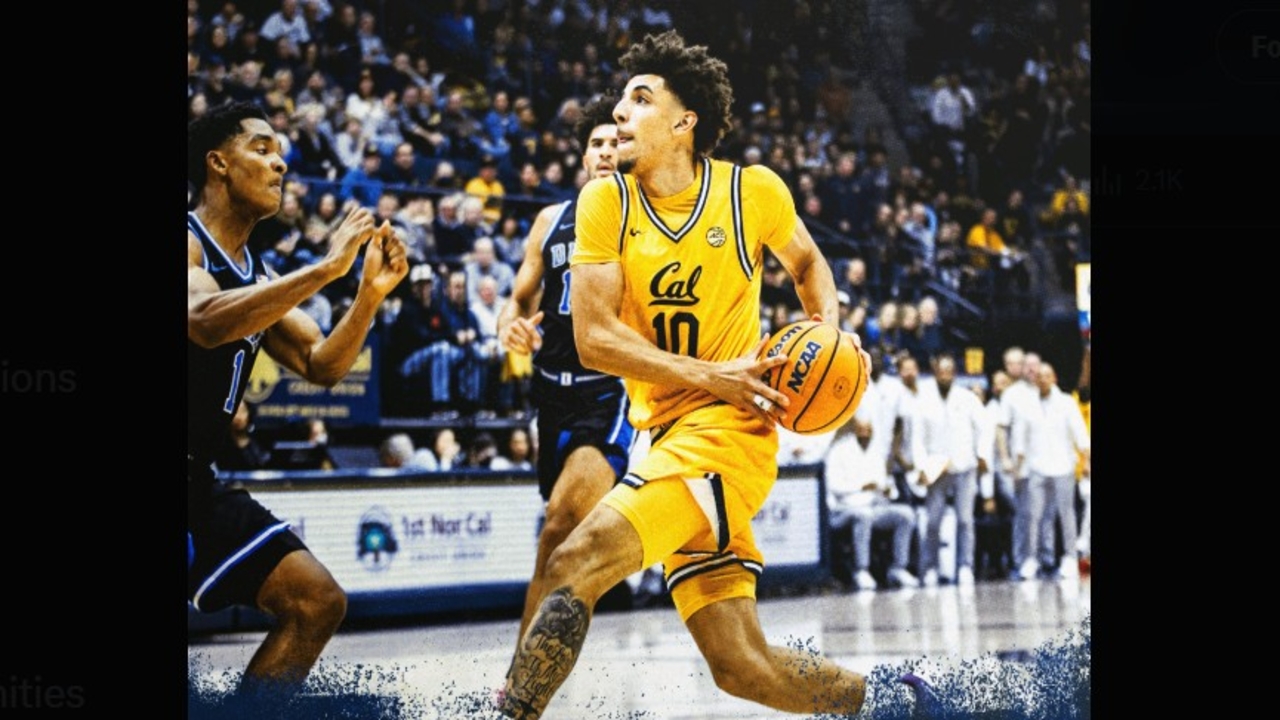
Photo by X / Cal Basketball
The Bears are entering crunch time as they prepare to face rival Stanford Saturday at 3 pm at Haas Pavilion. Coming in at 18-8 and 6-7 in conference play, the Bears currently sit in 10th in the ACC standings.
After starting strong with a fairly light non-conference schedule at 12-1, which included a 9-game win streak, the conference season started rough for the Bears with a blowout loss to #17 Louisville at home and a 1-4 start in ACC play. However, the start was heavily influenced by the front end of the schedule being stacked with many of the top teams in the conference and since the rough start, the Bears have responded well, including a home victory over #14 UNC, a come-from-behind road victory over Stanford and a thrilling 86-85 upset win on the road at Miami.

Forward John Camden
After their successful rebound from the tough conference start, the Bears have stumbled in recent weeks, including a blowout 77-55 home loss to Clemson and a tough 107-100 loss in 2OT at Syracuse last week. They were able to bounce back with a convincing 86-75 road win at Boston College on Saturday before heading back home.
The Bears have been led by guard Dai Dai Ames (17.1 points), Justin Pippen (14.9 points, 4.4 assists, 4 rebounds), John Camden (14.2 points, 4.7 rebounds, Chris Bell 13.5 points and Lee Dort (8.3 points, 7.7 rebounds prior to missing the last 7 games with a leg injury). Head coach Mark Madsen noted that there’s a reasonable chance the big man could return this weekend. That could be huge in the Bears’ efforts to finish strong, as could more quality minutes from 6-8/240 soph forward Sammie Yeanay as he continues to get healthier.

Center Lee Dort
While the Bears have been on the bubble in recent weeks for NCAA tournament selection, the big loss to Clemson hurt their chances, with most sources of reference putting them just outside likely selection.
The NCAA selection committee evaluates teams using both resume-based metrics and predictive metrics. Here is where Cal currently stands across the major systems:
NET Ranking (NCAA’s Official Metric)
The Bears’ current NET Ranking is 61. It was 51 after Miami win, rose to 55 after Georgia Tech win, dropped to 59 after Clemson loss and is now 60 after the Syracuse loss and BC win. The NET rewards quality wins, especially on the road. Cal’s NET peaked at 45 during the non-conference season and has fluctuated between 50 and 60 during ACC play. A NET ranking in the 50-60 range puts Cal on the bubble but not safely in the field.
Strength of Schedule & Quadrant Record
Strength of Schedule (SOS): Cal’s 1.08 (150th nationally per Sports Reference) is a weakness. Their non-conference SOS is ranked around 255-325 depending on the metric – a serious red flag.
Cal’s Quad 1 record is strong at 4-5 (wins over UNC at home, UCLA on neutral, Miami on road, Stanford on road). This is where the Bears’ case is the strongest. Their record of Quad 1/Quad 2 combined is 4-7. They have no bad losses (no Quad 3 or Quad 4 losses), which is a positive.
KenPom Ratings
Cal’s KenPom ranking dropped significantly after the Clemson blowout, plummeting from 54 to 71. KenPom is a predictive metric and Cal’s predictive metrics have lagged behind their resume metrics – a concern for the committee.
ESPN BPI (Basketball Power Index)
BPI and predictive rankings place Cal generally in the 60s-70s range. ESPN’s Bubble Watch consensus gives Cal approximately a 31% at-large probability. BPI represents how many points above/below average a team is and factors into ESPN’s season simulations
Bart Torvik (T-Rank)
The Torvik rating has Cal in the 60s-70s range in predictive metrics. Like KenPom, Torvik uses adjusted efficiency margins to project team quality. Cal’s predictive metrics in the 70s are a significant concern. The committee wants to see alignment between resume and predictive metrics.
Resume Metrics (SOR, KPI, WAB)
Resume-based metrics rank Cal higher than predictive ones, approximately in the mid-to-high 40s. Bleacher Report listed Cal’s RES (resume average of SOR, KPI, WAB) at 47.0 and QUAL (predictive average) at 72.0. The SOR (Strength of Record) measures how difficult Cal’s win-loss record is to achieve. This gap between resume (47) and predictive (72) metrics creates uncertainty for the committee.
Going forward
Cal has 5 regular season games remaining after the Boston College win. Here is a detailed look at each opponent:
Game 1: vs. Stanford (Home) – Saturday, Feb. 21
Stanford is 16-9 overall, 4-7 ACC (12th in ACC standings). While the win at Stanford is considered a Quad 1 win, this game is looking like a Quad 2 game with it being at home, depending on NET fluctuations. Stanford has moved between Q1 and Q2 recently. Cal won the first matchup at Stanford 69-60 on Jan. 24 (that win has since moved up to Quad 1 status). A win keeps the momentum going. A loss to a bubble-adjacent team would be damaging but not catastrophic
Game 2: vs. SMU (Home) – Wednesday, Feb. 25
SMU is currently 17-7 overall, 6-5 ACC (8th in ACC standings). It will likely be a Quad 1 (home, if SMU NET is top 30) or high Quad 2. SMU is an NCAA Tournament-level team and this is the only remaining game against a projected tournament team so a win would be a good resume builder and a loss could be surviveable if they win out the rest of the schedule. The game is Cal’s biggest remaining regular season game.
Game 3: vs. Pittsburgh (Home) – Saturday, Feb 28
Pitt is currently 9-17 overall, 2-11 ACC (tied for last in ACC). It will be a Quad 3 or Quad 4 game for the Bears. This is a must-win game. A loss to Pitts would be devastating to Cal’s tournament hopes
Game 4: at Georgia Tech (Road) – Wednesday, March 4
Georgia Tech’s current record is 11-15 overall, 2-11 ACC (17th in ACC) It should be a Quad 3 (road, roughly NET 150+) game. The Bears beat Georgia Tech 90-85 at home on Feb. 4. A loss here would be a Quad 3 loss and effectively end tournament hopes.
Game 5: at Wake Forest (Road) – Saturday, March 7
Wake Forest is currently 13-12 overall, 4-8 ACC (14th in ACC). Wake is currently a Quad 1 game. The Demon Deacons have been inconsistent but plays competitively at home. This road game closes the regular season. A win would be a solid Quad 1 result but a loss could be hard to overcome.
Path to the NCAA Tournament
Best-Case Scenario:
Win 4 or 5 of 5 Remaining (22-9 or 23-8). Going 5-0 (finishing 23-8, 11-7 ACC) would likely put Cal firmly in the field as an 11 or 12 seed. Going 4-1 with the loss coming at Wake Forest would still leave Cal in fairly strong position, especially if the SMU win is in hand
A win over SMU is the single most important remaining game for resume purposes. 22+ wins with no bad losses and 4-5 Quad 1 wins makes a compelling case for the Bears.
Realistic Scenario: Win 3 of 5 (21-9)
Going 3-2 (21-9, 9-9 ACC) leaves Cal sweating on Selection Sunday. This would likely put Cal as one of the “Last Four In” or “First Four Out” - likely the latter. In this scenario, the ACC Tournament becomes critical – Cal would likely need at least one win there. The quality of the 3 wins matters. Beating SMU + 2 others is much better than losing to SMU and beating the 3 weaker opponents
Worst-Case Scenario: Win 2 or Fewer (20-10 or worse)
Going 2-3 or worse would almost certainly require winning the ACC Tournament to make the NCAA Tournament. Cal cannot afford any Quad 3 or Quad 4 losses (Pittsburgh at home, Georgia Tech on road). A loss to Pitt would be a near-fatal blow to at-large hopes.
Key Number: 23 Wins
Multiple analysts have cited 23 wins as the target for Cal to feel safe on Selection Sunday. That means going 5-0 in remaining regular season games, or 4-1 plus an ACC Tournament win.
Buckle up, Bear fans! A tourney berth for the first time in 10 years seemed wildly improbable coming into this season but if a few things go the Bears way in the next few games, it just might be time to dust off your dancing shoees.
Never miss the latest news from Bear Insider!
Join our free email list




