
Too bad they couldn't flush the supply lines during the rehab.
Breaking News
3,187,471 Views |
20839 Replies |
Last: 1 day ago by Aunburdened
Sam Bankman-Fried of FTX officially applies for a Presidential pardon.
He's 2 years into a 25 year sentence.
I wonder if he has wetted any beaks.
Bearister?
He's 2 years into a 25 year sentence.
I wonder if he has wetted any beaks.
Bearister?
Patch: Massive Warehouse Fire Destroys Tracy Medical Supply Facility Multiple Blazes Reported
A million-square-foot medical supply warehouse sent black smoke billowing into the sky, and a nearby vegetation fire spread to 10.5 acres.
A million-square-foot medical supply warehouse sent black smoke billowing into the sky, and a nearby vegetation fire spread to 10.5 acres.
Trump at UFC Freedom 250 on Sunday:

“Cancel my subscription to the Resurrection
Send my credentials to the House of Detention
I got some friends inside”
—Jim Morrison
“I love Cal deeply, by the way, what are the directions to The Portal from Sproul Plaza?”
Send my credentials to the House of Detention
I got some friends inside”
—Jim Morrison
“I love Cal deeply, by the way, what are the directions to The Portal from Sproul Plaza?”
Innocent teenager stabbed in the throat.
Horrific scenes out of Burnley, England today as a 17yr old girl is stabbed in the throat in broad daylight. pic.twitter.com/yjoTiAF8Lg
— Tommy Robinson 🇬🇧 (@TRobinsonNewEra) June 12, 2026
Source: The Berkeley Scanner Dead body found at UC Berkeley https://share.google/EYJZ5lmB5F483SK5b
“Cancel my subscription to the Resurrection
Send my credentials to the House of Detention
I got some friends inside”
—Jim Morrison
“I love Cal deeply, by the way, what are the directions to The Portal from Sproul Plaza?”
Send my credentials to the House of Detention
I got some friends inside”
—Jim Morrison
“I love Cal deeply, by the way, what are the directions to The Portal from Sproul Plaza?”
https://www.instagram.com/reel/DZfzRt9yDnP/?igsh=MTc4MmM1YmI2Ng==
Two officers run over in The City. Gruesome.
Two officers run over in The City. Gruesome.
Does anyone have a solution to the recent aggressive pop up at the bottom of the mobile version of the BI page that makes the entire site as jumpy as when a thread is overloaded with videos?
Is downloading a pop up blocker the only solution? It is buzz killing the experience here.
Is downloading a pop up blocker the only solution? It is buzz killing the experience here.
“Cancel my subscription to the Resurrection
Send my credentials to the House of Detention
I got some friends inside”
—Jim Morrison
“I love Cal deeply, by the way, what are the directions to The Portal from Sproul Plaza?”
Send my credentials to the House of Detention
I got some friends inside”
—Jim Morrison
“I love Cal deeply, by the way, what are the directions to The Portal from Sproul Plaza?”
bearister said:
Does anyone have a solution to the recent aggressive pop up at the bottom of the mobile version of the BI page that makes the entire site as jumpy as when a thread is overloaded with videos?
Is downloading a pop up blocker the only solution? It is buzz killing the experience here.
Pay for premium?
Are there pop up blockers for mobile? I'm sure there are, just never thought of it before.
Source: The Berkeley Scanner Camp staffer arrested after child sexual assault at UC Berkeley https://share.google/q9DFllAws8FUttk6K
“Cancel my subscription to the Resurrection
Send my credentials to the House of Detention
I got some friends inside”
—Jim Morrison
“I love Cal deeply, by the way, what are the directions to The Portal from Sproul Plaza?”
Send my credentials to the House of Detention
I got some friends inside”
—Jim Morrison
“I love Cal deeply, by the way, what are the directions to The Portal from Sproul Plaza?”
bearister said:
Trump at UFC Freedom 250 on Sunday:
Trump should bring out Maduro in between rounds pic.twitter.com/z3CT4M9wt8
— Mostly Peaceful Memes (@MostlyPeaceful) June 15, 2026
bearister said:
Trump at UFC Freedom 250 on Sunday:
The President paid to get the epic flyover UFC photo, and it was well worth whatever it cost. But stop to consider that he got this picture for free. pic.twitter.com/0MhOFb7zB3
— Michael Knowles (@michaeljknowles) June 15, 2026
bearister said:
Trump at UFC Freedom 250 on Sunday:
This image is like those memes from 2016 of Trump crossing the Delaware with Washington on a tank playing an electric guitar or whatever, except this photo is real. pic.twitter.com/XFbdwMa4qz
— Michael Knowles (@michaeljknowles) June 15, 2026
"Brewers ace Jacob Misiorowski yet again broke his own record for the fastest pitch of the pitch-tracking era (since 2008), throwing a 104.5 mph fastball in Friday's 6-0 win over the Phillies as part of one of the greatest pitching performances in MLB history.
The Miz struck out 15, walked none and allowed just one hit in the 95-pitch shutout a near-perfect game that continued his historic hot streak. Since May 1, he's 7-0 with 80 strikeouts, 9 walks and a 0.17 ERA, the lowest in any eight-start span since earned runs became official in 1913."
YahooSportsAM
The Miz struck out 15, walked none and allowed just one hit in the 95-pitch shutout a near-perfect game that continued his historic hot streak. Since May 1, he's 7-0 with 80 strikeouts, 9 walks and a 0.17 ERA, the lowest in any eight-start span since earned runs became official in 1913."
YahooSportsAM
“Cancel my subscription to the Resurrection
Send my credentials to the House of Detention
I got some friends inside”
—Jim Morrison
“I love Cal deeply, by the way, what are the directions to The Portal from Sproul Plaza?”
Send my credentials to the House of Detention
I got some friends inside”
—Jim Morrison
“I love Cal deeply, by the way, what are the directions to The Portal from Sproul Plaza?”
Estados Unidos de America.
— Piro (@piroabrazo) June 15, 2026
Mundial de Fútbol.
Finales de la NBA.
UFC en la Casa Blanca.
Todo el mismo fin de semana.
Digan lo que quieran de los yankees. Pero que se divierten, se recontra divierten. pic.twitter.com/AoPxDKnYcm
"United States of America.
World Cup.
NBA Finals.
UFC at the White House.
All in the same weekend.
Say what you want about the Yankees. But they know how to have fun. They have a blast."
A report from the Fed found that illegal immigration alone accounted for increases in home prices of 30% and in rental prices of 20%.
— AF Post (@AFpost) June 18, 2026
The real impact is likely much higher when factoring in authorized immigrants who were given generous financing.
Follow: @AFpost pic.twitter.com/OQkH0A5ZvA
I remember many of you giving a poster here a hard time for claiming this was true. Well….
BearlySane88 said:A report from the Fed found that illegal immigration alone accounted for increases in home prices of 30% and in rental prices of 20%.
— AF Post (@AFpost) June 18, 2026
The real impact is likely much higher when factoring in authorized immigrants who were given generous financing.
Follow: @AFpost pic.twitter.com/OQkH0A5ZvA
I remember many of you giving a poster here a hard time for claiming this was true. Well….
Some Liberal know-it-alls here believe illegal immigrants aren't buying homes. They obviously know few, converse w few, and don't understand common folk realities today.
I wonder if tequila believes in climate change
Censorship has always been a tool of the fascist
Imagine if a real weather catastrophe close to the 1930s Dust Bowl happened today.

https://www.nydailynews.com/2022/04/13/haunting-vintage-images-of-the-1930s-dust-bowl/
The 1930s are still the hottest decade in recorded modern US history.


https://www.facebook.com/groups/453353528124367/posts/25803477332685304/
https://www.nydailynews.com/2022/04/13/haunting-vintage-images-of-the-1930s-dust-bowl/
The 1930s are still the hottest decade in recorded modern US history.
https://www.facebook.com/groups/453353528124367/posts/25803477332685304/
Cal88 said:
Imagine if a real weather catastrophe close to the 1930s Dust Bowl happened today.
https://www.nydailynews.com/2022/04/13/haunting-vintage-images-of-the-1930s-dust-bowl/
The 1930s are still the hottest decade in recorded modern US history.
https://www.facebook.com/groups/453353528124367/posts/25803477332685304/
Please provide the same data for Africa
Censorship has always been a tool of the fascist
dajo9 said:Cal88 said:
Imagine if a real weather catastrophe close to the 1930s Dust Bowl happened today.
https://www.nydailynews.com/2022/04/13/haunting-vintage-images-of-the-1930s-dust-bowl/
The 1930s are still the hottest decade in recorded modern US history.
https://www.facebook.com/groups/453353528124367/posts/25803477332685304/
Please provide the same data for Africa
There you go.
The Sahara is shrinking, Africa is greening.
https://www.thegwpf.org/images/stories/gwpf-reports/mueller-sahel.pdf
" The Sahel is greening
The people living in the Sahel, a semiarid area just south of the Sahara desert, spanning the entire African continent from the Atlantic Ocean to the Red Sea, were suffering from several devastating droughts and famines between the late 1960s and the early 1990s. The draughts were triggered by decreases in rainfall from the early 1950s to the mid-1980s.1
Global warming was supposed to increase the frequency and severity of the droughts, which would make crop-growing unviable and cause even worse famines.2 According to the United Nations, the outlook for the people in the Sahel was bleak.3
The Sahel is greening
However in sharp contrast to this gloomy outlook, it seems that global warming has exactly the opposite effect on the Sahara and the Sahel. The Sahara is actually shrinking, with vegetation arising on land where there was nothing but sand and rocks before.4 The southern border of the Sahara has been retreating since the early 1980s, making farming viable again in what were some of the most arid parts of Africa. There has been a spectacular regeneration of vegetation in northern Burkina Faso, which was devastated by drought and advancing deserts 20 years ago. It is now growing so much greener that families who fled to wetter coastal regions are starting to come back. There are now more trees, more grassland for livestock and a 70% increase in yields of local cereals such sorghum and millet in recent years. Vegetation has also increased significantly in the past 15 years in southern Mauritania, north-western Niger, central Chad, much of Sudan and parts of Eritrea.5
In Burkina Faso and Mali, production of millet rose by 55 percent and 35 percent, respectively, since 1980.6 Satellite photos, taken between 1982 and 2002, revealed the extensive re-greening throughout the Sahel.7 Aerial photographs and interviews with local people have confirmed the increase in vegetation.8
Causes of the greening
The main reason for the greening of the Sahara and the Sahel has been an increase in rainfall since the mid-1980s.9 Of the 40 rainfall stations across the Sahel, most of them have been observing an increase in rainfall.10 If sustained, the increasing rainfalls could revitalize drought-ravaged regions, reclaiming them for farming.11
The United Nations' Africa Report of 2008 confirmed that the greening of the Sahel is now well established and that increases in rainfall are the main driver of the change in the vegetation cover. The report noted that there was a 50% increase in vegetation in parts of Mali, Mauritania and Chad during 1982-2003.12 Vegetation changes play a significant role in the rainfall variability.13 The increase in rainfall has allowed more plants to grow, which in turn increases precipitation even more. Plants transfer moisture from the soil into the air by evaporation from their leaves and hold water in the soil close to the surface, where it can also evaporate. The darker surface of plants compared with sand also absorb more solar radiation, which can create convection and turbulence in the atmosphere which might create rainfall. Vegetation effects account for around 30 percent of annual rainfall variation in the Sahel.14 The increased vegetation will fix the soil, enhance its anti-wind erosion ability, reduce the possibility of released dust and consequently cause a decline in the numbers of sand-dust storms.15
However, the greening cannot be explained solely by the increase in rainfall. There were vegetation increases in areas where rainfall was decreasing, suggesting another factor was responsible for the greening in these areas.16 This other factor might have been the rise of atmospheric CO2 levels. The aerial fertilization effect of the ongoing rise in the air's CO2 concentration increases greatly the productivity of plants. The more CO2 there is in the air, the better plants grow. Rising atmospheric CO2 levels also have an antitranspiration effect, which enhances the water-use efficiency of plants and enables them to grow in areas that were once too dry for them.17
https://www.nasa.gov/centers-and-facilities/goddard/carbon-dioxide-fertilization-greening-earth-study-finds/
Carbon Dioxide Fertilization Greening Earth, Study Finds
Karl B. Hille
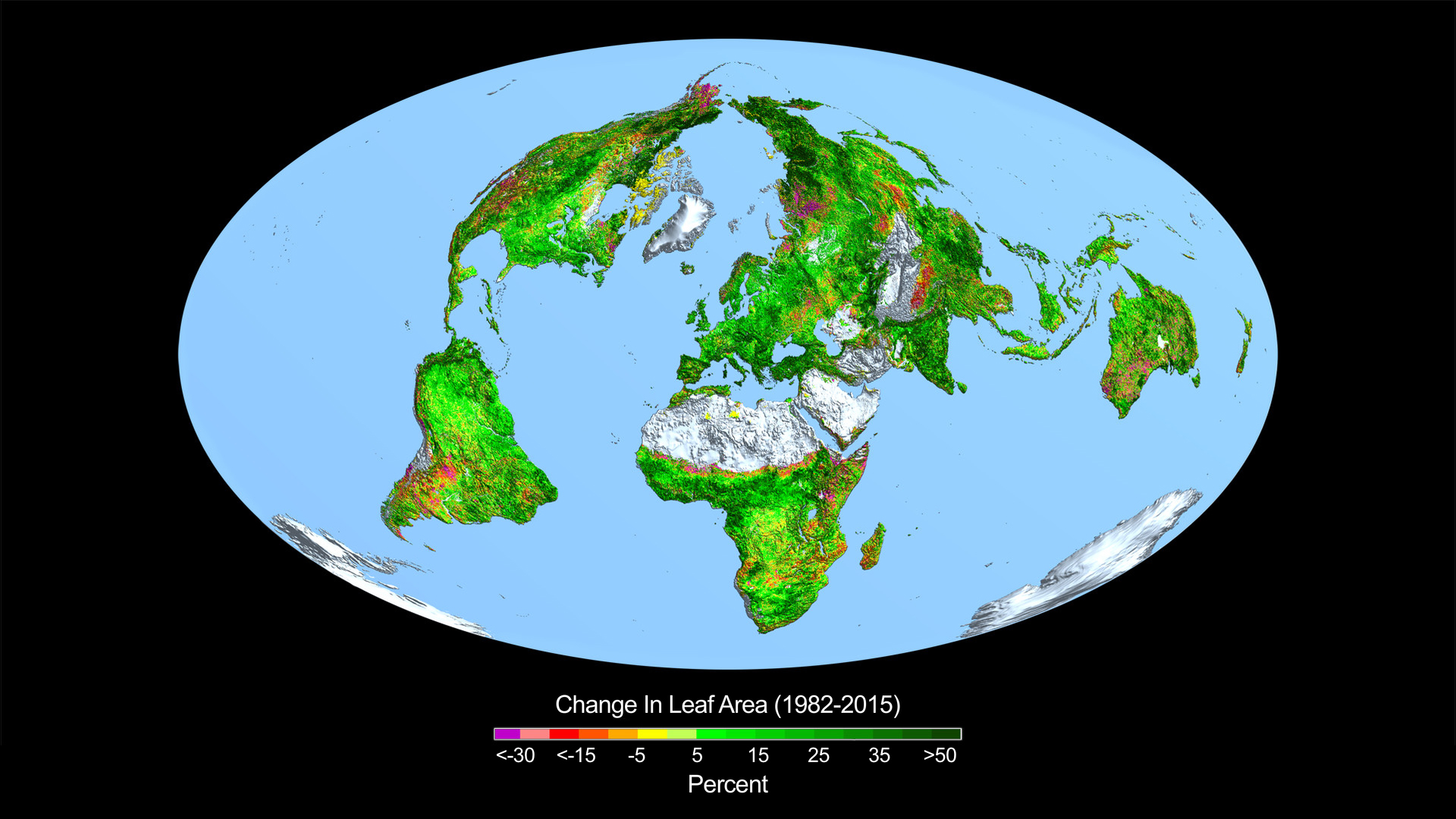
From a quarter to half of Earth's vegetated lands has shown significant greening over the last 35 years largely due to rising levels of atmospheric carbon dioxide, according to a new study published in the journal Nature Climate Change on April 25.
An international team of 32 authors from 24 institutions in eight countries led the effort, which involved using satellite data from NASA's Moderate Resolution Imaging Spectrometer and the National Oceanic and Atmospheric Administration's Advanced Very High Resolution Radiometer instruments to help determine the leaf area index, or amount of leaf cover, over the planet's vegetated regions. The greening represents an increase in leaves on plants and trees equivalent in area to two times the continental United States.
Cal88 said:dajo9 said:Cal88 said:
Imagine if a real weather catastrophe close to the 1930s Dust Bowl happened today.
https://www.nydailynews.com/2022/04/13/haunting-vintage-images-of-the-1930s-dust-bowl/
The 1930s are still the hottest decade in recorded modern US history.
https://www.facebook.com/groups/453353528124367/posts/25803477332685304/
Please provide the same data for Africa
There you go.
The Sahara is shrinking, Africa is greening.
https://www.thegwpf.org/images/stories/gwpf-reports/mueller-sahel.pdf
" The Sahel is greening
The people living in the Sahel, a semiarid area just south of the Sahara desert, spanning the entire African continent from the Atlantic Ocean to the Red Sea, were suffering from several devastating droughts and famines between the late 1960s and the early 1990s. The draughts were triggered by decreases in rainfall from the early 1950s to the mid-1980s.1
Global warming was supposed to increase the frequency and severity of the droughts, which would make crop-growing unviable and cause even worse famines.2 According to the United Nations, the outlook for the people in the Sahel was bleak.3
The Sahel is greening
However in sharp contrast to this gloomy outlook, it seems that global warming has exactly the opposite effect on the Sahara and the Sahel. The Sahara is actually shrinking, with vegetation arising on land where there was nothing but sand and rocks before.4 The southern border of the Sahara has been retreating since the early 1980s, making farming viable again in what were some of the most arid parts of Africa. There has been a spectacular regeneration of vegetation in northern Burkina Faso, which was devastated by drought and advancing deserts 20 years ago. It is now growing so much greener that families who fled to wetter coastal regions are starting to come back. There are now more trees, more grassland for livestock and a 70% increase in yields of local cereals such sorghum and millet in recent years. Vegetation has also increased significantly in the past 15 years in southern Mauritania, north-western Niger, central Chad, much of Sudan and parts of Eritrea.5
In Burkina Faso and Mali, production of millet rose by 55 percent and 35 percent, respectively, since 1980.6 Satellite photos, taken between 1982 and 2002, revealed the extensive re-greening throughout the Sahel.7 Aerial photographs and interviews with local people have confirmed the increase in vegetation.8
Causes of the greening
The main reason for the greening of the Sahara and the Sahel has been an increase in rainfall since the mid-1980s.9 Of the 40 rainfall stations across the Sahel, most of them have been observing an increase in rainfall.10 If sustained, the increasing rainfalls could revitalize drought-ravaged regions, reclaiming them for farming.11
The United Nations' Africa Report of 2008 confirmed that the greening of the Sahel is now well established and that increases in rainfall are the main driver of the change in the vegetation cover. The report noted that there was a 50% increase in vegetation in parts of Mali, Mauritania and Chad during 1982-2003.12 Vegetation changes play a significant role in the rainfall variability.13 The increase in rainfall has allowed more plants to grow, which in turn increases precipitation even more. Plants transfer moisture from the soil into the air by evaporation from their leaves and hold water in the soil close to the surface, where it can also evaporate. The darker surface of plants compared with sand also absorb more solar radiation, which can create convection and turbulence in the atmosphere which might create rainfall. Vegetation effects account for around 30 percent of annual rainfall variation in the Sahel.14 The increased vegetation will fix the soil, enhance its anti-wind erosion ability, reduce the possibility of released dust and consequently cause a decline in the numbers of sand-dust storms.15
However, the greening cannot be explained solely by the increase in rainfall. There were vegetation increases in areas where rainfall was decreasing, suggesting another factor was responsible for the greening in these areas.16 This other factor might have been the rise of atmospheric CO2 levels. The aerial fertilization effect of the ongoing rise in the air's CO2 concentration increases greatly the productivity of plants. The more CO2 there is in the air, the better plants grow. Rising atmospheric CO2 levels also have an antitranspiration effect, which enhances the water-use efficiency of plants and enables them to grow in areas that were once too dry for them.17
https://www.nasa.gov/centers-and-facilities/goddard/carbon-dioxide-fertilization-greening-earth-study-finds/
Carbon Dioxide Fertilization Greening Earth, Study Finds
Karl B. Hille
From a quarter to half of Earth's vegetated lands has shown significant greening over the last 35 years largely due to rising levels of atmospheric carbon dioxide, according to a new study published in the journal Nature Climate Change on April 25.
An international team of 32 authors from 24 institutions in eight countries led the effort, which involved using satellite data from NASA's Moderate Resolution Imaging Spectrometer and the National Oceanic and Atmospheric Administration's Advanced Very High Resolution Radiometer instruments to help determine the leaf area index, or amount of leaf cover, over the planet's vegetated regions. The greening represents an increase in leaves on plants and trees equivalent in area to two times the continental United States.
Good job on not providing the same data at all
Censorship has always been a tool of the fascist
experimental not so high speed chase, grabbed from bluesky, dunno weather legible here,,
https://bsky.app/profile/cwebbonline.com/post/3mjgj3bamj226
https://bsky.app/profile/cwebbonline.com/post/3mjgj3bamj226
According to Dr. Jordan Peterson, we had effectively eliminated worldwide hunger - until Covid madness hit.
And so-called "Green Energy" raises ful prices, which causes food prices to rise, which hurts the poor.
And so-called "Green Energy" raises ful prices, which causes food prices to rise, which hurts the poor.

HAPPY 82nd RAY!
“Cancel my subscription to the Resurrection
Send my credentials to the House of Detention
I got some friends inside”
—Jim Morrison
“I love Cal deeply, by the way, what are the directions to The Portal from Sproul Plaza?”
Send my credentials to the House of Detention
I got some friends inside”
—Jim Morrison
“I love Cal deeply, by the way, what are the directions to The Portal from Sproul Plaza?”
dajo9 said:Cal88 said:dajo9 said:Cal88 said:
Imagine if a real weather catastrophe close to the 1930s Dust Bowl happened today.
https://www.nydailynews.com/2022/04/13/haunting-vintage-images-of-the-1930s-dust-bowl/
The 1930s are still the hottest decade in recorded modern US history.
https://www.facebook.com/groups/453353528124367/posts/25803477332685304/
Please provide the same data for Africa
There you go.
The Sahara is shrinking, Africa is greening.
https://www.thegwpf.org/images/stories/gwpf-reports/mueller-sahel.pdf
" The Sahel is greening
The people living in the Sahel, a semiarid area just south of the Sahara desert, spanning the entire African continent from the Atlantic Ocean to the Red Sea, were suffering from several devastating droughts and famines between the late 1960s and the early 1990s. The draughts were triggered by decreases in rainfall from the early 1950s to the mid-1980s.1
Global warming was supposed to increase the frequency and severity of the droughts, which would make crop-growing unviable and cause even worse famines.2 According to the United Nations, the outlook for the people in the Sahel was bleak.3
The Sahel is greening
However in sharp contrast to this gloomy outlook, it seems that global warming has exactly the opposite effect on the Sahara and the Sahel. The Sahara is actually shrinking, with vegetation arising on land where there was nothing but sand and rocks before.4 The southern border of the Sahara has been retreating since the early 1980s, making farming viable again in what were some of the most arid parts of Africa. There has been a spectacular regeneration of vegetation in northern Burkina Faso, which was devastated by drought and advancing deserts 20 years ago. It is now growing so much greener that families who fled to wetter coastal regions are starting to come back. There are now more trees, more grassland for livestock and a 70% increase in yields of local cereals such sorghum and millet in recent years. Vegetation has also increased significantly in the past 15 years in southern Mauritania, north-western Niger, central Chad, much of Sudan and parts of Eritrea.5
In Burkina Faso and Mali, production of millet rose by 55 percent and 35 percent, respectively, since 1980.6 Satellite photos, taken between 1982 and 2002, revealed the extensive re-greening throughout the Sahel.7 Aerial photographs and interviews with local people have confirmed the increase in vegetation.8
Causes of the greening
The main reason for the greening of the Sahara and the Sahel has been an increase in rainfall since the mid-1980s.9 Of the 40 rainfall stations across the Sahel, most of them have been observing an increase in rainfall.10 If sustained, the increasing rainfalls could revitalize drought-ravaged regions, reclaiming them for farming.11
The United Nations' Africa Report of 2008 confirmed that the greening of the Sahel is now well established and that increases in rainfall are the main driver of the change in the vegetation cover. The report noted that there was a 50% increase in vegetation in parts of Mali, Mauritania and Chad during 1982-2003.12 Vegetation changes play a significant role in the rainfall variability.13 The increase in rainfall has allowed more plants to grow, which in turn increases precipitation even more. Plants transfer moisture from the soil into the air by evaporation from their leaves and hold water in the soil close to the surface, where it can also evaporate. The darker surface of plants compared with sand also absorb more solar radiation, which can create convection and turbulence in the atmosphere which might create rainfall. Vegetation effects account for around 30 percent of annual rainfall variation in the Sahel.14 The increased vegetation will fix the soil, enhance its anti-wind erosion ability, reduce the possibility of released dust and consequently cause a decline in the numbers of sand-dust storms.15
However, the greening cannot be explained solely by the increase in rainfall. There were vegetation increases in areas where rainfall was decreasing, suggesting another factor was responsible for the greening in these areas.16 This other factor might have been the rise of atmospheric CO2 levels. The aerial fertilization effect of the ongoing rise in the air's CO2 concentration increases greatly the productivity of plants. The more CO2 there is in the air, the better plants grow. Rising atmospheric CO2 levels also have an antitranspiration effect, which enhances the water-use efficiency of plants and enables them to grow in areas that were once too dry for them.17
https://www.nasa.gov/centers-and-facilities/goddard/carbon-dioxide-fertilization-greening-earth-study-finds/
Carbon Dioxide Fertilization Greening Earth, Study Finds
Karl B. Hille
From a quarter to half of Earth's vegetated lands has shown significant greening over the last 35 years largely due to rising levels of atmospheric carbon dioxide, according to a new study published in the journal Nature Climate Change on April 25.
An international team of 32 authors from 24 institutions in eight countries led the effort, which involved using satellite data from NASA's Moderate Resolution Imaging Spectrometer and the National Oceanic and Atmospheric Administration's Advanced Very High Resolution Radiometer instruments to help determine the leaf area index, or amount of leaf cover, over the planet's vegetated regions. The greening represents an increase in leaves on plants and trees equivalent in area to two times the continental United States.
Good job on not providing the same data at all
There are several dozen crucial data points in the above articles from reliable sources like NASA about how Africa and its most sensitive region when it comes to climate and hunger, the Sahel, has been greening, agriculture thriving, and ironically enough, higher CO2 concentration is a main reason.
The Sahara has lost a territory the size of Texas in the last few decades with the ongoing greening of the world's largest desert. This single data point is more relevant than any other one could conjure on how African climate has been improving.
What countries function well there. Mauritius, Botswana, and Rwanda?
Which would you rather listen to?
— Wall Street Mav (@WallStreetMav) June 23, 2026
AOC or Elon's Starship Raptor engine?pic.twitter.com/5NUlnPdWAa
PAC-10-BEAR said:Which would you rather listen to?
— Wall Street Mav (@WallStreetMav) June 23, 2026
AOC or Elon's Starship Raptor engine?pic.twitter.com/5NUlnPdWAa
Is this a trick question?

“Cancel my subscription to the Resurrection
Send my credentials to the House of Detention
I got some friends inside”
—Jim Morrison
“I love Cal deeply, by the way, what are the directions to The Portal from Sproul Plaza?”
Send my credentials to the House of Detention
I got some friends inside”
—Jim Morrison
“I love Cal deeply, by the way, what are the directions to The Portal from Sproul Plaza?”
movielover said:
What countries function well there. Mauritius, Botswana, and Rwanda?
https://afridigest.com/the-10-fastest-growing-economies-in-africa-in-2026/
He always came off like a turd.
Kellyanne Conway served as Senior Counsel to President Trump in his first term, after having had a senior role in his campaign that went from 1% GOP support in July 2015 to winning the Presidency in November 2016.
— Shipwreckedcrew (@shipwreckedcrew) June 24, 2026
Her now ex-husband George Conway, once believing himself to be…
movielover said:
He always came off like a turd.Kellyanne Conway served as Senior Counsel to President Trump in his first term, after having had a senior role in his campaign that went from 1% GOP support in July 2015 to winning the Presidency in November 2016.
— Shipwreckedcrew (@shipwreckedcrew) June 24, 2026
Her now ex-husband George Conway, once believing himself to be…
What did she come off as?

“Cancel my subscription to the Resurrection
Send my credentials to the House of Detention
I got some friends inside”
—Jim Morrison
“I love Cal deeply, by the way, what are the directions to The Portal from Sproul Plaza?”
Send my credentials to the House of Detention
I got some friends inside”
—Jim Morrison
“I love Cal deeply, by the way, what are the directions to The Portal from Sproul Plaza?”
Featured Stories
See All
Back-to-Back Historic Years For Cal Athletics
by Cal Athletics
The Four Big Questions Before Fall Camp Opens
by Bear Insider
Bear Insider Ultimate Insider E129: Cal ILB Tristan Jernigan
by Mike Pawlawski
Bear Insider Ultimate Insider E128: Cal OLB Justin Beadles
by Mike Pawlawski